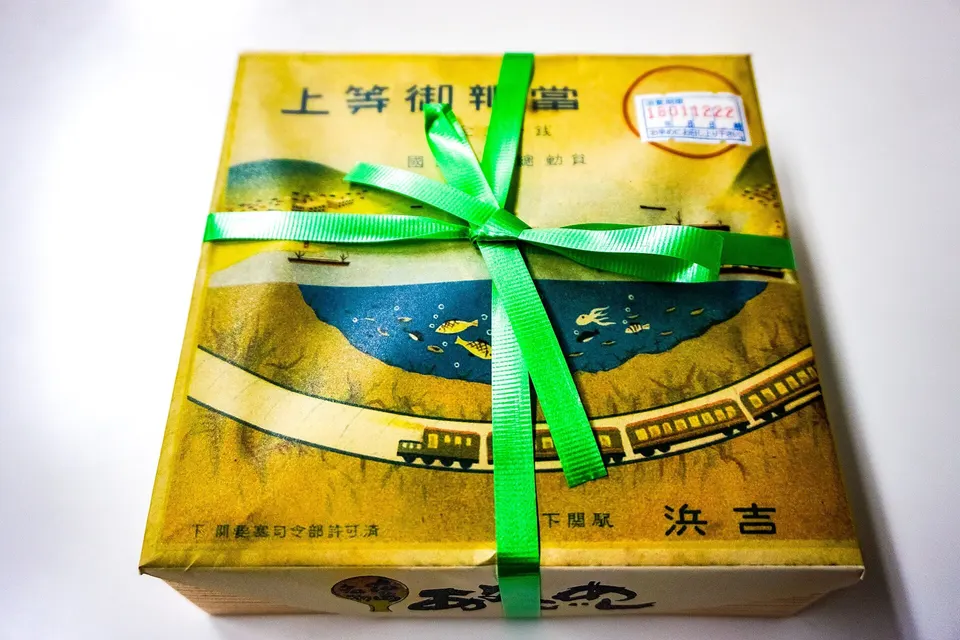
A kakegami is the sheet of printed paper laid over the lid of an ekiben, the bento sold at Japan's railway stations, and tied in place with string. It names the meal, the station and the maker, it has also carried route maps, advertisements and wartime slogans, and collectors and museums keep it long after the meal is eaten.
A sheet over the lid
In Japanese dictionaries a kakegami is the outer paper on a gift, and also the paper wrapped around the box of a catered bento. The first ekiben, sold in 1885, were rice balls wrapped in bamboo sheath, and boxed meals followed within a few years. The early wrappers gave little more than the name of the bento and the name of the station. More was added as time went on, and the designs became varied. In 1962, when Minamoto of Toyama put its Masu no Sushi in a box, paper and string were still the usual dress of an ekiben, and in 2026 many ekiben were still sold in a kakegami.
What is printed on it
A first-class bento sold at Hachiōji Station came in a wrapper that doubled as a tourist guide. It showed a map of the railway lines and the sights nearby, with the distance from the station to each: "to Daizenji, 15 chō," in a unit of length no longer used. Its date stamp, 14.10.30 午后5, gives the day and hour the bento was prepared: 5 p.m. on October 30 of a year 14 in the Japanese calendar, which the price of 35 sen places in Taishō 14, or 1925. Such stamps are thought to have begun around 1917, and they are a clue to the age of a wrapper.
A wrapper from Chiba Station, stamped in August 1926, has three frames above its picture. Two hold advertisements, for a beer and a sake. The third tells passengers how to get rid of the empty box and fruit peel. Passengers of those years threw boxes and earthenware teapots out of train windows, men working on the track were hurt, and wrappers asked that empty containers be left under the seat.
In 1922, when the British crown prince, the future Edward VIII, visited Japan, ekiben makers across the country used a commemorative wrapper of one shared design, with only the maker's name changed.
Slogans of the war years
After the National General Mobilization Law of 1938, wartime slogans appeared on wrappers. The Fukuoka City Museum holds wrappers of those years. A wrapper from Osaka Station reads 総力戦一人一人がみな戦士, "in total war every one of us is a soldier." A wrapper for a rice ball bento from Onomichi Station shows a soldier and a comfort bag with the words 応へよ将兵に, "answer our officers and men." The reprinted wrapper in the photograph at the top of this page, marked 下関駅, Shimonoseki Station, has a slogan ending in 總動員, "general mobilization," partly hidden by the ribbon, and in the lower left corner the line 下関要塞司令部許可済, "approved by the Shimonoseki Fortress Command."
Wrappers turned colorful around the Tokyo Olympics of 1964. After the world's fair of 1970, beginning with the "Discover Japan" campaign, they carried the national railway's advertising slogans.
The people who keep them
Kaga Toyosaburō, who died in 1944, pasted ekiben wrappers into a bound scrapbook and titled the cover 汽車辨套, "train bento covers." The scrapbook is in the Tokyo Metropolitan Library. Izumi Kazuo, the author of a book on ekiben wrappers, began collecting in junior high school and by 2020 had more than 10,000 sheets.
In April 2026 the city of Maibara designated as cultural property 345 items kept by Izutsuya, which sold ekiben at Maibara Station from 1889 until February 2025. Among them are 156 wrappers. Makers count their own designs too. The wrapper of Kiyoken's shūmai bento is the fourth design, and the wrapper of the ikameshi of Mori Station is based on the second one its maker used. In October 2022, for the 150th anniversary of the railway, 31 makers sold 34 ekiben on the theme of revival, several of them in reprinted wrappers.
The wrappers of Tōge no Kamameshi
Tōge no Kamameshi, which Oginoya began selling at Yokokawa Station on February 1, 1958, comes in an earthenware pot, and its kakegami is tied over the lid of the pot. Oginoya's own history of the product shows 13 of these wrappers, from 1960 to 2019.
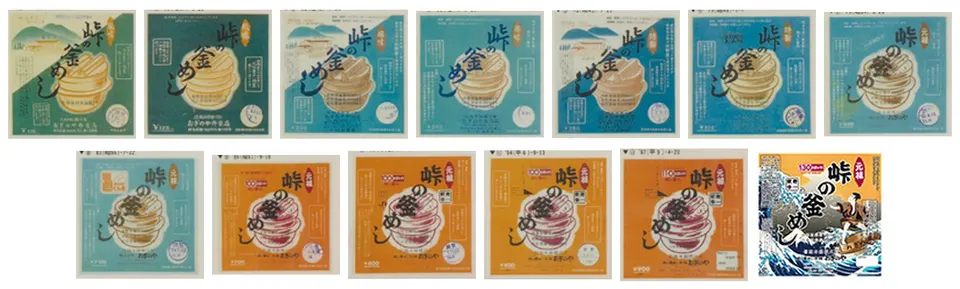
The twelve wrappers from 1960 to 1997 all have the name written with a brush down the sheet and a drawing of the pot with its lid on. The 1960 wrapper is divided on the diagonal: cream above, with green mountains and a long, low building, and green below. The 1962 wrapper is dark green all over. The six wrappers from 1968 to 1981 are light blue or blue, and the four from 1986 to 1997 are orange, with the pot drawn in red. From 1979 an oval beside the name reads 元祖, "the original." Most of the 13 carry a round date stamp in the lower right corner. The wrapper shown for 2019 is of another kind: a great blue wave and a figure in a kimono. The orange design was still in everyday use that year.
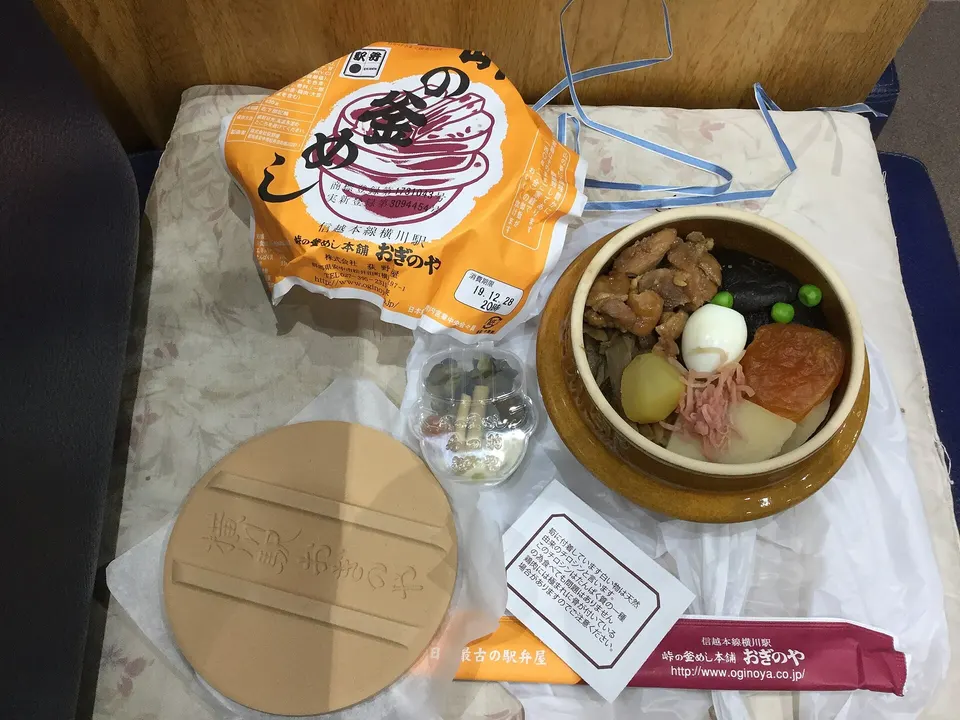
A wrapper photographed in December 2019 is orange, with the pot in red and a sticker giving the use-by date and hour, and was tied with a light blue string.
On two days in 2018, in a campaign for the 130th anniversary of the Shin-etsu Line, Tōge no Kamameshi was sold at Karuizawa Station in two different commemorative wrappers. On October 1, 2021, another wrapper marked the last regular run of the E4 series "Max" Shinkansen; the contents were the usual ones. From October 1 to November 30, 2022, as one of the 34 revival ekiben, Tōge no Kamameshi was sold in a reprint of the design from the time it first went on sale. From July 11 to September 28, 2026, the Railway Museum in Saitama held an exhibition on ekiben design whose first chapter was the kakegami, and Oginoya was one of the six companies that cooperated.
References
- Tokyo Metropolitan Library: Wrappers and Covers (Kaga Collection)
- Kotobank: “Kakegami”
- Fukuoka City Museum (Japan Search): ekiben wrapper, Osaka Station
- Fukuoka City Museum (Japan Search): ekiben wrapper, Onomichi Station
- Nippon Broadcasting System, Ekiben Hizakurige (August 1, 2020): interview with Izumi Kazuo
- The Railway Museum: press release on the ekiben design exhibition (June 25, 2026)
- City of Maibara: Kōhō Maibara, August 2026 (PDF)
- Kyodo News via Akita Sakigake Shimpō: ekiben wrappers designated a cultural property (August 23, 2026)
- Japan Railway Station Concessions Central Association and Yokohama Archives of History: press release on the revival ekiben (September 29, 2022, PDF)
- artscape: review of the exhibition Ekiben mukashi monogatari (2015–16)
- Oginoya: Company timeline
- Shinano Railway: press release (October 18, 2018, PDF)
- Kotobank: “Ekiben” (Japanese dictionaries and encyclopedias)
Image credits (resized for display):