Masu-zushi is the pressed sushi of Toyama: vinegared rice and vinegar-cured trout, wrapped in bamboo grass leaves and pressed in a round wooden box. It went on sale as an ekiben at Toyama Station in 1912 under the name Masu no Sushi, and the railways and ekiben fairs made it known across Japan.
A round of pressed sushi
Pressed sushi, oshi-zushi, is made by packing vinegared rice into a frame, laying fish on top and setting a weight on it. In Toyama the frame is a wappa, a round container made by bending a thin sheet of wood into a ring and fitting it with a base. The wappa is lined with bamboo grass, and rice and trout are pressed into it in layers. Masu-zushi comes as a single round or as two rounds stacked.
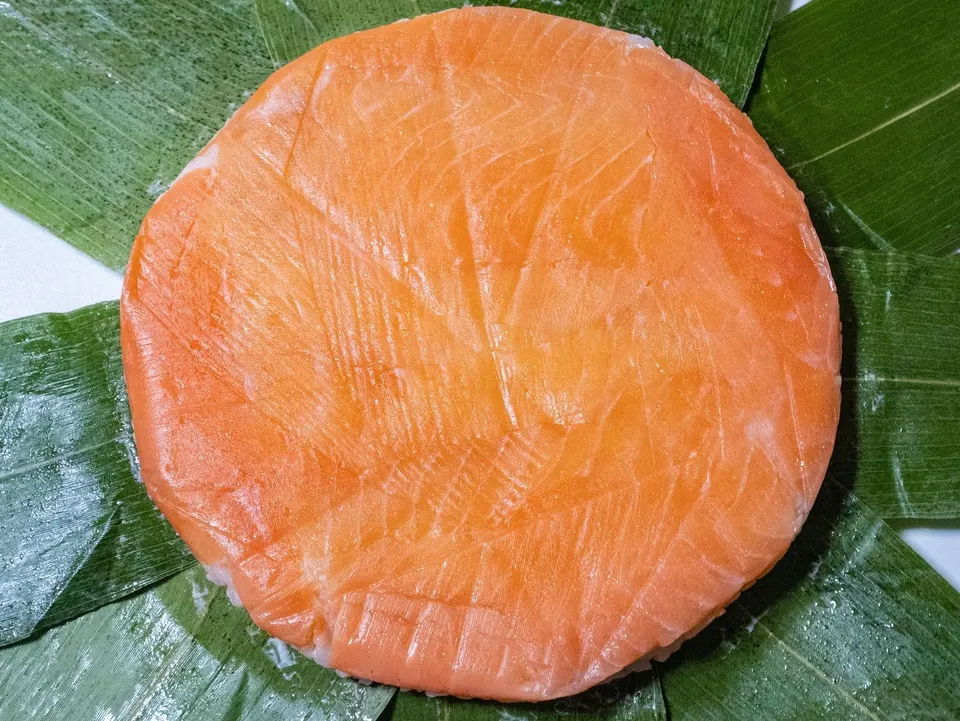
Shops write and say the name in several ways, masu-zushi and masu no sushi among them, and all mean the same thing. Masu no Sushi is the name used by Minamoto, the ekiben maker of Toyama Station.
There are two ways of putting it together. In omote-oki, the trout lies on top when the leaves are opened. In ura-oki, the trout goes into the wappa first and the rice on top of it, so that opening the leaves shows only white rice. With the trout on top, its flavor and fat pass into the rice. With the trout underneath, less fat reaches the rice and the taste is lighter. The thickness of the fish, the amount of vinegar and salt, and how firmly the rice is pressed all differ from shop to shop.
How it is made
Bamboo grass leaves are laid in the bottom of the wappa so that they fan out from the center, and vinegared rice is spread evenly over them. The trout has been salted, cured in vinegar and sliced thin. The slices are fitted to the round of the wappa on top of the rice, the leaves are folded over one after another, the lid goes on, and a weight is set on it for a few hours.
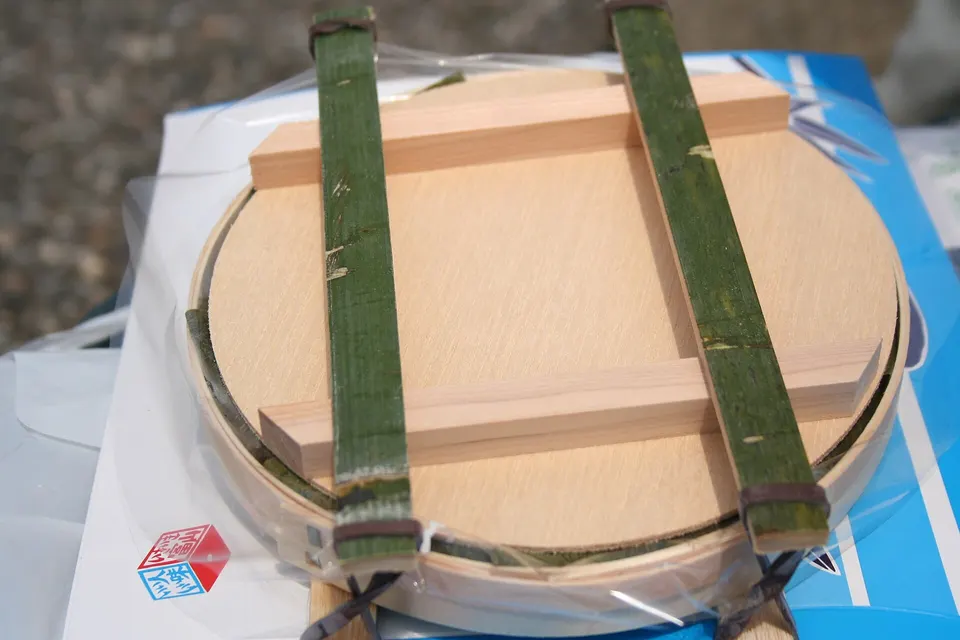
To finish, bamboo sticks are laid across the top and the bottom, and strong rubber bands are stretched over them. The bands go on pressing the sushi until it is eaten. The flavor goes on developing too: masu-zushi is soft on the day it is made, and the fish and rice settle into each other as time passes.
The fish is sakuramasu, cherry salmon, a member of the salmon family that grows to 60 or 70 centimeters. It swims up rivers from the sea in spring, when the cherry trees are in flower, which is how it got its name. Chum salmon and other fish are sometimes used instead. The bamboo grass leaves give the sushi their scent.
From sweetfish to trout
Accounts of where masu-zushi began differ, and some point to a record from the year 845. The story usually told starts in 1717. Yoshimura Shinpachi, a samurai of the Toyama domain, made sushi from the ayu, or sweetfish, of the Jinzū River and local rice, and presented it to Maeda Toshioki, the third lord of the domain. Toshioki sent it on to Tokugawa Yoshimune, the eighth Tokugawa shogun. Yoshimune praised it, and it came to be called a specialty of Toyama.
The Jinzū flows north through the middle of Toyama Prefecture into Toyama Bay. Cherry salmon came up it every spring, and toward the end of the Edo period (1603–1868) they took the place of the sweetfish. From the last years of the shogunate into the Meiji era, teahouses selling the sushi appeared at the foot of the Funahashi, a bridge of boats across the Jinzū, and travelers spread its reputation.
A wooden bridge replaced the boats in 1882. In the years around 1900 the river was straightened, and far fewer cherry salmon came up it afterward. Masu-zushi remained a specialty of Toyama all the same. Shops with long histories stand along the Matsukawa, the stream that the straightening created.
The ekiben of Toyama Station
Minamoto began as Toyama Hotel, a restaurant and inn that the first head of the Minamoto family opened in 1900. In 1908 a branch of the hotel was licensed to make and sell bento and sweets inside Toyama Station, and it began selling ekiben there. Four years later, in 1912, it put Masu no Sushi on sale. The Toyama specialty of the day was sweetfish sushi, and Minamoto made that too.
Around 1932 few trains ran, and Masu no Sushi was not yet widely known as a Toyama souvenir. The company lived on its inn, its sweetfish sushi and its sweets. In 1945 an air raid burned down Toyama Station and Minamoto's factory. The company cooked bento in the borrowed kitchen of an ironworks and took them to the station by handcart. It began selling Masu no Sushi again in 1949, in its prewar form.
The package took its present shape in the 1960s. In 1962, when most ekiben were wrapped in paper and tied with string, Minamoto put the wappa in a box. In 1963 it replaced the wisteria vine that had bound the wappa with rubber bands, and made the base and lid of plywood. Wood that had soaked up water was heavy, and workers who tied the vines with bare hands were easily hurt. Since 1965 the box has carried a trout painted by the artist Nakagawa Kazumasa, with his calligraphy.
Ekiben fairs carried it further. From about 1955, ekiben named for a local rice dish or sushi appeared all over Japan. The first national ekiben fair was held at the Takashimaya department store in Osaka in February 1958, the same month that Tōge no Kamameshi, the leading example of those ekiben, went on sale at Yokokawa Station. Fairs then spread to department stores and supermarkets around the country. At the national fairs Masu no Sushi was called "the yokozuna of the west," after the top rank in sumo, and it became established as the souvenir of Toyama. Toyama Station is now a stop on the Hokuriku Shinkansen, and Minamoto still sells this regional ekiben there.
How to open it and cut it
The lid is clamped between bamboo sticks held by rubber bands. There is no need to pull the bands off: slide the sticks slowly sideways and they come away. Under the lid are the leaves, overlapping. A plastic knife is packed with the sushi.
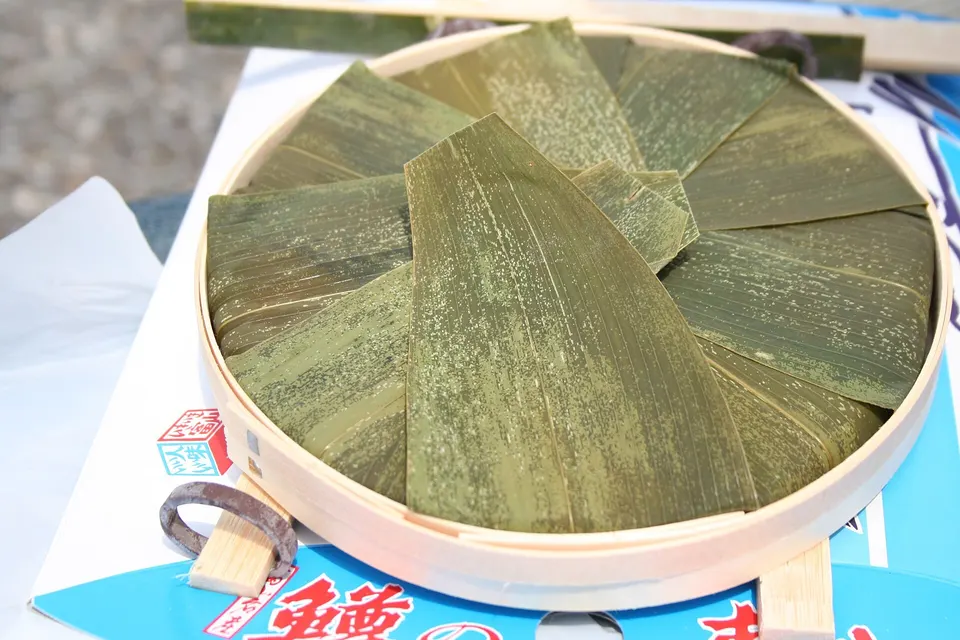
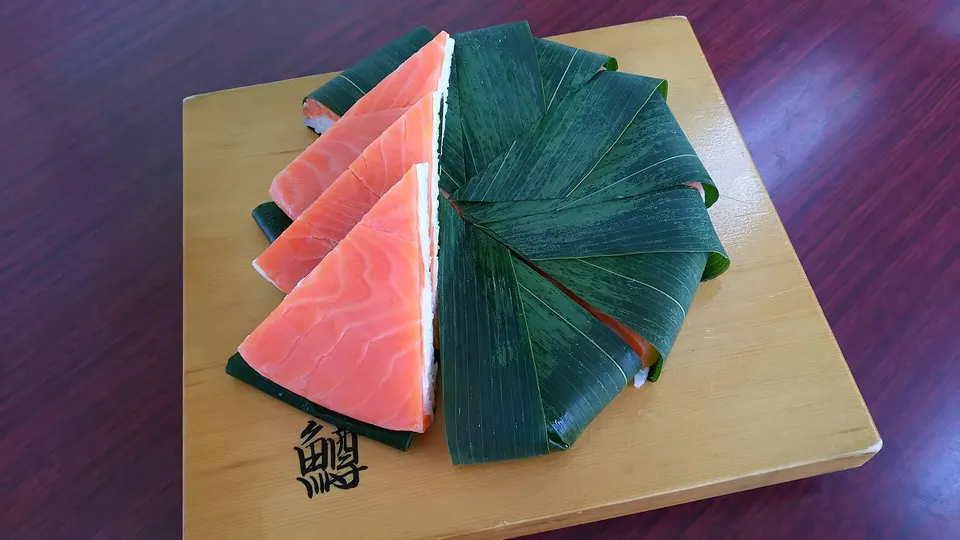
If the trout is on top, open the leaves and cut the sushi where it sits. If the rice is on top, turn the wappa over onto its lid, so that the trout comes out uppermost, and cut through the leaves into eight wedges, like a cake. Press the knife down as you cut so that it goes all the way through. Leave the leaves on. A wedge held in its leaf, the way a rice ball is held, keeps hands and table clean.
The whole round can also be moved onto a cutting board, still in its leaves, and cut by pressing straight down, which keeps the fish from breaking up. Minamoto lays the belly of the trout at the center and the back toward the edge. A wedge is eaten from the point, so the richest part comes first. Masu-zushi should be kept at room temperature. In a refrigerator the rice turns hard.
Many makers, and a museum
In Toyama most people buy masu-zushi from a specialist shop rather than make it at home, and many have a shop they favor. The city of Toyama alone has more than twenty specialist shops, and hotels, sushi restaurants and delicatessens in the prefecture make it as well. It is eaten at festivals, at Obon in summer and over the New Year, and bought as a gift. Twelve shops in the city belong to the Toyama Masu-zushi Cooperative, which sells sets for comparing one shop's sushi with another's and runs classes in making it.
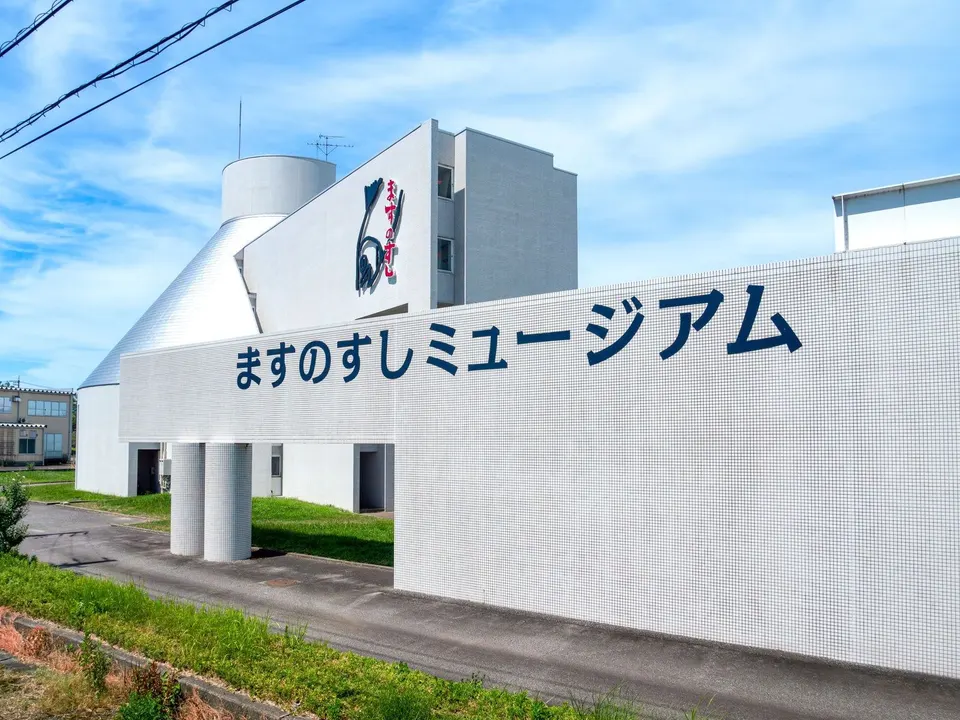
Minamoto opened the Masu no Sushi Museum in 2009 beside its head office and factory in the city of Toyama. Visitors watch part of the production through glass, in a factory that turns out several thousand items a day. In a part of the museum called the Denshōkan, craftspeople make Masu no Sushi by the older methods behind glass. Learning to fillet the trout and salt it, they say, takes at least five years of daily work. The museum also displays a map of Japan made of ekiben wrappers from around the country, and bento containers and travelers' belongings from the Edo period to the Shōwa era. Visitors can make a Masu no Sushi of their own.
References
- Kotobank: “Masu-zushi” (dictionary of Japanese regional dishes)
- Ministry of Agriculture, Forestry and Fisheries: Our Regional Cuisines, “Masu-zushi” (Toyama)
- Ministry of Agriculture, Forestry and Fisheries: Traditional Foods of Japan, “Masu-zushi”
- Masu no Sushi Honpo Minamoto: History of Minamoto
- Masu no Sushi Honpo Minamoto: Masu no Sushi Museum
- Toyama Prefecture, Etchū Toyama Food Kingdom: feature vol. 38, “Masu-zushi”
- Toyama Prefecture, Etchū Toyama Food Kingdom: “Masu-zushi”
- Toyama Prefecture, doors TOYAMA: how to eat masu-zushi
- Toyama Tourism Organization: making Masu no Sushi at the Masu no Sushi Museum
- Toyama City Tourism Association: ten facts about masu-zushi
- Kotobank: “Ekiben” (Japanese dictionaries and encyclopedias)
Image credits (resized for display):