From the Meiji era (1868–1912) until the 1950s and 1960s, the tea sold beside ekiben at Japan's railway stations came in a small pottery teapot called a kisha dobin, a "train teapot." Glass replaced it for a time after 1921, polyethylene replaced it for good from the 1950s, and canned and bottled green tea arrived in 1985 and 1990.
A teapot at Shizuoka Station
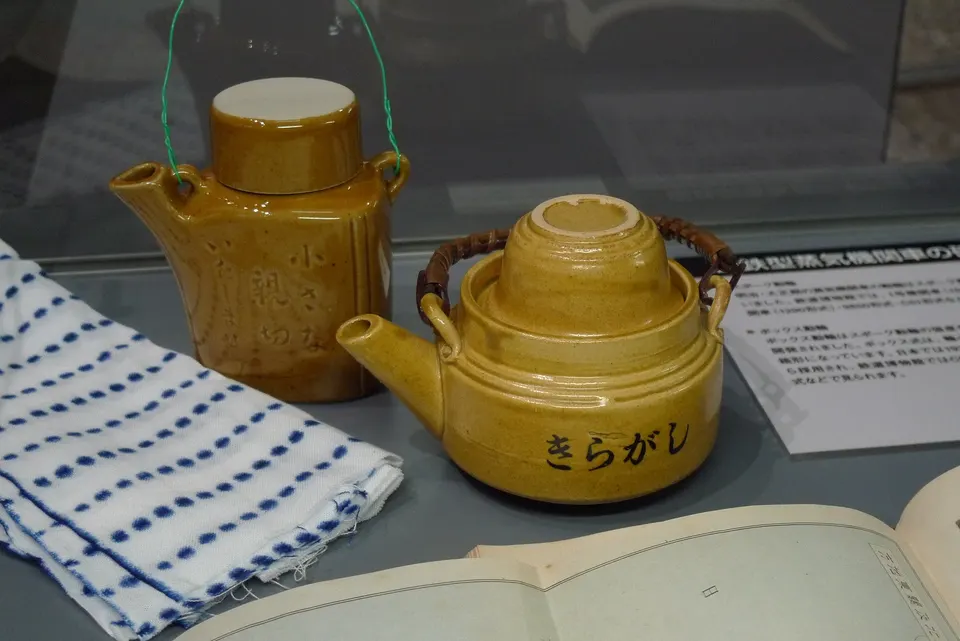
A dobin is a pottery teapot with a spout on its body and a bail handle hooked through two lugs on its shoulders. The train teapot was a small one, sold full of tea alongside the station bento. The trade is said to have begun in 1889 at Shizuoka Station, where a bento seller filled teapots of Shigaraki ware with Shizuoka tea.
The first train teapots were ordinary ones holding two or three gō, roughly 360 to 540 milliliters, with a small cup alongside, and they carried no station name and no seller's name. Purpose-made teapots appeared a little after 1892. They were smaller, and the name of the station and of the bento seller was written on them. Some train teapots had a lid, and on others the cup sat upside down over the mouth and served as the lid. On a long journey a passenger could buy a refill of tea alone at a later station.
Work for the pottery towns
Train teapots were made in pottery towns across the country: Shigaraki in Shiga Prefecture, Mashiko in Tochigi, Seto and Tokoname in Aichi, Mino in Gifu, Aizu-Hongō in Fukushima, Shiraishi in Saga. Shigaraki is said to be where they began. Its potters had been hit hard when the kettle took the place of the teapot, and then tea began to be sold at stations with the bento.
The first train teapots from Mashiko were painted with plum blossoms. In the last years of the Meiji era its train teapots went to the Tōkaidō Line east of Shizuoka and to the Kantō region, the Jōshin-etsu area, Tōhoku and Hokkaido. The waste heap of one Mashiko kiln has yielded large numbers of train teapots from about the middle of the Taishō era (1912–1926), with station names such as Kōriyama, Shirakawa and Wakamatsu written on them.
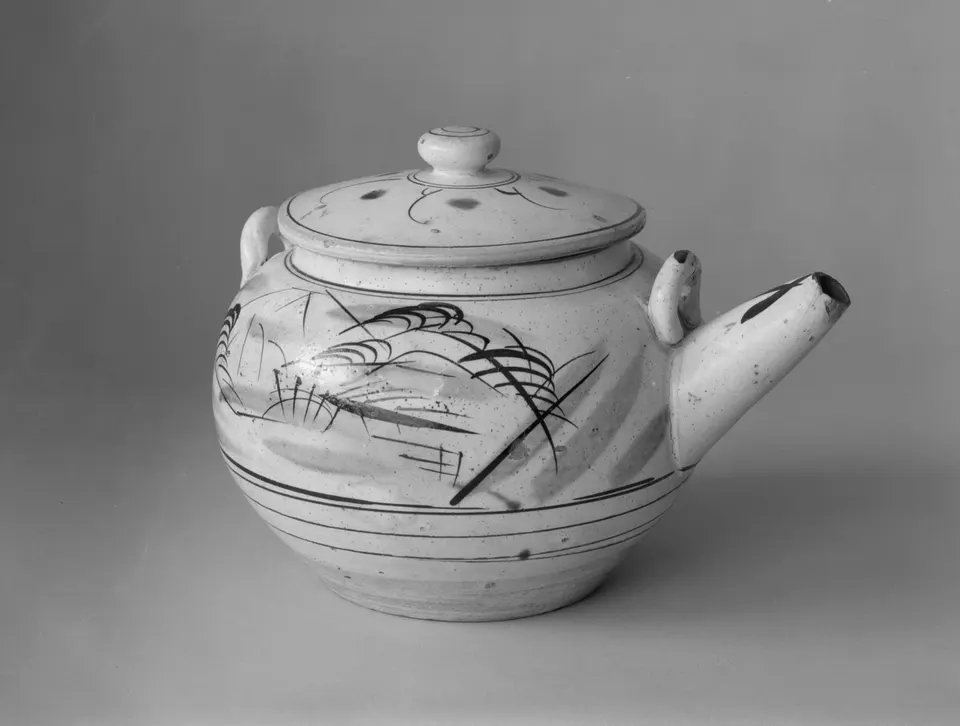
Mashiko threw its teapots on the wheel. Other towns turned to slip casting, which means pouring liquid clay into molds, and the round teapot was joined by square, cylindrical and octagonal ones, some with lettering in relief. Mashiko could not compete with cast production and is thought to have stopped early in the Shōwa era (1926–1989).
Under the seat, out of the window
The names on the teapots are thought to have been there so that the teapots could be collected and used again. A fragment found near Kōfu Station reads 土びんはこしかけの下, "teapot under the seat." A newspaper wrote in August 1923 that even at the best of times only about 30 percent came back in good order, and that most of the others seemed to get broken. Teapots thrown from train windows sometimes injured men working on the track, and both bento wrappers and teapots carried a notice asking passengers to leave empty containers under the seat.
Archaeologists find train teapots along the lines. A Meiji-era teapot marked 濱, thought to stand for Hamamatsu Station, was dug up between Hikone and Maibara stations, at a place with no station. A single pit at a former rail yard in Fukuoka held the bodies of more than 4,000 teapots. A square train teapot found about 130 meters from Toyama Station is 8.2 centimeters tall, has お茶, "tea," in raised letters and still has its wire handle. It has soot on its base, because someone used it again to warm soup.
The glass bottle
In 1921 the Ministry of Railways banned the pottery teapot and told vendors to use glass. Teapots broke easily, scraps of packing material were hard to get out of them, and a buyer could not see how much tea was inside. Glass was disliked. Broken pieces cut people, and a glass bottle filled with tea looked like a urine bottle. Pottery gradually came back, now cast in molds to cut costs and square in form.
Around 1955 Seto and Mino made tea containers shaped after local specialties: a pufferfish for Shimonoseki, a carp for Kamisuwa, a castle for Nagoya.
Polyethylene, cans and PET bottles
Plastic tea containers, light and unbreakable, began to spread in the second half of the 1950s, and within about ten years they had taken the place of pottery. Shigaraki went on making train teapots until about 1965. The plastic container, a polyethylene bottle with a wire handle, is known as the pori chabin, the "poly tea bottle."
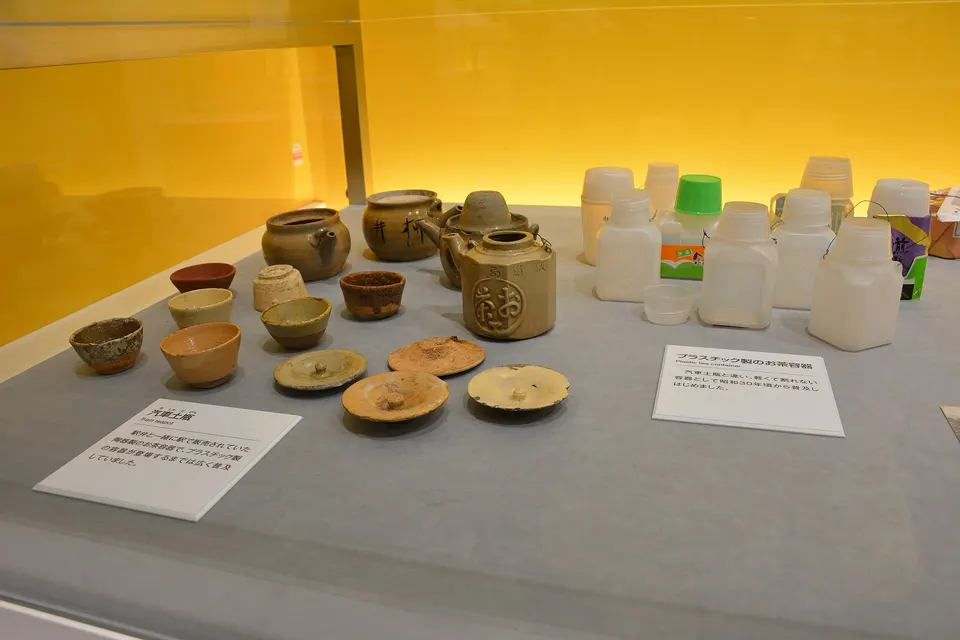
In February 1985 the tea company Ito En began selling sencha in a can, which it describes as the world's first green tea drink. Shops were slow to stock it, because tea in Japan was understood to be something served free. A member of Ito En's sales staff, buying a bento on a Shinkansen platform, saw polyethylene bottles of tea being sold with the bento and decided that canned tea should be bought with a bento too. The company took the can to bento sellers. Ito En followed with green tea in a 1.5-liter PET bottle in March 1990. As canned and bottled tea became easy to buy, the polyethylene bottle disappeared from the stations.
Pottery that stayed at the station
At Yokokawa Station in 1949, Oginoya began selling black tea, with salt in it because sugar could not be had. On February 1, 1958, while plastic was taking over the tea trade, Oginoya put a station bento into pottery. Tōge no Kamameshi, the leading example of the regional ekiben that appeared from about 1955, is packed in an earthenware pot of Mashiko ware, from the town whose teapots had once gone to the stations of eastern Japan.
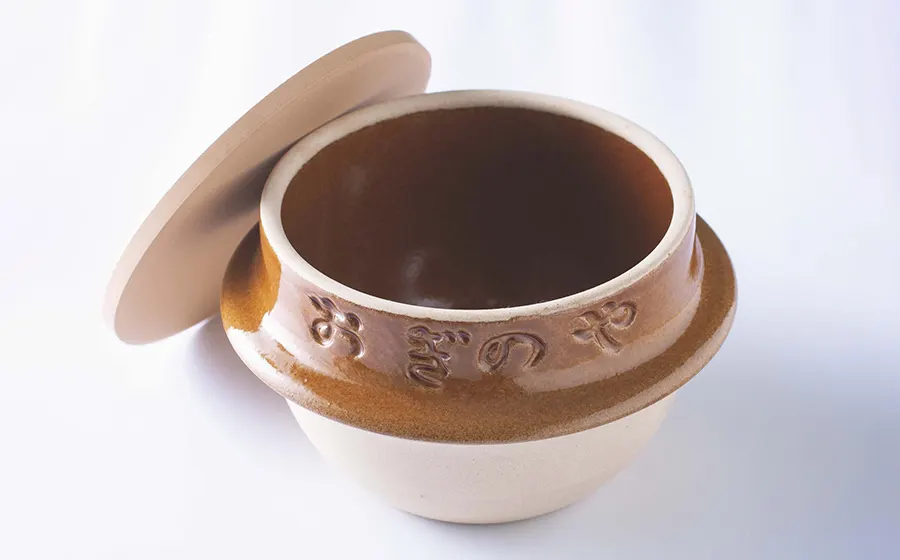
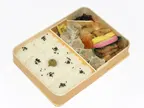
The pot comes back as the teapots were meant to: Oginoya collects used pots, washes them twice with steam and uses them again. It also publishes recipes that use the empty pot. The containers of the bento themselves have a history of their own.
References
- Toyama City Board of Education: Train teapots excavated at the Toyama Castle site (2023)
- Yamanashi Prefectural Center for Archaeological Operations: Train teapots from the Kōfu castle town site
- Fukushima Prefecture Culture Promotion Foundation: research column no. 84, On train teapots (2020)
- Kasamashiko Japan Heritage council: Train teapot (early Mashiko ware)
- Koka City: Shigaraki ware, four-museum joint exhibition leaflet (2020, PDF)
- Fukuoka City archaeological report no. 319: Ekiben and archaeology (1993)
- Umakato: Train tea bottles and train teapots
- artscape: review of the exhibition Ekiben mukashi monogatari (2015–16)
- Ito En: reference material for the 30th anniversary of Oi Ocha (2019, PDF)
- Oginoya: Company timeline
- Kotobank: “Dobin”
- Kotobank: “Ekiben” (Japanese dictionaries and encyclopedias)
Image credits (resized for display):
- Motokoka / Wikimedia Commons, CC BY-SA 4.0, 2009
- Brooklyn Museum / Wikimedia Commons, No restrictions
- Cheng-en Cheng / Wikimedia Commons, CC BY-SA 2.0, 2016
- Oginoya