The Usui Pass Railway Heritage Park (Usui Tōge Tetsudō Bunka Mura) is a railway museum beside Yokokawa Station in Annaka, Gunma Prefecture, opened on April 18, 1999, on the site of the depot whose locomotives worked the Usui Pass. It displays more than 30 railway vehicles, keeps four EF63 electric locomotives in running order for visitors to drive after a one-day course, and runs a trolley train about 2.6 kilometers up the closed line.
A locomotive depot turned museum
The last trains between Yokokawa and Karuizawa ran on September 30, 1997. The next day the Shinkansen to Nagano opened and the line over the pass was closed. The depot beside Yokokawa Station had been the base of every EF63, the locomotive built only for the railway over the pass.
The town of Matsuida opened the park on the depot site with the cooperation of JR East, to hand on what the line had left. Matsuida merged with the city of Annaka in 2006, and the park is a city facility, managed for Annaka by a foundation, Usui Tōge Kōryū Kinen Zaidan. In English the park calls itself Usuitouge Railway Heritage Park, and the signs on its buildings carry its nickname, Poppo Town.
The inspection shed and the ED42
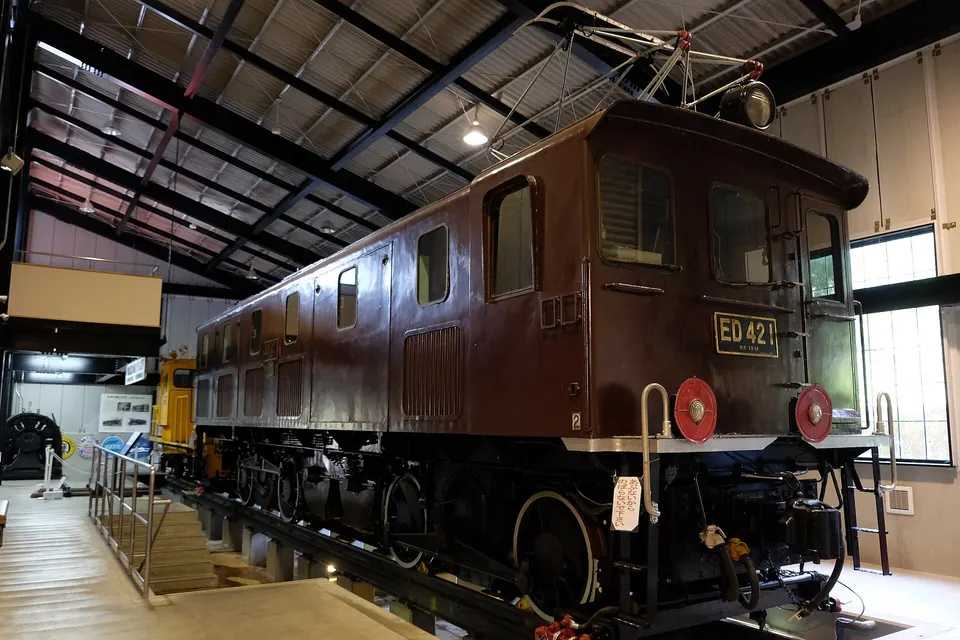
The Railway Exhibition Hall is the depot's inspection shed, the building where JR checked and repaired rolling stock until the line closed in 1997. The park opened the shed as it stood, with the inspection equipment still in place.
Inside stands ED42 1, No. 1 of the 28 electric locomotives built to work the pass on the Abt rack system, with a top speed of 25 kilometers per hour. ED42 1 was withdrawn in December 1963, named a Quasi Railway Memorial in 1967 and restored to running order in 1987. A length of rack rail is displayed in the hall, and visitors can see the ED42's pinion, the cogwheel that meshed with the rack.
In the same hall, the cab of EF63 18 is a driving simulator. The master controller, brake valves and gauges are the locomotive's own, and the Usui Pass of the line's working years is recreated in computer graphics.
The park's Railway Museum has a large HO-gauge model of the Usui Pass on its ground floor. The trains on the model include a pair of EF63s with the limited express Asama, and four ED42s with the Hakuchō, a train of KiHa 82 diesel railcars. The floor above holds documents, locomotive drawings, maps, photographs and a display of how uniforms changed.
Seven EF63s
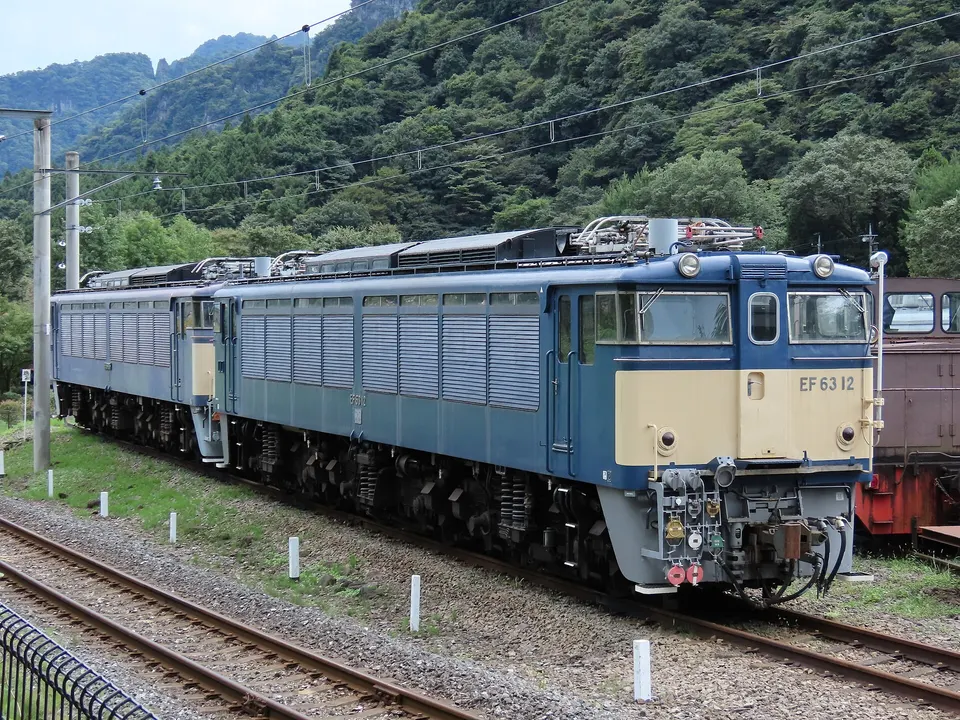
Twenty-five EF63s were built, beginning with a prototype, No. 1, made by Toshiba in 1962. An EF63 is 18 meters long and weighs 108 tons. For the grade of 66.7 per mil it carried dynamic brakes to hold its speed on the way down, an overspeed detector to stop a runaway, an electromagnetic brake for emergencies, and lock cylinders that kept the brakes on if air pressure fell during a long stop on the slope.
The park has seven EF63s. Nos. 11, 12, 24 and 25, all painted blue, are kept in running order. Nos. 1 and 18, in brown, and No. 10, in blue, are static exhibits.
Driving a 108-ton locomotive
Visitors can drive the working EF63s themselves, and the park calls this the only chance in Japan to drive a real electric locomotive. A driver first takes a one-day course. The morning is classroom study of the railway between Yokokawa and Karuizawa and of how the EF63 works. The afternoon is practical: a video of an EF63 being driven, then instruction in the cab. The day ends with a test of ten multiple-choice questions and a pass mark of 60 points, and anyone who fails retakes the test the same day until they pass.
Nobody drives on the day of the course. From the next day on, a certificate holder can apply to drive any number of times. With an instructor in the cab, the driver takes the locomotive about 400 meters along a track of the former Shin-etsu Main Line inside the park and back again, a round trip of about 30 minutes. Drivers receive armbands as their number of drives rises: apprentice engineer, assistant engineer, engineer. An engineer, with 50 drives or more, may also push from behind, couple up, and drive two locomotives coupled together.
The outdoor display
Outdoors stand vehicles from the years of the Japanese National Railways, repaired and repainted as they were in service: electric, steam and diesel locomotives, diesel railcars and passenger carriages.
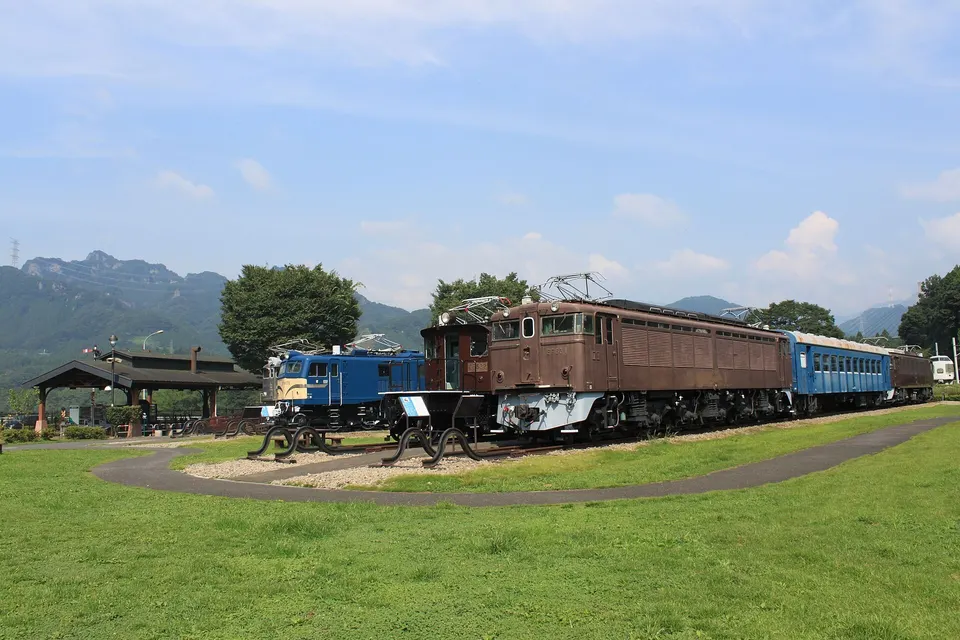
The steam locomotive D51 96, built in March 1938, is one of the D51s nicknamed namekuji (slug) for the long dome behind the chimney. EF58 172 pulled the limited expresses Hato and Tsubame, and an imperial train on the Nikkō Line. The dining car Oshi 17 2055 was rebuilt in 1974 as a training car for electric locomotive crews, and the instruments fitted then are still inside. The park also keeps 189-series cars of the limited express Asama, which crossed the pass until the line closed, in trains of up to 12 cars working in coordination with the EF63s.
Sherpa-kun, the trolley train
The park's trolley train, Sherpa-kun, runs on the Karuizawa-bound track of the closed line, about 2.6 kilometers from Bunkamura Station inside the park to Tōge no Yu Station, beside a hot-spring bathhouse opened in 2001. The steepest part of the trolley line is 65 per mil. The locomotive is a diesel built for this line and fitted with a retarder, a device that keeps the speed from rising too far on the way down. Going up, the locomotive pushes the two carriages from behind, and coming down it leads and holds them back. The carriage at the Karuizawa end is open, with no glass in its windows and a viewing space at the front, and the second carriage has glazed windows, heating and air conditioning.
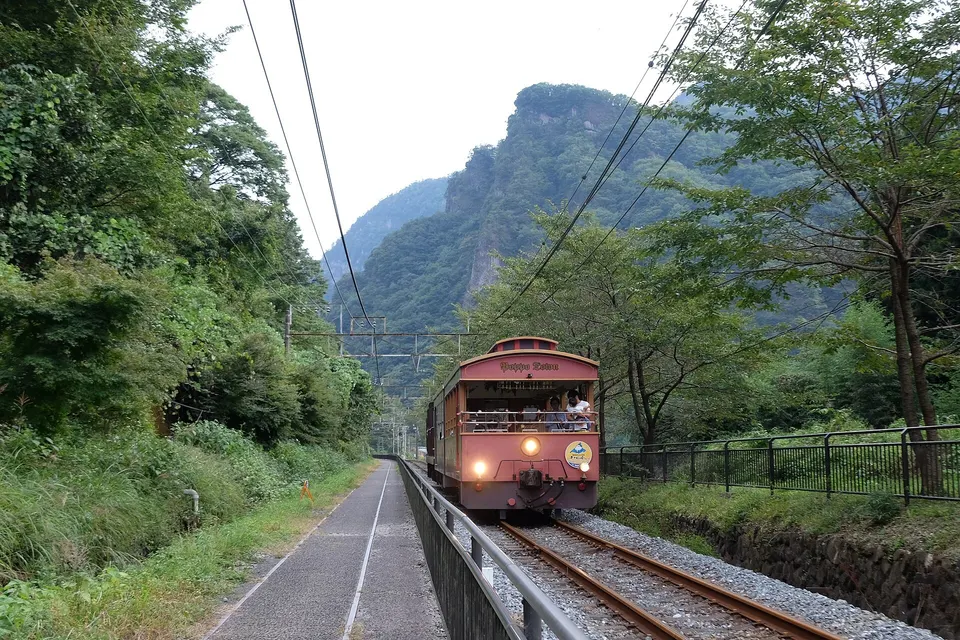
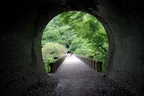
On the way up, trains stop at Maruyama Station, beside the former Maruyama Substation. The Tokyo-bound track beside the trolley line now carries the walking path Abt no Michi.
The park and Tōge no Kamameshi
Yokokawa Station, next to the park, is where Oginoya put Tōge no Kamameshi on sale on February 1, 1958. Trains over the pass stopped at Yokokawa to take on their EF63s, and passengers bought Tōge no Kamameshi on the platform while the locomotives were being coupled.
In April 2019, for the park's twentieth anniversary, Oginoya and the park planned Tōge no Kamameshi with a commemorative kakegami, the printed paper wrapper, in an original design for each of the four seasons. The spring edition went on sale inside the park on April 18, 2019, in a limited black pot, and part of the proceeds was to go to the upkeep of the park's equipment. In 2025 the park's hands-on programs included one in which visitors put on a happi coat and tried the work of the sellers who sold Tōge no Kamameshi on the platform at Yokokawa Station in the years when locomotives were coupled and uncoupled there.
References
- Usui Pass Railway Heritage Park, "Guide to the exhibited vehicles"
- Usui Pass Railway Heritage Park, "Facilities"
- Usui Pass Railway Heritage Park, "EF63 driving experience"
- Usui Pass Railway Heritage Park, "Frequently asked questions"
- Usui Pass Railway Heritage Park, park guide map (PDF, August 2019)
- Usui Pass Railway Heritage Park, "Experience Program" (PDF, February 2025)
- Usui Pass Railway Heritage Park, "The park's 25th anniversary" (April 2024)
- Usui Pass Railway Heritage Park, "Twentieth-anniversary project with Oginoya" (April 2019)
- Usui Tōge Kōryū Kinen Zaidan, "Activities"
- City of Annaka, "Usui Pass Railway Heritage Park"
- City of Annaka, "Trolley train operation details"
- City of Annaka, "Basic concept for a roadside station" (draft, February 2024, PDF)
- Oginoya, chronology
Image credits (resized for display):