Steam locomotives, which the Japanese call SL, left the regular trains of the national railway in the mid-1970s, and the last steam-hauled passenger train ran in Hokkaido on December 14, 1975. By the following July a private railway in Shizuoka had steam running again for visitors. In 2026 preserved locomotives pull tourist trains for several railway companies, and one of those trains runs from Takasaki to Yokokawa, the station of Tōge no Kamameshi.
Why steam went
Japan's first railway opened in 1872 with ten locomotives imported from Britain. At the end of the Second World War Japan still had more than 5,000 steam locomotives. A steam locomotive is simple, sturdy and cheap to build. It also turns only 3 to 6 percent of its heat into work, needs water and coal often, and is slow to turn around at the end of a run. Its smoke bothered crews, passengers and people living beside the line.
The national railway built no new steam locomotives after 1949. From 1960 it replaced them with electric and diesel locomotives, and the numbers fell fast. The last steam passenger train, on December 14, 1975, ran between Muroran and Iwamizawa. Reference works date the end of all regular steam working to the close of 1975 or to 1976.
Back within a year
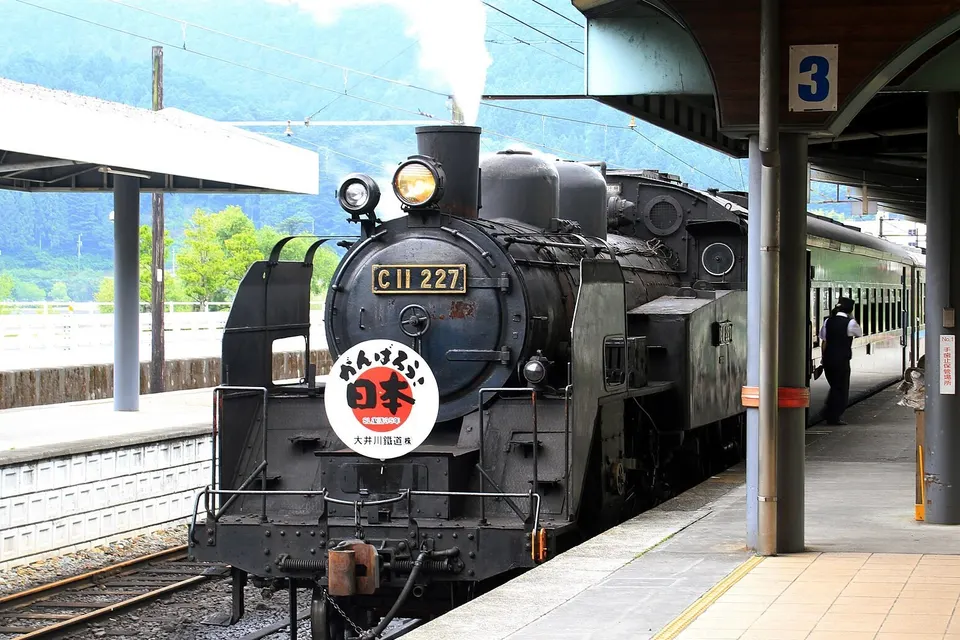
Keeping an old machine in working order is called dōtai hozon, dynamic preservation. The Oigawa Railway, a private line in Shizuoka Prefecture, had been electric since 1949. On July 9, 1976, it began running steam trains on its main line with C11 227, a tank locomotive built in 1942. The railway hired retired national-railway men who knew how to drive and maintain steam, and their knowledge has passed to younger staff. A replacement part comes from a locomotive on static display somewhere in Japan, or the railway makes it.
The national railway followed. Steam had left the Yamaguchi Line, in western Japan, in 1973. Enthusiasts and the towns along the line pressed for its return, and on August 1, 1979, the SL Yamaguchi began running the 62.9 kilometers from the station now called Shin-Yamaguchi to the old castle town of Tsuwano. Its locomotive, C57 1, is nicknamed Kifujin, the Lady.
Out of the park, onto the main line
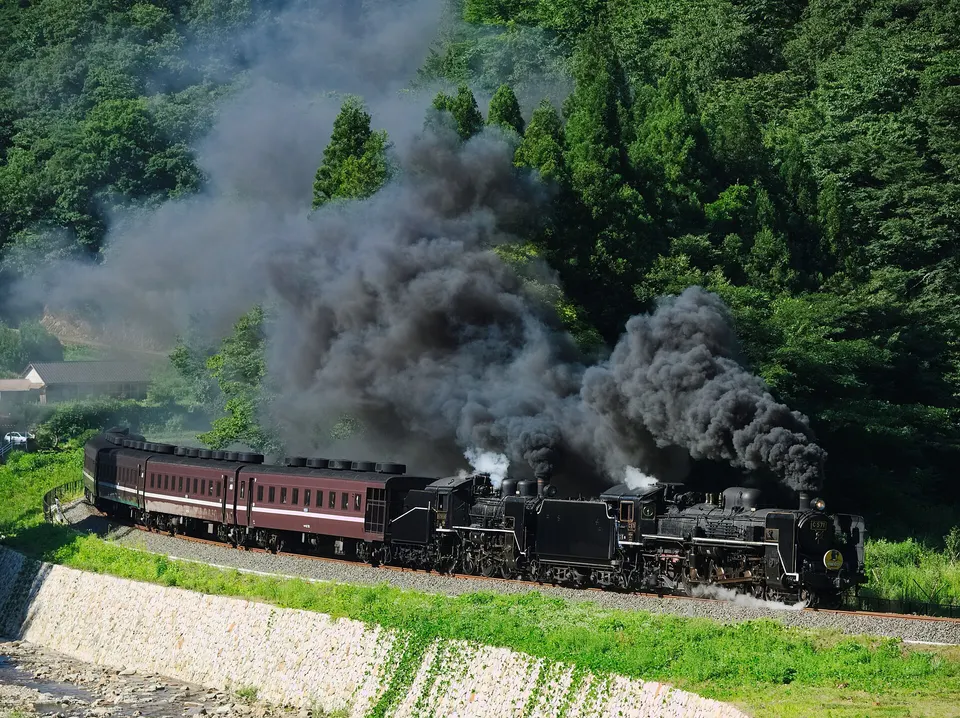
Several of the locomotives that returned had stood for years as outdoor exhibits. C58 363 was retired in 1972 and kept in the yard of an elementary school in Saitama Prefecture. Since 1988 it has pulled the Chichibu Railway's SL Paleo Express. C12 66 was on display at a housing estate in Fukushima Prefecture. The city of Moka led a project to restore C12 66, and in 1994 the locomotive began pulling the SL Moka on the Moka Railway, the line that passes through the pottery town of Mashiko.
The letter in a locomotive's name gives its number of driving axles: C for three, D for four. The C57 was built to pull passenger trains at speed, on driving wheels 1,750 millimeters across. The D51 was built to pull heavy freight, and its driving wheels measure 1,400 millimeters. The D51, nicknamed Degoichi, went into production in 1936, and its 1,115 units are the most of any locomotive class in Japan.
Steam to Yokokawa
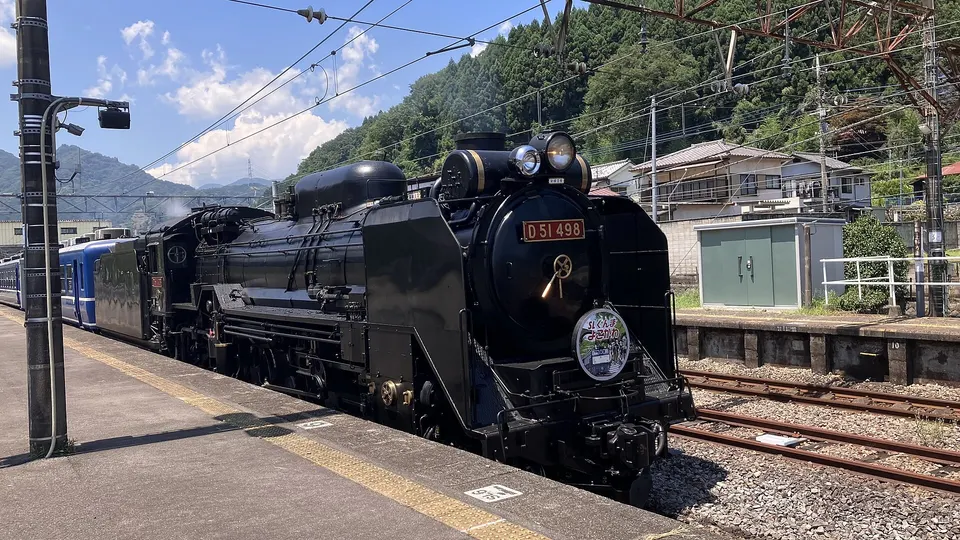
JR East keeps two steam locomotives at Takasaki, in Gunma Prefecture. D51 498 was built in Kobe in 1940, worked for 32 years and then stood in front of Gokan Station on the Jōetsu Line until it was restored in 1988. C61 20, built in 1949 as one of a class of 33 passenger locomotives, was retired in 1973 and stood from 1974 in an amusement park in Isesaki. It was restored in 2011 and ran again on June 4 of that year, for the first time in 38 years.
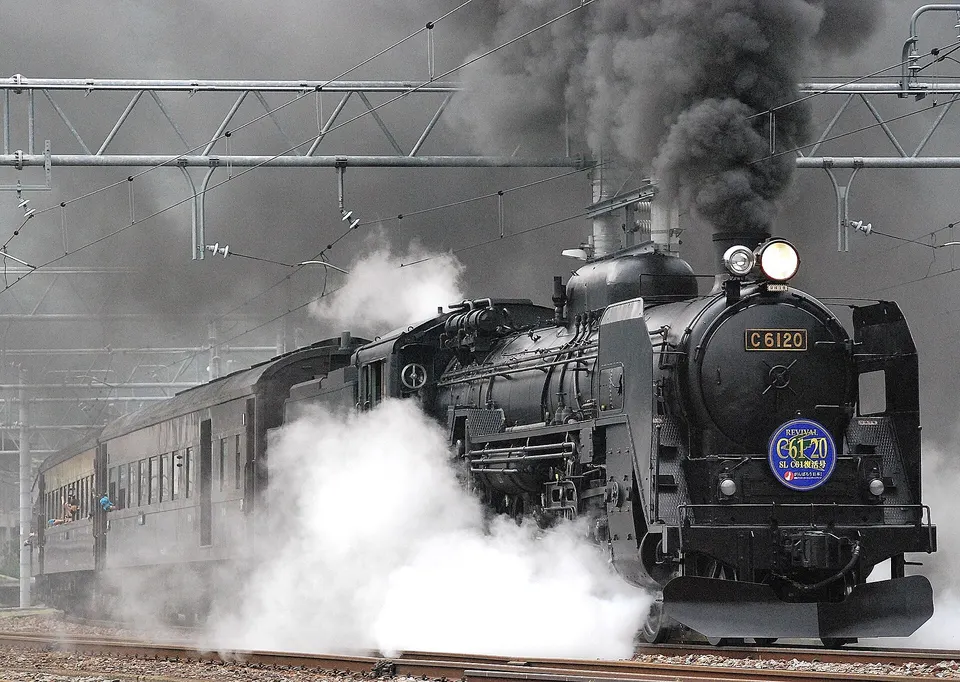
As of August 2026, either D51 498 or C61 20 pulls the SL Gunma, which runs mainly on weekends and in the tourist seasons from Takasaki to Minakami on the Jōetsu Line, to Kiryū on the Ryōmō Line and to Yokokawa on the Shin-etsu Main Line. Minakami has a turntable. Yokokawa and Kiryū have none, so on those lines a GV-E197 series diesel-electric railcar is coupled to the train and hauls it too.
The railway from Takasaki reached Yokokawa on October 15, 1885, and Oginoya opened for business at the station the same day. Tōge no Kamameshi went on sale there in 1958. Beyond Yokokawa, steam rack locomotives imported from Germany climbed the Usui Pass to Karuizawa, and smoke in the 26 tunnels was one reason the section was electrified in 1912, the first on a Japanese trunk line. At the Usui Pass Railway Heritage Park beside the station, D51 96 is among more than 30 exhibits, and a British-built steam locomotive named Green Breeze pulls visitors around a loop of about 800 meters.
Seven steam trains
| Train | Railway and line | Locomotives | Dates |
|---|---|---|---|
| Oigawa Railway steam trains | Oigawa Railway main line, Shizuoka | C11 227 and others | Since 1976. A typhoon cut the line in September 2022; in November 2026 the section between Kawane-Onsen-Sasamado and Senzu was still closed |
| SL Yamaguchi | JR West, Shin-Yamaguchi to Tsuwano | C57 1, D51 200 | Since 1979. C57 1 broke down in October 2020 and returned on October 3, 2026 |
| SL Paleo Express | Chichibu Railway, Kumagaya to Mitsumineguchi | C58 363 | Since March 15, 1988 |
| SL Gunma | JR East, from Takasaki | D51 498, C61 20 | D51 498 restored in 1988, C61 20 in 2011 |
| SL Moka | Moka Railway, Shimodate to Motegi | C12 66 | Since 1994. Suspended from January 19, 2026, to the end of March 2027 |
| SL Taiju | Tobu Railway, Kinugawa Line | C11 207, C11 325 and C11 123 | Since 2017 |
| SL Hitoyoshi | JR Kyushu, Kumamoto to Hitoyoshi | No. 58654 of the 8620 class | April 2009 to March 23, 2024, when the locomotive, built in 1922, was retired |
In Kyoto, the Umekōji Steam Locomotive Museum opened in 1972 for the centenary of Japan's railways, and in April 2016 the Kyoto Railway Museum took over its collection on the same site.
References
- Kotobank: “Steam locomotive” (Japanese encyclopedias)
- Kotobank: “Yamaguchi Line”
- Kotobank: “Ōigawa Railway”
- nippon.com: On this day, December 14
- nippon.com: Japan's oldest working steam locomotive makes its last run (April 2024)
- Ōigawa Railway: Outline and history
- Ōigawa Railway: Keeping steam locomotives in working order
- Ōigawa Railway: Steam and electric locomotive trains
- SL Yamaguchi official site: About the SL Yamaguchi
- SL Yamaguchi official blog (September 29, 2026)
- Chichibu Railway: About the SL Paleo Express
- Mōka Railway: The SL Mōka
- Mōka Railway: notice of suspension of the SL Mōka (January 19, 2026, PDF)
- Tobu Railway: SL Taiju, trains and locomotives
- JRE Media: JR East's steam locomotives
- JRE Media: steam locomotives from Takasaki Station
- Usui Pass Railway Heritage Park: About the park and the Usui line
- Usui Pass Railway Heritage Park: Exhibits
- Oginoya: Company timeline
Image credits (resized for display):