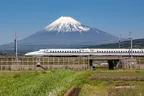
The Hokuriku Shinkansen runs from Tokyo to Tsuruga, in Fukui Prefecture: across the Kantō Plain to Takasaki, over the Usui Pass to Karuizawa and Nagano, then out to the Sea of Japan and along it through Toyama, Kanazawa and Fukui. It opened in three stages, to Nagano in 1997, to Kanazawa in 2015 and to Tsuruga in 2024. It is one line of the Shinkansen, Japan's high-speed railway.
Twenty-four stations in eight prefectures
Trains leave Tokyo on the track of the Tōhoku Shinkansen as far as Ōmiya, then on that of the Jōetsu Shinkansen as far as Takasaki. The Hokuriku Shinkansen branches off at a switch 3.3 kilometers beyond Takasaki Station and runs about 470 kilometers from Takasaki to Tsuruga. From Tokyo the route has 24 stations in eight prefectures: Tokyo, Saitama, Gunma, Nagano, Niigata, Toyama, Ishikawa and Fukui. JR East operates the line as far as Jōetsumyōkō Station, in Niigata Prefecture, and JR West from there to Tsuruga.
Hokuriku, the Sea of Japan side of central Japan, is one of the snowiest parts of the country.
Past the Usui Pass at 30 per mil
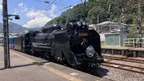
West of Takasaki the line meets the Usui Pass, on the border between Gunma and Nagano prefectures. The older Shin-etsu Main Line climbed the pass from Yokokawa on a grade of 66.7 per mil, and every train took on helper locomotives to do it. The Shinkansen takes a different route, through a tunnel about 6 kilometers long. Between Takasaki and Karuizawa it climbs at 30 per mil, 30 meters for every kilometer, for about 22 kilometers without a break.
On October 1, 1997, the day the Shinkansen opened, the Shin-etsu Main Line between Yokokawa and Karuizawa was closed. Oginoya had been in business at Yokokawa Station since 1885, and since 1958 it had sold Tōge no Kamameshi there. On that same day Tōge no Kamameshi went on sale aboard the Shinkansen between Takasaki and Karuizawa.
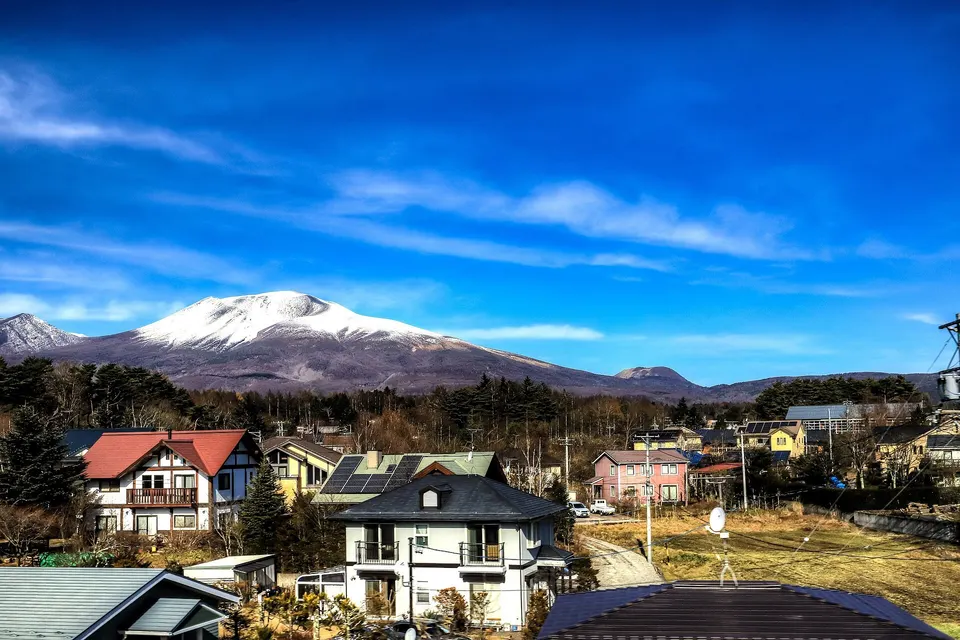
Karuizawa stands on a plateau about 1,000 meters above sea level, at the southeastern foot of Mount Asama, an active volcano 2,568 meters high. In the Edo period (1603–1868) it was a post town on the Nakasendō highway. A missionary, A. C. Shaw, spent a summer there in the 1880s, and Karuizawa became a summer resort.
Built in time for the Nagano Olympics
The plan for a Hokuriku Shinkansen from Tokyo to Osaka was fixed in 1973, as one of five lines decided under a national law. Work on the section from Takasaki began in 1989. It was built to be ready for the Winter Olympics that opened in Nagano on February 7, 1998.
The 117 kilometers from Takasaki to Nagano were the first section of any of the five lines to open. About half the distance is in tunnels, and the Gorigamine Tunnel between Ueda and Nagano is 15.2 kilometers long. Until 2015 the line was called the Nagano Shinkansen. Its trains were named Asama, the name of the limited express that had crossed the Usui Pass.
Past Karuizawa come Ueda, a castle town in the Edo period, and Nagano, which grew up as the town at the gate of the temple Zenkōji.
Out to the Sea of Japan
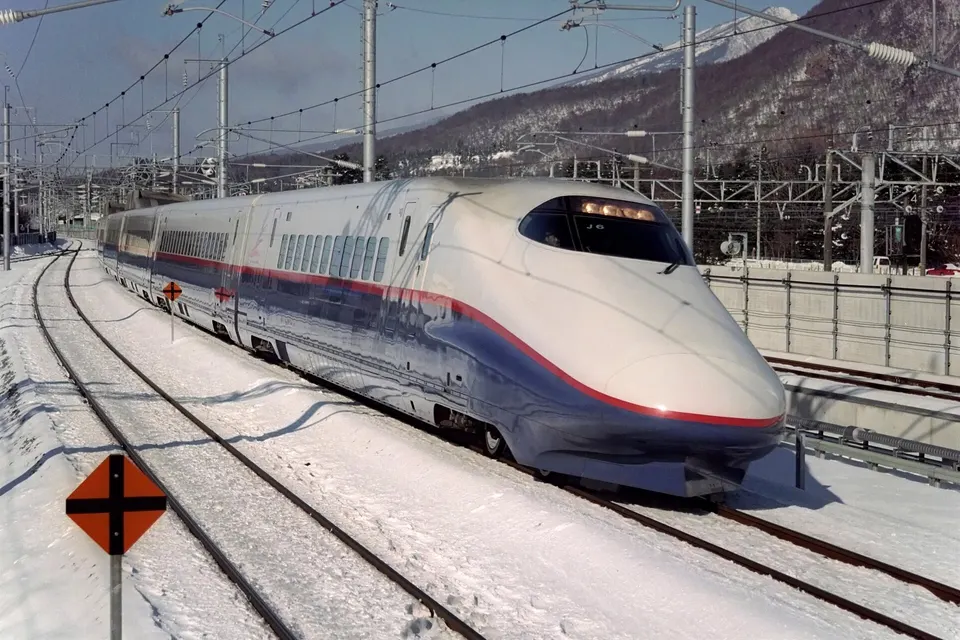
The 228 kilometers from Nagano to Kanazawa opened on March 14, 2015, and the whole line took its proper name, the Hokuriku Shinkansen. Between Iiyama and Jōetsumyōkō stations it runs through the Iiyama Tunnel, 22.2 kilometers long. Boring it through folded and faulted rock took more than nine years, from 1998 to 2007.
The line comes out on the Sea of Japan at Itoigawa, a town known for jade. Beyond it is the Toyama Plain, with Toyama Bay to the north and, to the east, the Tateyama range of the Northern Alps, a row of peaks around 3,000 meters high. Toyama grew around the castle town of a branch of the Maeda family, and its station is where Masu no Sushi has been sold as an ekiben since 1912.
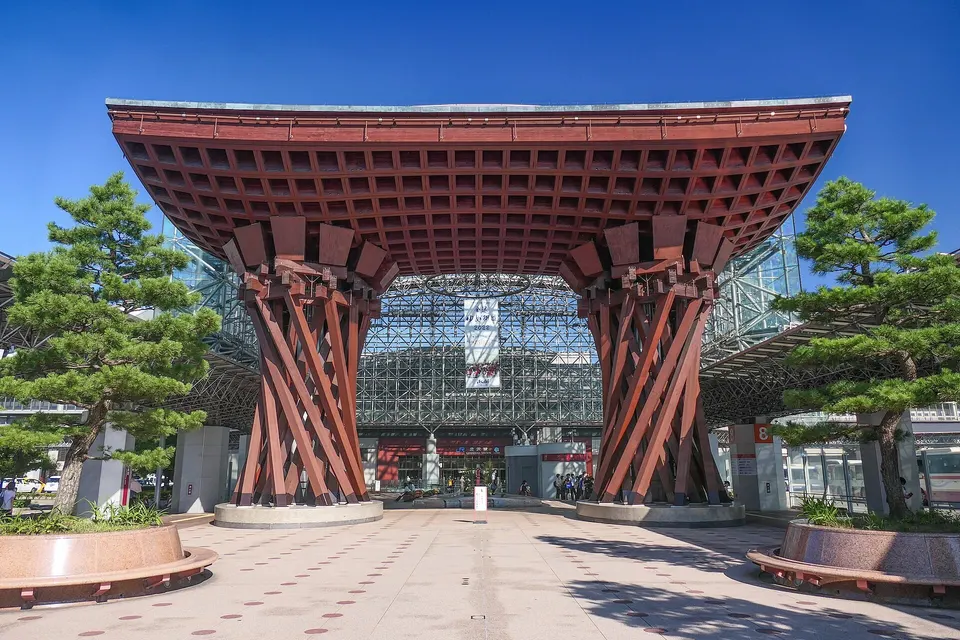
Kanazawa was the castle town of the main Maeda house, the lords of the Kaga domain. The city was not damaged in the Second World War, and the look of the castle town remains in many places, along with the castle site and the garden Kenrokuen.
On to Tsuruga
The section from Kanazawa to Tsuruga, about 125 kilometers, opened on March 16, 2024, with stations at Komatsu, Kagaonsen, Awaraonsen, Fukui, Echizen-Takefu and Tsuruga.
Tsuruga is a natural harbor on Tsuruga Bay. It lies on the shortest way from Nara and Kyoto, past Lake Biwa, to the Sea of Japan, and from early times it was the gateway to Hokuriku and to the Asian mainland.
Construction of the Shinkansen between Tsuruga and Shin-Osaka has not begun. From Tsuruga, limited expresses on the conventional Hokuriku Main Line run on toward Kyoto and Osaka.
Four names, one kind of train
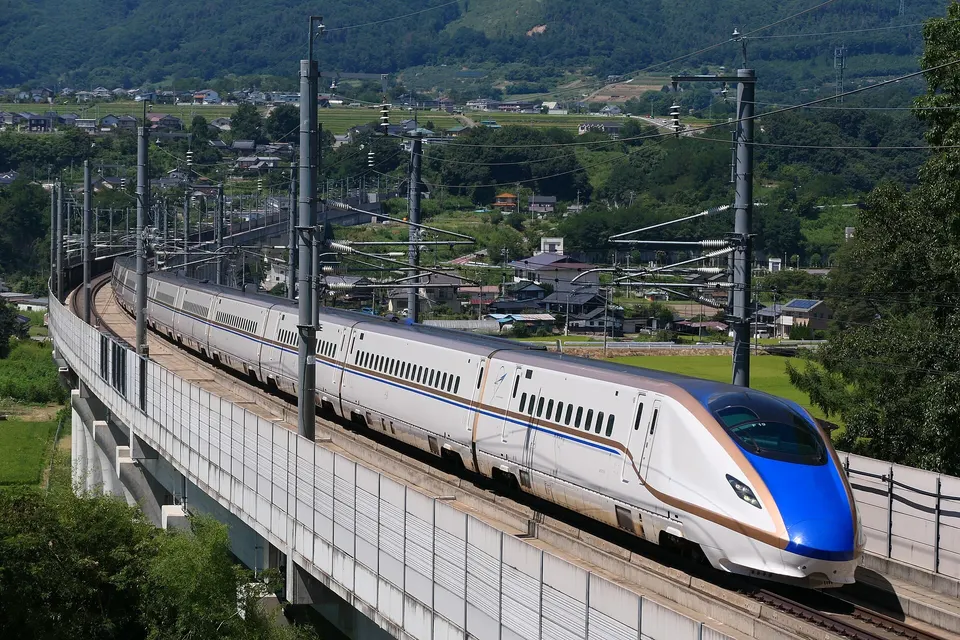
Every train on the line is an E7 series of JR East or a W7 series of JR West. The two are the same design, with 12 cars, and car 12 is Gran Class. Beyond Takasaki the top speed in service is 260 km/h. The E7 began running as far as Nagano in 2014.
Electricity is supplied at 50 hertz in eastern Japan and 60 hertz in western Japan. The Hokuriku Shinkansen has sections of both, and the E7 and W7 run on both.
Because the trains are alike, the name tells where a train goes and how often it stops.
| Name | Service |
|---|---|
| Kagayaki | Tokyo to Tsuruga with few stops; every seat is reserved |
| Hakutaka | Tokyo to Tsuruga with more stops than the Kagayaki |
| Asama | Tokyo to Nagano |
| Tsurugi | Toyama to Tsuruga |
The four names were settled in 2013, after a public contest that drew 144,931 entries. Hakutaka came first, with 9,083. It was already the familiar name of a train linking the Tokyo area with Hokuriku. Asama, in use since 1997, was kept for the trains to Nagano.
References
- Japan Railway Construction, Transport and Technology Agency: Hokuriku Shinkansen (Takasaki–Nagano)
- Japan Railway Construction, Transport and Technology Agency: Hokuriku Shinkansen (Nagano–Kanazawa)
- Japan Railway Construction, Transport and Technology Agency: Hokuriku Shinkansen (Kanazawa–Tsuruga)
- Ministry of Land, Infrastructure, Transport and Tourism: Shinkansen railways
- JR East and JR West: Train names for the Hokuriku Shinkansen (October 2013)
- JR East and JR West: New trains for the Hokuriku Shinkansen (September 2012, PDF)
- JRE Media: Hokuriku Shinkansen stations and train names
- Kotobank: “Hokuriku Shinkansen”
- Kotobank: “Nagano Shinkansen”
- Kotobank: “Usui Pass”
- Kotobank: “Karuizawa”
- Oginoya: Company timeline
Image credits (resized for display):