The Shinkansen is Japan's high-speed railway: a set of lines built apart from the older network, on wider track, where trains run at 200 kilometers per hour or more. The first line opened between Tokyo and Shin-Osaka on October 1, 1964, and the lines now reach from Hokkaido in the north to Kagoshima in the south.
A railway of its own
Shinkansen means "new trunk line," and in English it is also called the bullet train. Japanese law defines a Shinkansen by speed: a trunk railway on whose main sections trains can run at 200 km/h or more.
The older lines are called zairaisen, conventional lines, and the difference begins with the track. The rails of a conventional line are 1,067 millimeters apart. Shinkansen rails are 1,435 millimeters apart, the standard gauge, which steadies a train at high speed and allows a larger car body. A full-size Shinkansen car is 3.4 meters wide and 25 meters long, with room for five seats across, two on one side of the aisle and three on the other.
Shinkansen track carries passenger trains only. Every road and every other railway passes over or under it, so there are no grade crossings. No signals stand beside the track, because a driver traveling at more than 200 km/h can hardly read them. The permitted speed is displayed in the cab, and the brakes apply automatically if the train exceeds it.
The ticket differs too: a Shinkansen journey takes a limited express ticket in addition to the basic fare ticket, as a limited express on a conventional line does.
October 1, 1964
From about 1955 the Tōkaidō Main Line between Tokyo and Osaka needed more capacity than it had. On May 30, 1957, engineers at the national railway's research institute announced at a public lecture that a high-speed electric train on standard gauge could run from Tokyo to Osaka in three hours. The cabinet decided in 1958 to build the line, and construction started in April 1959, with the 1964 Tokyo Olympics as the target.
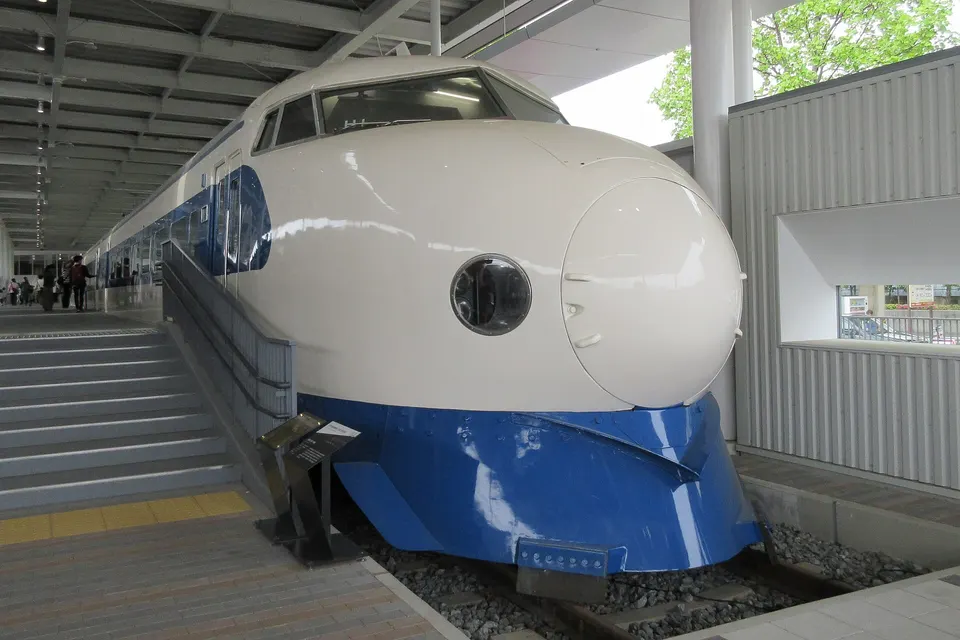
The line, the Tōkaidō Shinkansen, opened on October 1, 1964, just before the Olympics began. Its train, the 0 series, had 12 cars with motors on every one and a top speed of 210 km/h. Two services ran once an hour each: the Hikari ("light"), which stopped only at Nagoya and Kyoto on the way, and the Kodama ("echo"), which stopped at every station. The Hikari took four hours from Tokyo to Shin-Osaka at first and three hours from a year later.
Where it runs
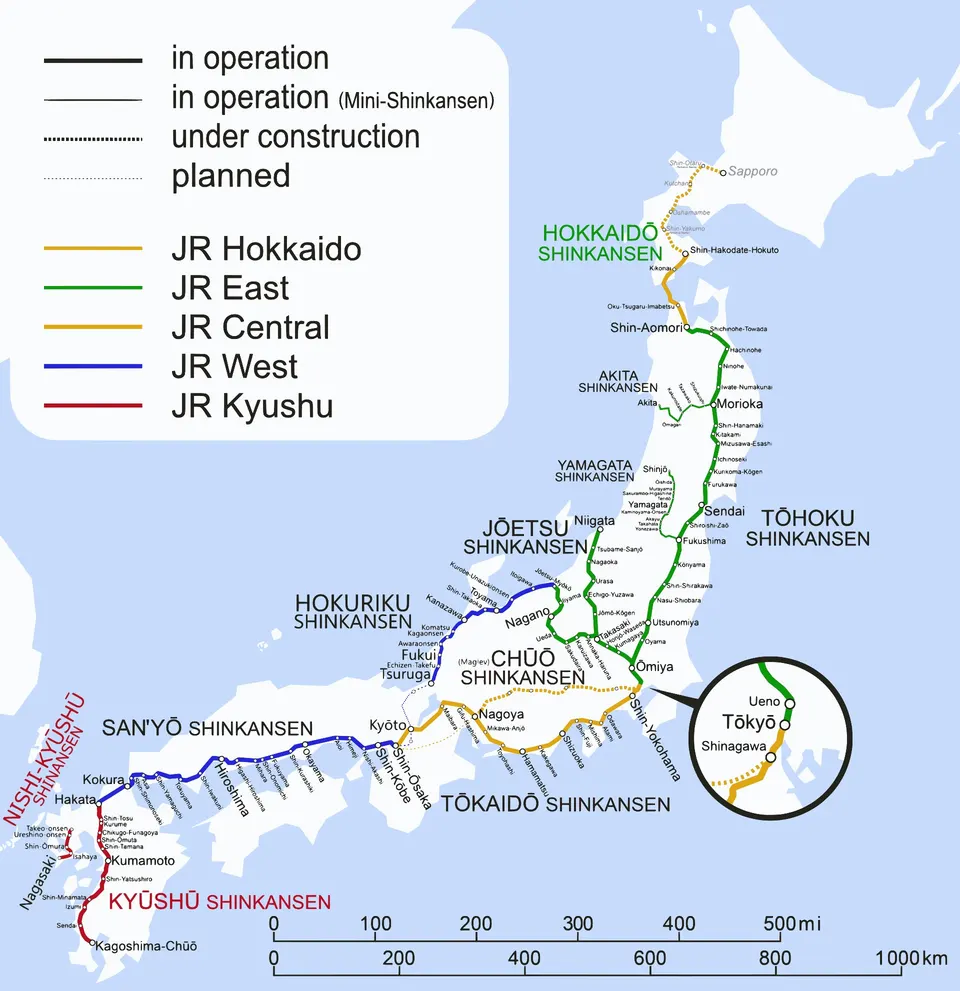
The San'yō Shinkansen carried the line west from Shin-Osaka, to Okayama on March 15, 1972, and to Hakata in Fukuoka on March 10, 1975. In 1982 the Tōhoku Shinkansen opened from Ōmiya to Morioka and the Jōetsu Shinkansen from Ōmiya to Niigata. Their trains reached Ueno in March 1985 and Tokyo Station on June 20, 1991, and the Tōhoku line reached Shin-Aomori in December 2010. The Kyushu Shinkansen opened between Shin-Yatsushiro and Kagoshima-Chūō in 2004 and was joined to Hakata in March 2011. The Hokkaido Shinkansen opened from Shin-Aomori to Shin-Hakodate-Hokuto on March 26, 2016, and its extension to Sapporo is under construction. The Nishi-Kyushu Shinkansen, between Takeo-Onsen and Nagasaki, opened on September 23, 2022.
Five JR companies, successors of the national railway privatized on April 1, 1987, operate the Shinkansen: JR Hokkaido, JR East, JR Central, JR West and JR Kyushu.
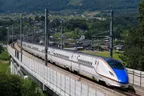
The Hokuriku Shinkansen branches from the Jōetsu Shinkansen at Takasaki. Its first section, from Takasaki to Nagano, opened on October 1, 1997, and it reached Kanazawa in 2015 and Tsuruga in 2024. On the day the first section opened, the conventional line over the Usui Pass, between Yokokawa and Karuizawa, was closed, and Oginoya, which had sold Tōge no Kamameshi at Yokokawa Station since February 1, 1958, began selling it aboard the Shinkansen between Takasaki and Karuizawa.
The Yamagata Shinkansen, opened in 1992, and the Akita Shinkansen, opened in 1997, are conventional lines whose track was changed to standard gauge so that trains could run through from the Tōhoku Shinkansen. On those sections speed is held to about that of a conventional line. Some Komachi trains for Akita run coupled to a Hayabusa between Tokyo and Morioka, and some Tsubasa trains for Yamagata to a Yamabiko between Tokyo and Fukushima.
What the train names mean
Shinkansen trains carry names, and on a given line the name tells which stations the train serves. On the Tōkaidō Shinkansen the Kodama stops at every station and the Nozomi ("hope") at fewer than the Hikari or the Kodama. The Nozomi was added on March 14, 1992, with the 300 series train and a top speed of 270 km/h.
| Line | Train names |
|---|---|
| Tōkaidō and San'yō | Nozomi, Hikari, Kodama |
| San'yō and Kyushu | Mizuho, Sakura, Tsubame |
| Nishi-Kyushu | Kamome |
| Tōhoku | Hayabusa, Hayate, Yamabiko, Nasuno |
| Hokkaido | Hayabusa |
| Yamagata | Tsubasa |
| Akita | Komachi |
| Jōetsu | Toki, Tanigawa |
| Hokuriku | Kagayaki, Hakutaka, Asama, Tsurugi |
Top speed has risen to 285 km/h on the Tōkaidō Shinkansen, 300 km/h on the San'yō Shinkansen and 320 km/h on the Tōhoku Shinkansen between Utsunomiya and Morioka. In fiscal 2023 the Tōkaidō Shinkansen ran 372 trains a day, and the average delay was 1.6 minutes per train.
Seats
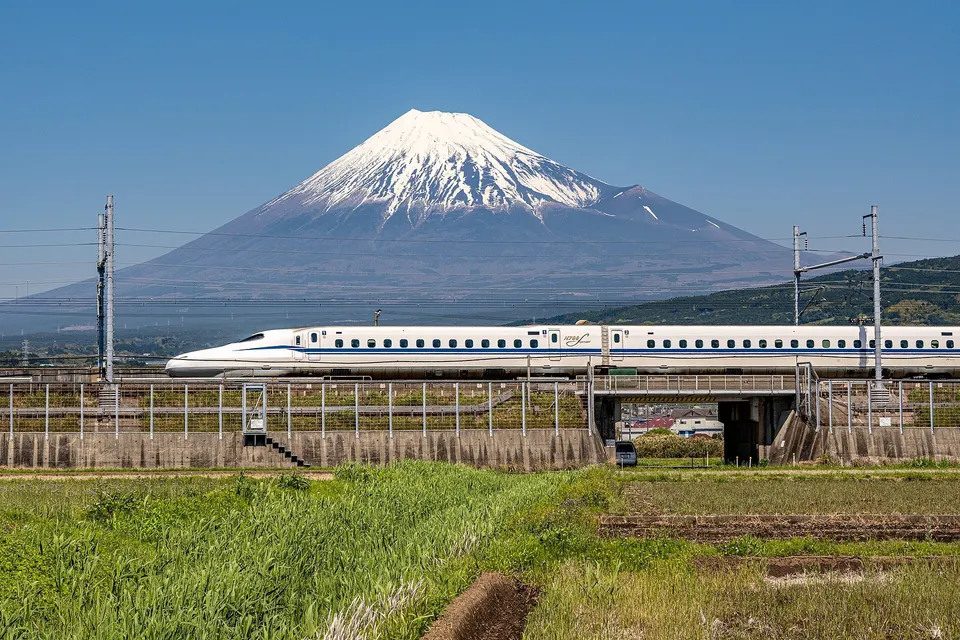
A Shinkansen train has ordinary cars and Green Cars, the class above. On the N700S, the train in the top photograph, an ordinary seat is 440 millimeters wide, or 460 for the middle seat of three, and a Green Car seat is 480. A Tōkaidō Shinkansen train has 16 cars, three of them Green Cars, and more than 1,300 seats.
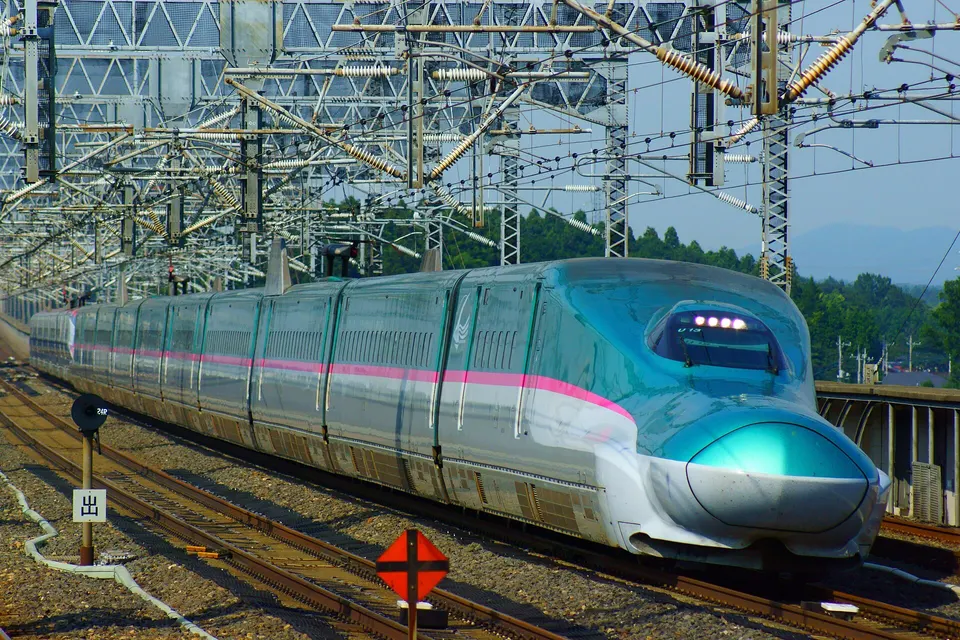
The Tōhoku, Hokkaido, Jōetsu and Hokuriku Shinkansen have a class above the Green Car, called Gran Class. On the E5 series it is a single car of 18 seats, three across.
Many trains have both reserved and non-reserved seats, and some are reserved only. The seat has a table, and eating a meal at it is an ordinary part of the journey: many travelers bring an ekiben, a boxed meal sold at the station.
References
- Kotobank: “Shinkansen” (Japanese encyclopedias)
- Kotobank: “Tōkaidō Shinkansen”
- Nationwide Shinkansen Railway Development Act (e-Gov)
- Ministry of Land, Infrastructure, Transport and Tourism: Shinkansen railways
- JR Central: About the Shinkansen
- JR Central: N700S
- Japan National Tourism Organization: Shinkansen (Bullet Train)
- JR West: Riding the Train, The Basics
- JR West: Train information
- Oginoya: Company timeline
Image credits (resized for display):