On the Shinkansen and on limited express trains in Japan, eating a meal at your seat is an ordinary part of the journey, and the seat has a table for it. On commuter trains and subways a meal is considered bad manners, and visitors are asked to refrain out of courtesy to the passengers around them.
Trains with a table at the seat
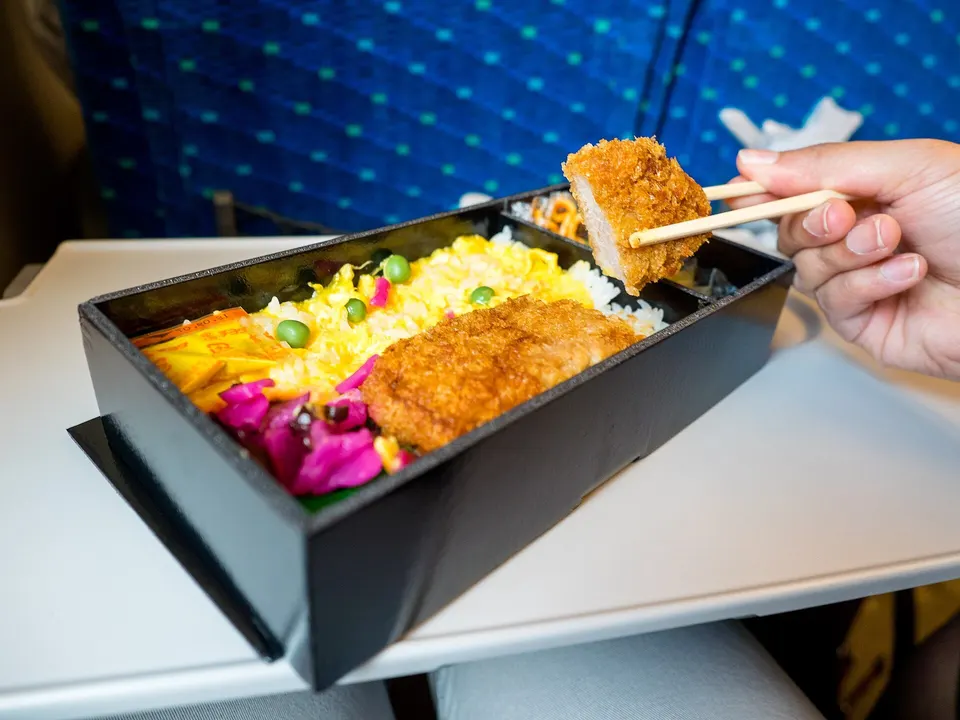
Long-distance trains are where ekiben, the boxed meals sold at stations, are eaten. An ekiben comes with everything needed to eat it, so it can be unwrapped as soon as its owner sits down.
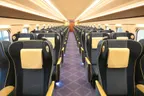
On the N700 trains of the Tōkaidō and San'yō Shinkansen, the table folds down from the back of the seat in front. The Green Car, the class above the ordinary car, adds a side table that pulls out of the armrest, and its seat-back table is larger and slides toward the passenger. Ordinary cars of the W7 trains on the Hokuriku Shinkansen have a large fold-away table and a power outlet at every seat.
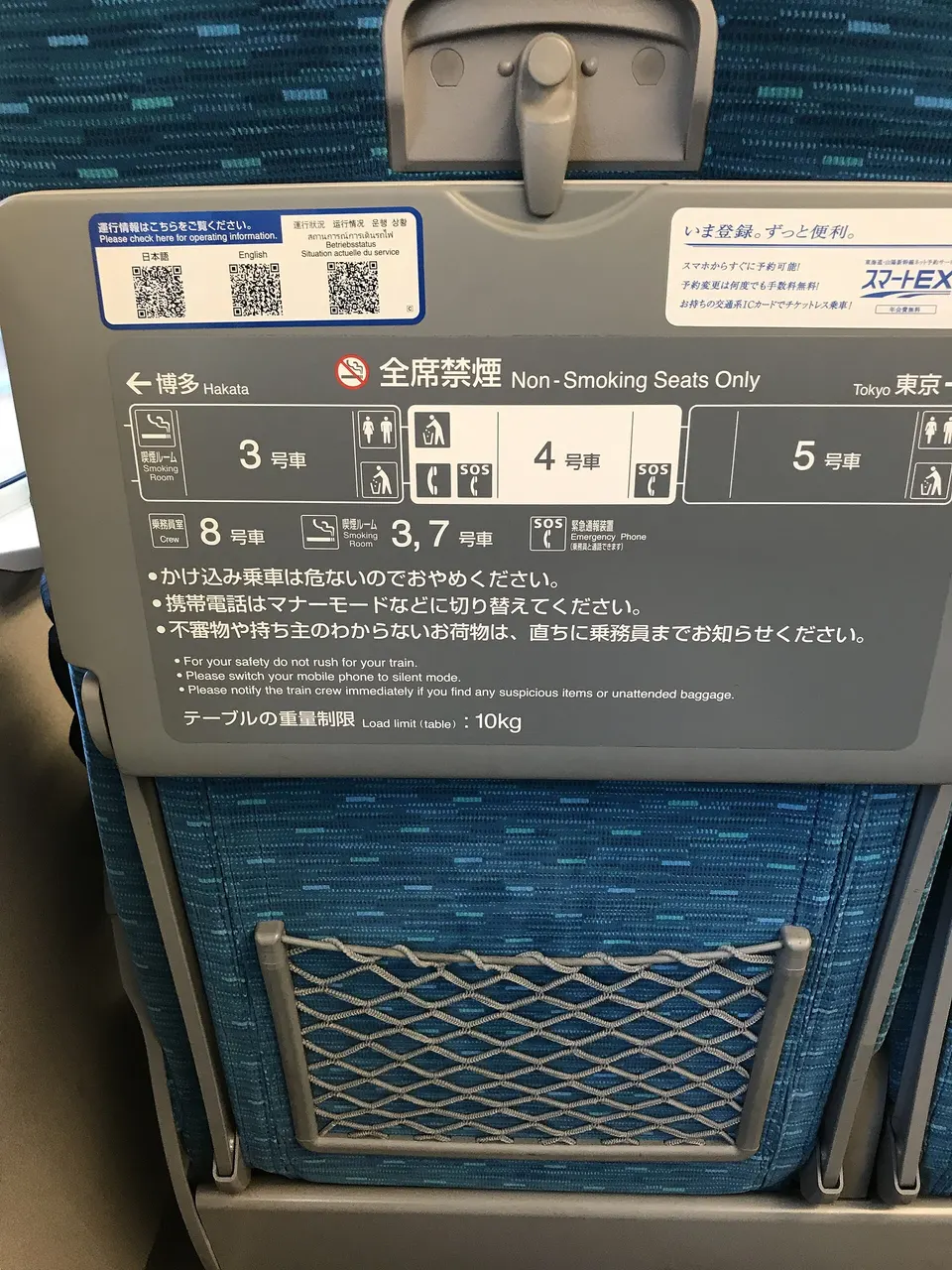
The folded table of an ordinary N700 seat carries a printed panel. A diagram of the nearby cars marks the toilets and the telephones, and shows the trash bins at the ends of the cars. Below it are a request to switch mobile phones to silent mode and the table's load limit, 10 kilograms.
N700 seats recline, and the table hangs on the seat back. Railways ask for care with that. JR Hokkaido, for one, asks passengers on its trains to check with the person behind before reclining and to lower the seat back slowly: a seat that drops suddenly startles the passenger behind, and one tilted far back can feel oppressive.
Commuter trains and subways
The dividing line is the table. On public transport, eating and drinking are avoided unless the seat has one, and eating on a local train or a subway is generally taken as impolite. Short-distance local trains have no space set up for a meal, and they can become extremely crowded. It is considered good form there to take up as little room as possible. Someone drinking water or tea is an occasional sight, and in a packed car the concern is spilling it on a neighbor.
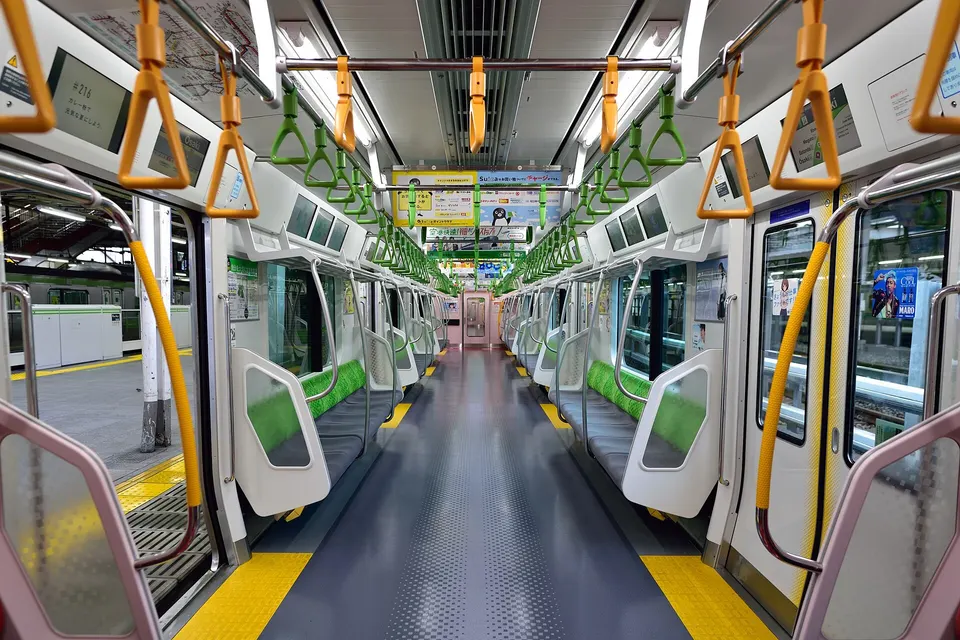
Tokyo's metropolitan government asks visitors to refrain from eating on commuter trains and city buses. Hankyu Railway, whose main lines run from Umeda in Osaka to Kyoto, Kobe and Takarazuka, answers the question "Is eating and drinking on the train prohibited?" by saying that it is not, and asks passengers to take care that it does not trouble those around them.
A survey of passengers shows where food stands among their complaints. In October and November 2025 the Japan Private Railway Association asked people online which behaviors in stations and trains bothered them, and 5,202 answered, each choosing up to three. Eating and drinking in a crowded car was picked by 7.5 percent and came fourteenth of the 18 items. Coughing or sneezing without regard for others came first with 34.7 percent, followed by the way people sit, such as not moving over or stretching out their legs (31.9 percent), and noisy conversation and rowdiness (30.2 percent).
What is sold on board
The first dining car in Japan was coupled to an express of the San'yō Railway in May 1899, and dining cars went on to run on long-distance limited expresses and on the Shinkansen. As trains grew faster and journeys shorter, fewer passengers used them, and the dining cars of the Shinkansen closed in March 2000.
The cart in the aisle has gone from the Tōkaidō Shinkansen as well. JR Central ended cart sales on Nozomi and Hikari trains on October 31, 2023. The reasons it gave were the better selection at shops around the stations, the growing number of passengers bringing food and drink aboard, requests for a quieter car, and a coming shortage of labor. Since then, between Tokyo and Shin-Osaka, Green Car passengers on Nozomi and Hikari trains scan a code at the seat with their own mobile devices to order food and drinks, and a purser brings them. Ordinary cars and Kodama trains have no sales, and vending machines for drip coffee and ice cream were added on the platforms of the stations where Nozomi trains stop. The San'yō Shinkansen, which runs on from Shin-Osaka to Hakata, replaced its cart with mobile ordering from October 1, 2026.
Carts still pass through some trains on the Tōhoku, Yamagata, Akita, Jōetsu and Hokuriku Shinkansen and on the Azusa and Hitachi limited expresses. The carts' product list for November 2026 has coffee, green tea, beer, sake, ice cream, sweets and snacks, and no boxed meals. JR Hokkaido has no onboard sales on any of its conventional-line limited expresses and asks passengers to buy what they need before boarding. The meal comes from the shops at the station.
When the meal is over
JR West tells passengers to put food and drink waste in the receptacles provided on the train or in the station. JR Hokkaido asks them to use the bin or take the trash along, and to tidy the area around the seat before getting off, so that the next person can sit down to a clean one.
Trash left behind draws more complaints than eating does. In the same 2025 survey, 12.9 percent chose abandoned trash and plastic bottles, which put it ninth, five places above eating in a crowded car.
One ekiben leaves more than a wrapper. Tōge no Kamameshi, which went on sale at Yokokawa Station on February 1, 1958, comes in an earthenware pot, chosen because passengers worn out by long train journeys said they wanted a warm bento. Pots that come back after one use are washed twice with steam at Oginoya and used again. For customers who said the pot was heavy to carry, Oginoya also packs the same meal in a molded-pulp container.
References
- Japan National Tourism Organization: Experience Japan's Local Ekiben Culture
- Japan National Tourism Organization: Responsible Travel Guide, Traveling Mindfully
- Japan National Tourism Organization: Traveling by Rail
- Tokyo Metropolitan Government: How to Enjoy Tokyo! Manners & Customs Handbook (2025, PDF)
- Hankyu Railway: FAQ, Is eating and drinking on the train prohibited?
- Japan Private Railway Association: 2025 survey of nuisance behavior in stations and trains
- JR West: Train and Station Manners
- JR West: Tōkaidō and San'yō Shinkansen (N700)
- JR West: Hokuriku Shinkansen (W7)
- JR Central and JR West: press release on Supreme Class (June 17, 2026, PDF)
- JR Central: press release on new onboard services (August 8, 2023, PDF)
- JR Central: Onboard sales
- JR East Service Creation: Onboard sales product list (PDF)
- JR Hokkaido: Manner guide
- JR Hokkaido: FAQ on reclining
- JR Hokkaido: FAQ on onboard sales
- Kotobank: “Shokudōsha” (dining car)
- Oginoya: Company timeline
- Oginoya: About the containers
Image credits (resized for display):