Station soba, ekisoba in Japanese, is a bowl of soba or udon noodles in hot broth, served at small shops on the platforms and beside the ticket gates of Japan's railway stations and usually eaten standing up. It is ordered at the counter or with a ticket from a vending machine, and it is ready in about five minutes. Of the stations named as its birthplace, Karuizawa is said to be the oldest: its noodle seller is on record from 1892.
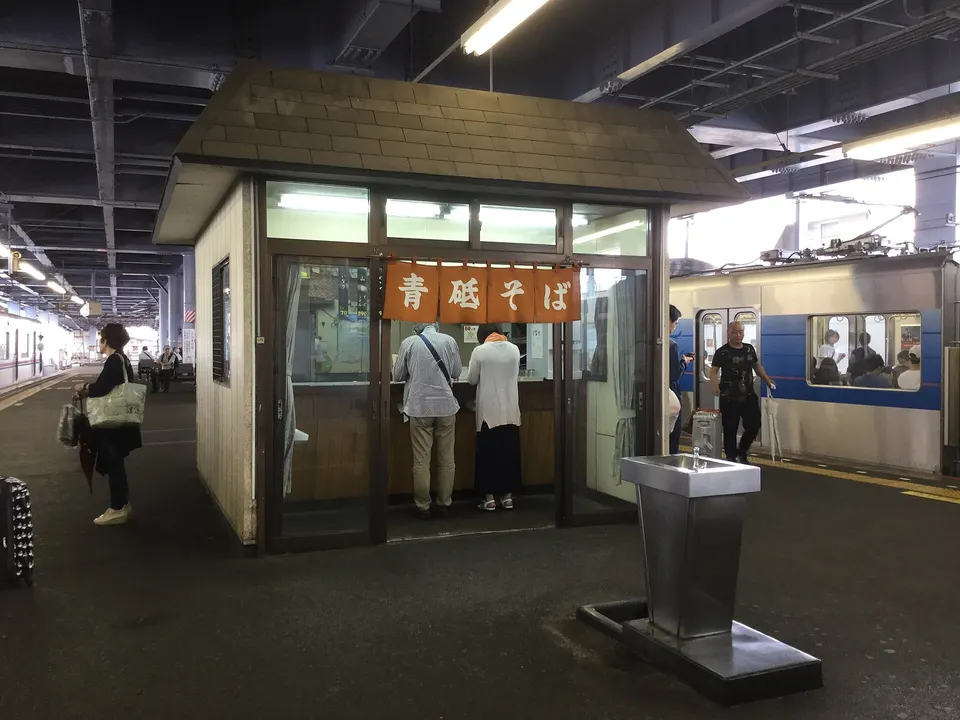
A noodle shop inside the station
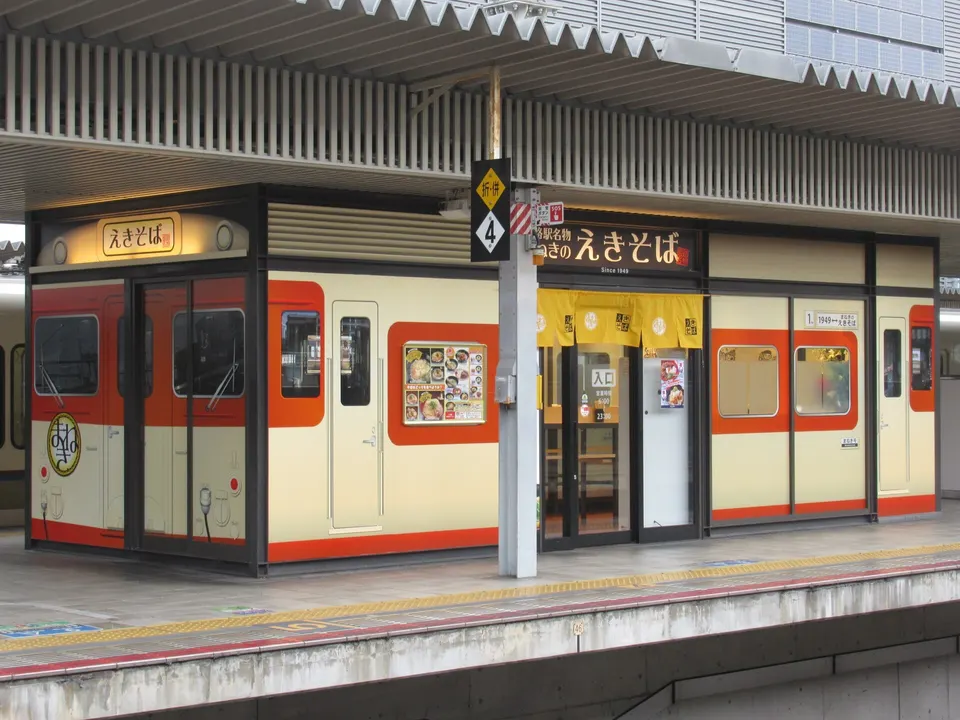
Eating on one's feet is called tachigui, and a tachigui soba shop serves soba to customers who stand. Such shops are mostly self-service. Inside a station the shop is called ekisoba, a name that covers station udon as well; out in the streets it is tachisoba. The shops trade on platforms all over the country, and the meal fits the wait for a train: cheap, quick and easy. The shop pictured above is on a platform of Aoto Station in Tokyo.
What is in the bowl
Soba are thin noodles cut from a rolled dough of buckwheat flour, usually with wheat flour added to bind it; udon are wheat-flour noodles. The basic item at a station is kakesoba, boiled soba in a deep bowl with nothing but hot broth poured over it.
The rest of the menu is that bowl with something on top. Tempura soba carries tempura. Kitsune soba, "fox soba," has a piece of fried tofu simmered sweet and salty, which foxes are said to love. Tanuki soba, named for the raccoon dog, has crumbs of fried tempura batter and chopped green onion. Tsukimi soba, "moon-viewing soba," has a raw egg, its yolk standing for the full moon.
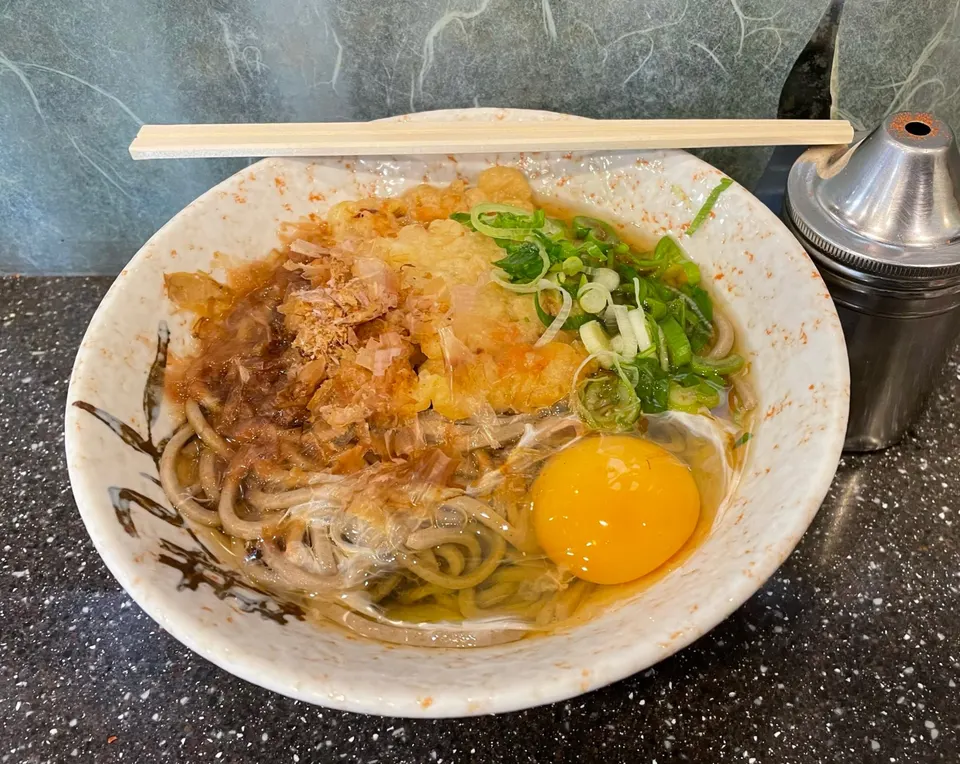
The broth changes with the region. In eastern Japan it is dark, built on bonito and soy sauce. In western Japan it is pale, made with kelp and other seafood stock and light-colored soy sauce. On the Tōkaidō Main Line the border lies at Sekigahara: a traveler heading west from Tokyo meets the pale broth in the udon on the platform at Maibara Station, in Shiga Prefecture.
Ordering by ticket
Fuji Soba, a standing soba chain that opened in Shibuya, Tokyo, in 1966, explains in English how to buy a shokken, a meal ticket, from its machines. The routine runs like this:
- Put cash into the machine. Some machines also take transit e-money such as Suica and PASMO; credit cards are not accepted.
- Press a button: yellow for hot noodles, blue for cold noodles, orange for rice or a set of rice and noodles. Take the ticket, then press the change button for the change.
- Hand the ticket to the staff behind the counter and say soba or udon, hot or cold. The staff give back half of the ticket.
- When the number on the half-ticket is called, collect the order on its tray. After eating, take the tray to the return window.
Karuizawa, 1892
Where station soba began is not settled. Mori and Oshamambe in Hokkaido, Morioka in Iwate, Yokokawa in Gunma and Karuizawa in Nagano have all been named, and Karuizawa is said to be the oldest. A record compiled in 1958 by the national railway's association of station vendors lists Aburaya Ryokan, an inn in front of Karuizawa Station, as founded on April 1, 1892, with a platform stall selling "noodles (soba) and raw eggs."
As relatives of the inn's family tell it, Aburaya began in 1892 by serving hot soba to the workers building the line between Yokokawa and Karuizawa. After that line opened in 1893, Aburaya went on serving passengers who waited at Karuizawa while the locomotives for the Usui Pass were changed. Its sellers went along the platform with bento and with soba in bowls.
In the 1980s the Karuizawa shop passed from Aburaya to Oginoya, the ekiben maker of Yokokawa, the station at the foot of the same pass. A framed sign in the shop reads 駅そば発祥の地 軽井沢駅, "Karuizawa Station, birthplace of station soba."
From the train window to the counter
Station soba multiplied from the Taishō era (1912–1926), and it was mainly the makers of ekiben, the station bento, who sold it. In those years a seller took an order, poured heated broth over boiled noodles and passed the bowl to a passenger inside the train, as platform vendors did with ekiben. Standing to eat on the platform began to take hold around 1955, and in the 1960s standing soba shops spread to the streets outside the stations.
Noodles from the ekiben makers
Oginoya has traded at Yokokawa Station since October 15, 1885, and Tōge no Kamameshi, its ekiben in an earthenware pot, went on sale there on February 1, 1958. Oginoya is a noodle seller as well as an ekiben maker: its station shops serve soba and udon alongside Tōge no Kamameshi.
At Himeji the ekiben maker came up with a noodle of its own. Maneki Shokuhin began selling bento at Himeji Station in 1889, among them the boxed meal that replaced rice balls as ekiben. After the Second World War, wheat flour was under government control and hard to get, so Maneki mixed konjac flour with buckwheat flour into something like udon and served it in Japanese-style broth. Those noodles went soft and spoiled quickly, and Maneki turned to yellow Chinese-style noodles made with kansui, an alkaline water. On October 19, 1949, it began selling them on the platform under the name Ekisoba. A bowl cost 50 yen in a lidded ceramic container, at a time when udon in town cost 30 yen, and Maneki bought the container back for 10 yen.
At Tosu Station in Saga and Orio Station in Fukuoka, in northern Kyushu, the plain bowl is often missing from the menu, and the standard is kashiwa udon or kashiwa soba, topped with chicken simmered sweet. Tōchikuken, an ekiben maker whose forerunner started at Orio Station in 1921, puts chicken in every bowl of udon and soba at its shops.
References
- Nikkei (Nikkei Plus 1, October 15, 2016): How standing soba has evolved
- NBS Nagano Broadcasting Systems (January 14, 2026): Did station soba begin at Karuizawa Station?
- Toretabi: Mastering station soba
- Fuji Soba: How to buy the ticket from the vending machine (PDF)
- Maneki Shokuhin: Ekisoba
- Maneki Shokuhin: Company profile and history
- Tōchikuken: Company profile and history
- Tōchikuken: Products
- Oginoya: Company timeline
- Oginoya: Shop list
- Kotobank: “Ekisoba”
- Kotobank: “Tachigui soba”
- Kotobank: “Soba”
Image credits (resized for display):
- Nesnad / Wikimedia Commons, CC BY 4.0, 2019
- ウィキ太郎(WikiTaro) / Wikimedia Commons, Public domain, 2021
- TRJN / Wikimedia Commons, CC BY-SA 4.0, 2019