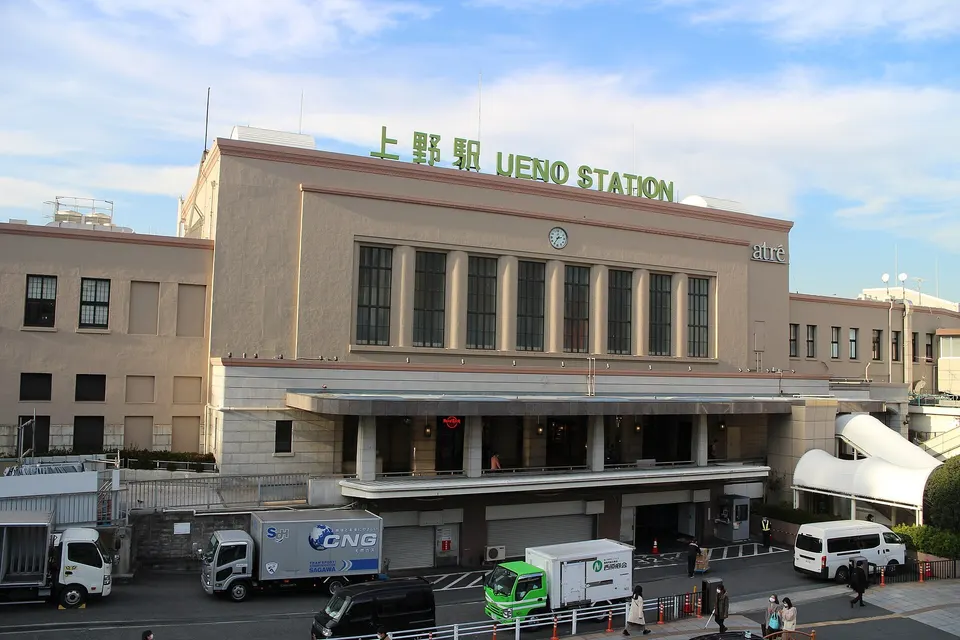
Ueno Station, in Tokyo's Taitō ward, opened in 1883 as the Tokyo terminal of the Nippon Railway and grew into the station where trains for the north of Japan began and ended their runs, on the Tōhoku, Jōban, Jōetsu and Shin-etsu lines. That is why Ueno is called Tokyo's gateway to the north. Its station building dates from 1932, and in 2015 many of the trains that had ended at Ueno began running through Tokyo Station onto the Tōkaidō Main Line.
The Nippon Railway's Tokyo terminal
The Nippon Railway, founded in 1881 with money from nobles led by Iwakura Tomomi, was Japan's first private steam railway. It built its line from Tokyo to Takasaki first, and in 1882 it chose Ueno as its Tokyo terminal, on a large plot where sub-temples of Kan'ei-ji, a family temple of the Tokugawa shoguns, had stood.
The line from Ueno to Kumagaya opened on July 28, 1883, eight days after Iwakura's death. A brick station building replaced the temporary one in July 1885. The Nippon Railway's lines reached Takasaki in 1884 and Aomori, at the northern end of Honshu, in 1891, a trip of 26 hours. The state took over the company in 1906.
Gateway to the north
Tokyo's terminal for the south was Shimbashi, and its terminal for the north was Ueno. A line through the city center joined them on November 1, 1925, when the elevated line from Tokyo Station reached Ueno and the Yamanote Line began to run as a loop. The starting point of the Tōhoku Main Line moved to Tokyo Station, but many long-distance trains for the north went on leaving from Ueno. They included the Hatsukari to Aomori from 1958 and, after the Seikan Tunnel opened in 1988, the sleeper Hokutosei to Sapporo.
Trains for the Shin-etsu Main Line also left from Ueno. On October 15, 1885, the railway from Takasaki reached Yokokawa, at the foot of the Usui Pass, and that day Oginoya began selling rice balls at Yokokawa Station, the second station in Japan to sell ekiben, after Utsunomiya. In April 1893 the rack railway over the pass opened, and trains could run from Ueno through to Naoetsu on the Sea of Japan. Until 1997 every train over the pass stopped at Yokokawa to couple or uncouple locomotives for the climb. On February 1, 1958, Oginoya put Tōge no Kamameshi, an ekiben in a clay pot, on sale at Yokokawa, and more than 170 million have been sold since.
The station of 1932
The brick station burned down in the Great Kantō Earthquake of 1923. Work on a new building, designed by engineers of the Ministry of Railways, began in March 1930. Digging the foundations, workers found bones and weapons from the Battle of Ueno, fought around Kan'ei-ji in 1868. The new station, second in scale only to Tokyo Station, came into use on April 5, 1932. Its front came through the air raids of the Second World War, and its exterior has changed little since.
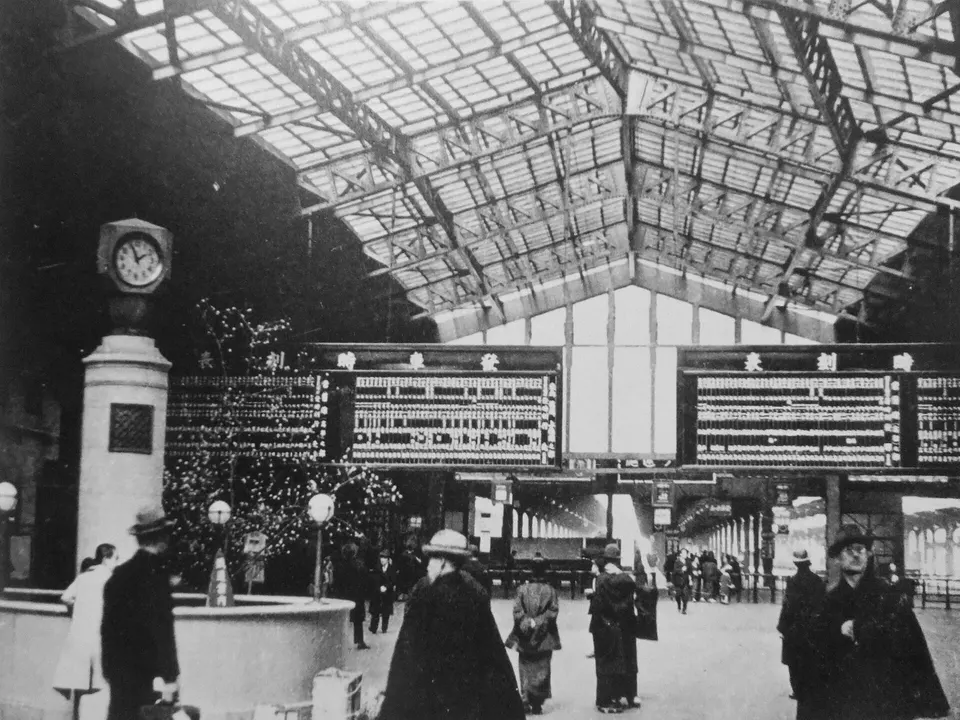
The design used the lie of the land. The entrance for departing passengers and the exit for arriving passengers were placed one above the other, and a passage under the station plaza kept people on foot apart from cars. The station combined through tracks on an elevated level with tracks at ground level that end at the station, and Ueno became known as an example of the platform layout of a terminal. Many of the long-distance trains for the north arrived and left at ground level.
Takuboku's poem and group employment
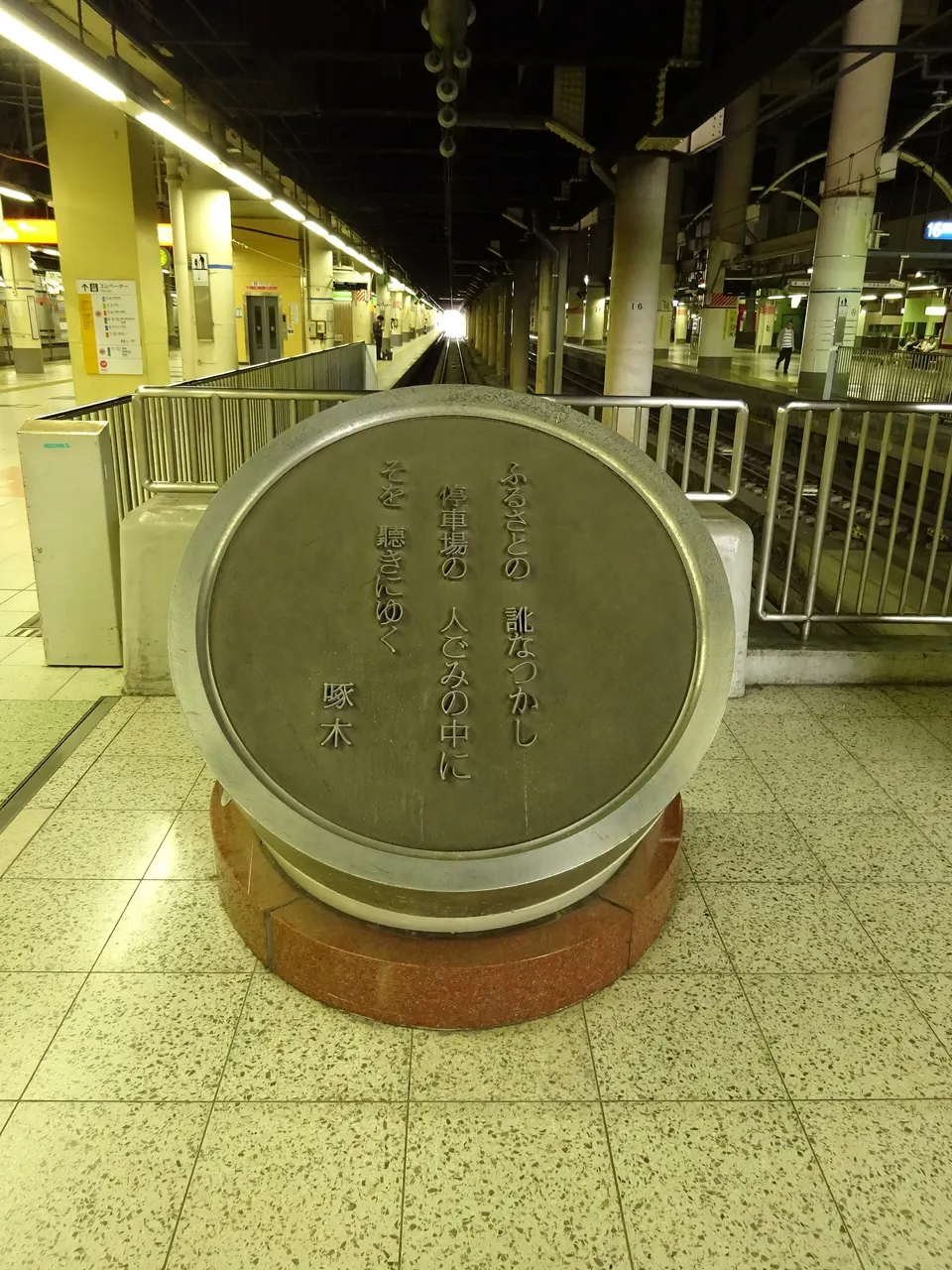
A Handful of Sand (1910), the first collection of tanka by Ishikawa Takuboku, includes the poem "Missing the accent of home, I go into the crowd at the station to hear it." A monument with the poem stands in Ueno Station.
From 1954, firms and shops in the big cities hired young people from the countryside who had just finished junior high school, in groups: shūdan shūshoku, group employment. It peaked in 1964, with 78,407 people from 35 prefectures, and 3,000 special trains in all carried them before it ended in 1977. Boys and girls from Tōhoku, Niigata, Nagano and the Hokuriku region, called kin no tamago, "golden eggs," stepped off at Ueno's platform 18. In 1964 Izawa Hachirō had a hit with "Aa Ueno-eki" ("Oh, Ueno Station"), a song to cheer them on. A monument to the song was set up at the station in 2003.
The Shinkansen and the Ueno-Tokyo Line
The Tōhoku and Jōetsu Shinkansen opened from Ōmiya in 1982 and were extended to Ueno in March 1985, when the section between Ōmiya and Ueno opened on March 14. Their platforms were built on the fourth level below ground, beneath tracks 17 to 20. The Shinkansen reached Tokyo Station on June 20, 1991. By then many limited expresses had given way to the Shinkansen, and Ueno became mainly a station for commuters.
Since 1925 some trains from the north had used a track for empty trains to reach Tokyo Station, but from 1983 they could not, because land near Akihabara and Kanda had been taken for the Shinkansen. A new link was built from 2008, laid near Kanda directly above the Shinkansen. With the Ueno-Tokyo Line, opened in March 2015, trains of the Tōhoku (Utsunomiya), Takasaki and Jōban lines began running through Tokyo onto the Tōkaidō Main Line.
Ueno Park and Ameyoko
On the hill above the station, Kan'ei-ji was founded in 1624, and most of the temple burned in the Battle of Ueno. In May 1873 Ueno Park and Asakusa Park were designated Japan's first parks. The museum that is now the Tokyo National Museum and Ueno Zoo opened in the park in 1882. In 1924 the Imperial Household Ministry gave the park to the City of Tokyo, and its name became Ueno Onshi Kōen, "Ueno Park, the imperial gift."
Ameya Yokochō, or Ameyoko, is the market street along the elevated tracks between Ueno and Okachimachi stations. Black-market stalls opened there in 1946, and so many sold candy, ame, that the street was named for its candy shops. Its year-end sales of food and seafood became one of the sights of Tokyo.
References
- Kotobank, "Ueno Station"
- Kotobank, "Takasaki Line"
- Kotobank, "Ueno-Tokyo Line"
- Kotobank, "Tōhoku Shinkansen"
- Kotobank, "Group employment"
- Kotobank, "A Handful of Sand"
- Kotobank, "Ueno Onshi Park"
- Kotobank, "Ameya Yokochō"
- Taito City, "Thinking of Ueno Station"
- Taito City, "Relocation of the 'Aa Ueno-eki' song monument"
- Kajima Corporation, "The history of Ueno Station"
- National Diet Library, "What railways changed: town planning"
- National Diet Library, "Column: Ueno Park"
- Onoda Shigeru, "100 years of the Yamanote loop" (Tokyo Metropolitan Library lecture handout)
- JR East, JRE Media, "Ueno Station ground-level platform event"
- Oginoya, chronology
- Oginoya, "Tōge no Kamameshi"
Image credits (resized for display):
- Suicasmo / Wikimedia Commons, CC BY-SA 4.0, 2021
- Kōyō Ishikawa / Wikimedia Commons, Public domain, 1933
- Nyao148 / Wikimedia Commons, CC BY-SA 3.0, 2016