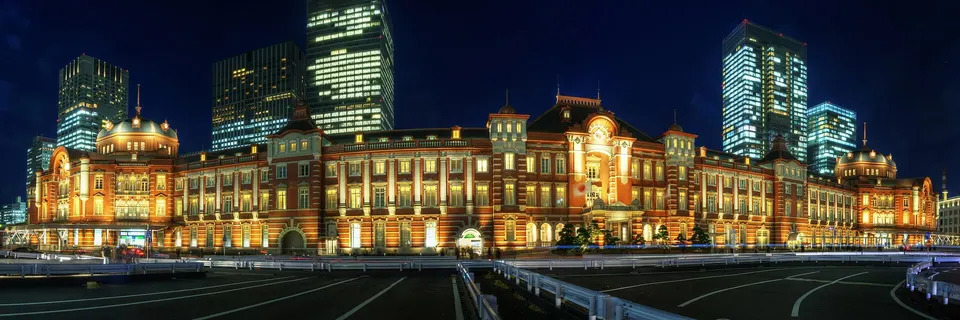
Tokyo Station, in the Marunouchi district of central Tokyo, is the starting point of the Tōkaidō, Tōhoku, Chūō and Sōbu main lines and of the Tōkaidō and Tōhoku Shinkansen. Its red-brick building, designed by Tatsuno Kingo, opened in December 1914, lost its domes and its third story to fire in an air raid in 1945, and was returned to its original form in 2012.
A central station between Shimbashi and Ueno
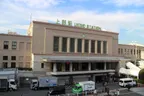
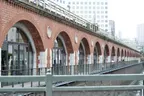
Before 1914 Tokyo's main terminals were Shimbashi and Ueno. Shimbashi, where Japan's first railway opened in 1872, was the starting point of the Tōkaidō Main Line. Ueno, opened in 1883, was the starting point of the line that became the Tōhoku Main Line. In the 1880s, the plans for rebuilding Tokyo as a modern capital called for an elevated line through the city to join Shimbashi and Ueno, with a central station on it. The elevated line was finished in 1910.
The new station was built for trains to run through it. Shimbashi, Ueno and the central stations of Europe's large cities were dead ends, where moving a locomotive from one end of a train to the other took space and time.
While it was being built the station was called the Central Station, Chūō Teishajō. The Railway Agency settled on the name Tokyo Station on December 5, 1914, two weeks before the opening. On December 20 the station opened and the starting point of the Tōkaidō Main Line moved there from Shimbashi. The starting point of the Tōhoku Main Line followed in 1925, when the elevated line from Ueno was finished and the Yamanote Line began running as a loop.
Tatsuno Kingo's building
The design was entrusted in 1903 to Tatsuno Kingo (1854–1919), the architect of the Bank of Japan's head office, and he worked on it for eight years. Construction began in March 1908, and the building was completed on December 14, 1914.
The building is about 335 meters long, made of brick on a frame of 3,157 tons of steel. It had three stories and a dome at each end, north and south. It stands at the end of the avenue that runs straight east from the Imperial Palace, and the entrance at its center was reserved for the imperial household. Passengers boarding went in under the south dome and passengers arriving came out under the north dome, an arrangement that lasted until 1948. The east side of the station had no entrance until 1929.
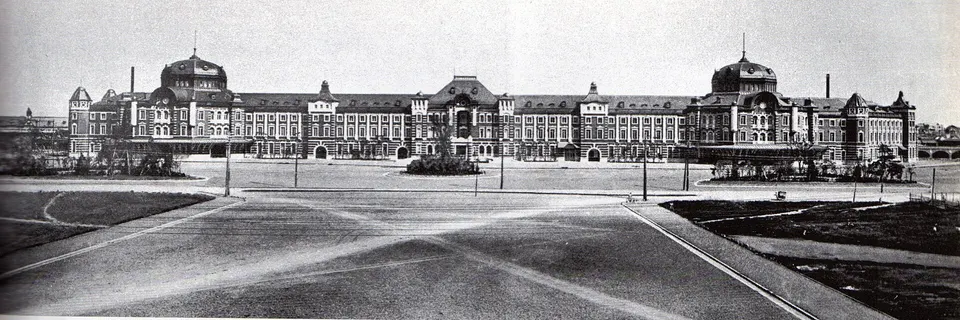
The Great Kantō Earthquake of September 1, 1923, did the building no serious damage, and about 8,000 people took refuge in the station.
The fire of 1945 and the two-story station
Incendiary bombs dropped by American B-29 bombers set the building on fire shortly after 11 p.m. on May 25, 1945. By the time the fire was out, a little after 7 the next morning, the domes and the third story were gone. Five trains ran again on May 27.
In 1947 the stationmaster argued hard for rebuilding the station as it had been, but there was no money for that. The building was finished that year with two stories, and octagonal roofs took the place of the domes.
Back to the form of 1914
The building was designated an Important Cultural Property on May 30, 2003, and work to preserve and restore it began in 2007. The first and second stories kept their original brick. The third story was rebuilt in reinforced concrete and faced with brick tiles made to resemble those of 1914.
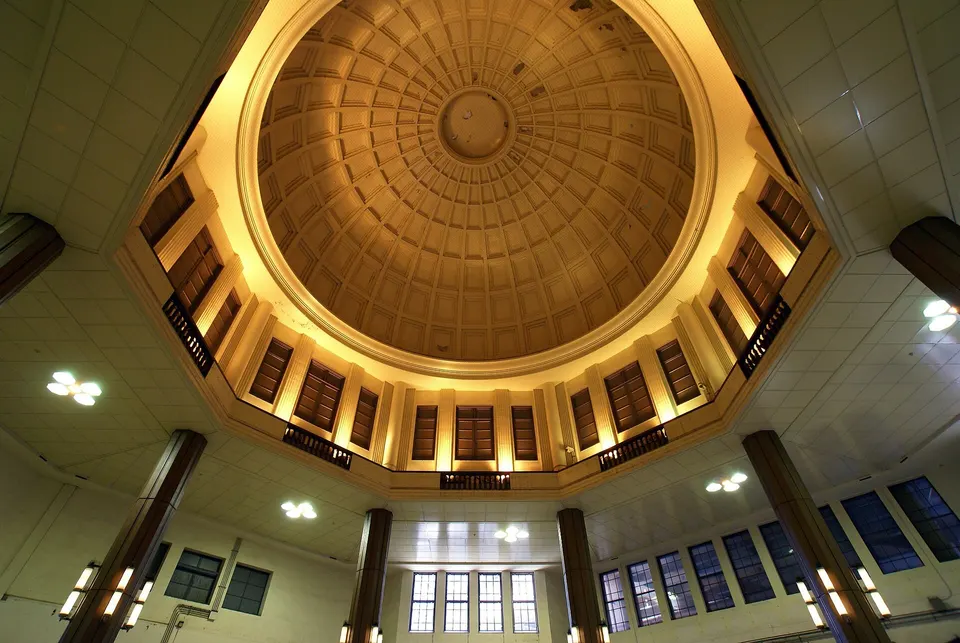
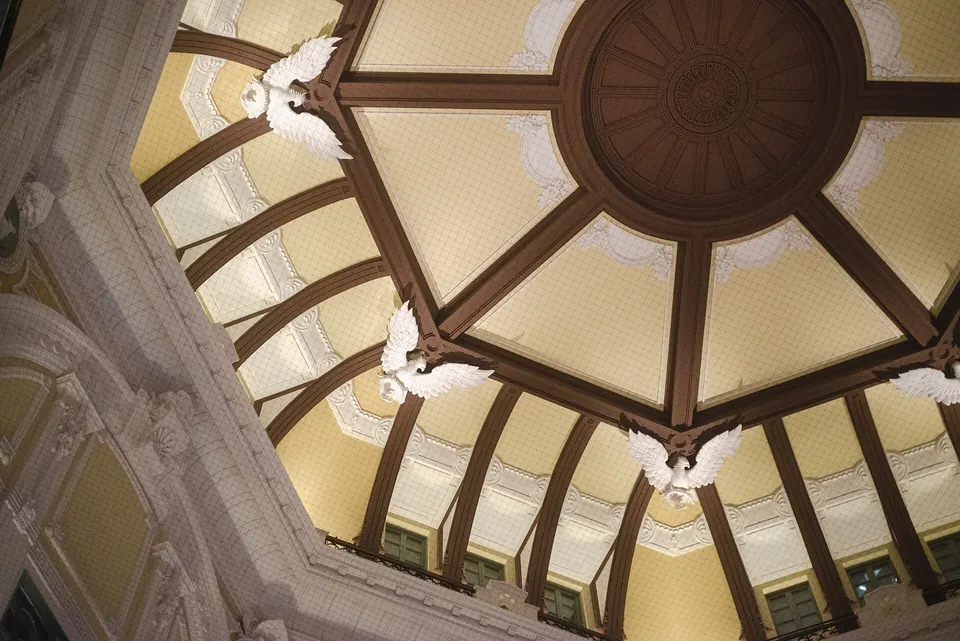
The insides of the domes were restored with the help of photographs from the time of the opening. At the eight corners under each dome are eagles with wings about 2.1 meters across, and reliefs of eight of the twelve zodiac animals, each placed in its own compass direction. The rat, rabbit, horse and rooster, which stand for north, east, south and west, are left out.
Below ground, the pine piles under the brick walls were replaced with new piles, two basement levels were built, and the building was set on seismic isolators. The restored station came into use in October 2012.
The Yaesu side and the Shinkansen
The east side of the station is called Yaesu, a name worn down from that of Jan Joosten, a Dutchman who served Tokugawa Ieyasu and was given a house in Edo. The Yaesu entrance opened in 1929 beside the outer moat. The moat was filled in after the Second World War, and in 1954 the Railway Hall was built there with the Daimaru department store inside.
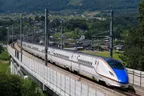
The platforms of the Tōkaidō Shinkansen were built on the Yaesu side. Work on them began in 1961 and ended in July 1964, three months before the line opened on October 1. The Tōhoku and Jōetsu Shinkansen reached Tokyo Station on June 20, 1991. The Hokuriku Shinkansen, which leaves Tokyo on the same tracks, opened as far as Nagano on October 1, 1997. GranRoof, a canopy about 230 meters long over the Yaesu entrance, was completed in 2013.
Inside the station
As of January 1, 2020, JR East gave the station's area as 182,000 square meters, with 28 platform tracks, six of them for the Tōkaidō Shinkansen. About 4,000 trains ran each day, and about 460,000 passengers boarded on an average day. Markers called zero-kilometer posts show the point where the lines begin.
Two prime ministers were attacked in the station. Hara Takashi was stabbed to death at the Marunouchi south entrance on November 4, 1921. Hamaguchi Osachi was shot on a platform on November 14, 1930, and died in August 1931. A plaque marks each place.
The Tokyo Station Hotel opened in the south part of the building in 1915. Tokyo Station Gallery, an art museum, opened in 1988.
The station's ekinaka, its shops and restaurants, include GranSta, opened on October 25, 2007, and Ekibenya Matsuri, a shop devoted to ekiben, the station bento, opened inside the ticket gates on August 9, 2012. In 2022 the manager of Ekibenya Matsuri said that some customers work out the hour and the shelf and wait for Tōge no Kamameshi, the ekiben in an earthenware pot that Oginoya first sold at Yokokawa Station in 1958.
References
- Kotobank, "Tokyo Station"
- Kotobank, "Tatsuno Kingo"
- Kotobank, "Yaesu"
- Tokyo Station City, "Overview and history of Tokyo Station"
- Tokyo Station City, "Highlights of the Marunouchi Station Building"
- Tokyo Station City, "Highlights inside Tokyo Station"
- Agency for Cultural Affairs, Cultural Heritage Online, "Tokyo Station Marunouchi Building"
Image credits (resized for display):
- Yuya Sekiguchi / Wikimedia Commons, CC BY 2.0, 2012
- Unknown author / Wikimedia Commons, Public domain, 1914
- 663highland / Wikimedia Commons, CC BY 2.5, 2007
- Khronos-dolls / Wikimedia Commons, CC0, 2023