

Categories
Places in Japan
-
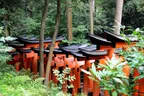
Fushimi Inari Taisha: why so many torii gates line Mount Inari
Fushimi Inari Taisha in Kyoto is the head shrine of about 30,000 Inari shrines. Why worshippers have given it some 10,000 torii, what the vermilion and the foxes mean, and how inarizushi got its name. -
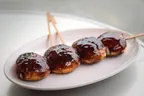
What to eat in Gunma: wheat noodles, yakimanjū, konnyaku and sukiyaki
Gunma eats wheat: okkirikomi noodles, three towns' udon and grilled yakimanjū. It also grows more than nine-tenths of Japan's konnyaku potatoes, and its ekiben comes in a clay pot. -
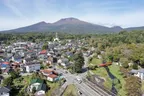
Karuizawa: how a post town on the Nakasendō became a summer resort
Karuizawa stands about 1,000 meters up at the foot of Mount Asama, just west of the Usui Pass. How a fading post town became a summer resort after 1886. -
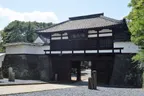
Komoro and Ueda: two castle towns beyond the Usui Pass
Komoro and Ueda are castle towns on the Chikuma River in eastern Nagano: a castle built below its own town, and the Sanada castle that held off two Tokugawa armies. -
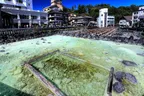
Kusatsu Onsen: the hot-spring town around the Yubatake
Kusatsu Onsen in Gunma stands 1,200 meters up on the slope of a volcano. At its center is the Yubatake, a spring that sends 4,000 liters a minute down wooden troughs. -
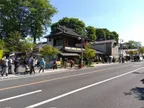
Mashiko: the pottery town in Tochigi
Mashiko is a town of about 20,000 people in Tochigi Prefecture where pottery has been made since about 1853: its kilns, its fair, Hamada Shōji's house, indigo vats and a gate of 1492. -
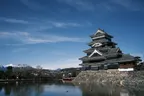
Matsumoto Castle: the black keep below the Japan Alps
Matsumoto Castle in Nagano has a National Treasure keep of five linked buildings. Who built it, why its walls are black, and how the town saved it. -
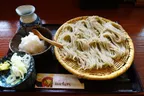
What to eat in Nagano: soba, oyaki and the food of Shinshu
Nagano, the old Shinshu, is mountain country with no coast. Why its food is soba, oyaki dumplings, nozawana pickles, gohei mochi, apples and wasabi. -
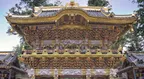
Nikkō Tōshōgū: the gilded shrine of Tokugawa Ieyasu
Nikkō Tōshōgū in Tochigi enshrines Tokugawa Ieyasu as a god. Why his grandson rebuilt it in gold leaf and carvings in 1636, the Yōmeimon gate, the three monkeys and the sleeping cat. -
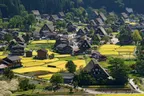
Shirakawa-go's gasshō houses: why the thatched roofs are so steep
The gasshō-zukuri farmhouses of Shirakawa-go have thatched roofs pitched at nearly 60 degrees. What the attic was for, how the roof is tied together, and how the village has kept its houses. -

Snow monkeys: why the macaques of Jigokudani bathe in a hot spring
At Jigokudani in northern Nagano, wild Japanese macaques sit in a hot spring through winters when the temperature falls below minus 10°C. The habit began with one young monkey in 1963. -
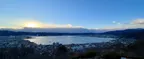
Suwa: the lake, the four shrines and the log-riding festival
Suwa lies around a lake 759 meters up in central Nagano. Its ice ridges, the four shrines of Suwa Taisha, the Onbashira log festival, hot springs and silk. -
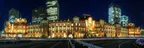
Tokyo Station: the red-brick station at the center of Japan's railways
Tokyo Station opened in 1914 as the capital's central station. Who designed its red-brick building, how it burned in 1945, and how it got its domes back in 2012. -
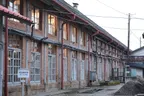
Tomioka Silk Mill: Japan's first government silk factory
Tomioka Silk Mill opened in Gunma in 1872 with French machines to teach Japan machine silk reeling. Who built it, who worked there, and why it is a World Heritage site. -
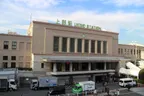
Ueno Station: Tokyo's gateway to the north
Ueno Station opened in 1883 as the Tokyo terminal of Japan's first private steam railway. Why trains for the north started here, its 1932 building and two levels of tracks, and what changed in 1985 and 2015. -
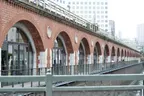
Under the tracks in Tokyo: the brick arches of Yūrakuchō and Kanda
Why restaurants and shops fill the space under the railway at Yūrakuchō and Kanda: a brick viaduct modeled on Berlin's and completed in 1910, and a station closed in 1943. -
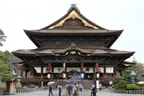
Zenkōji: the temple in Nagano that welcomes everyone
Zenkōji in Nagano belongs to no sect and has long taken in anyone. Its hidden Amida image, the Gokaichō held once in seven years, and its 1707 main hall.