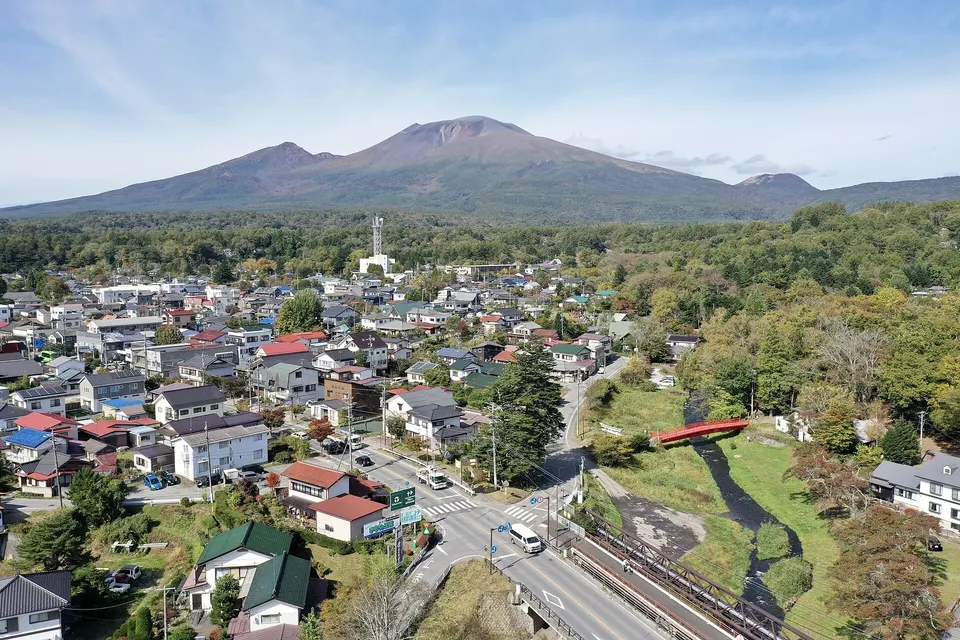
Karuizawa is a town in eastern Nagano Prefecture, on a plateau about 1,000 meters above sea level at the southeastern foot of Mount Asama, just west of the Usui Pass. A post town on the Nakasendō highway in the Edo period (1603–1868), it became a summer resort after a missionary, A. C. Shaw, spent the summer of 1886 there and built a villa in 1888, and after the railway over the pass arrived in 1893.
A plateau where August averages 20.8°C
The average temperature in Karuizawa in August is 20.8°C, against 26.9°C in Tokyo, and the average daily high in Karuizawa is 26.3°C. Larch and white birch grow on the plateau. About 19,000 people lived in the town in 2020, and at the height of summer the population swells to ten times that.
Mount Asama, on the border of Nagano and Gunma prefectures, is an active volcano 2,568 meters high. Its eruption of 1783 killed more than a thousand people, and the lava that came down the north slope hardened into Onioshidashi, a field of rock about 5 kilometers long.
Three post towns below the pass
In the Edo period the Nakasendō, the inland highway between Edo and Kyoto, came over the Usui Pass and ran through three post towns at the foot of Mount Asama: Karuizawa, Kutsukake and Oiwake. Pilgrims on their way to the temple Zenkōji and feudal lords traveling to and from Edo rested here after the climb.
The post town of Karuizawa had no rice paddies, only dry fields, and lived mainly on the traffic of the road. The 1783 eruption wrecked most of it. Its population fell from 1,395 in 1753 to 451 in 1843. After 1868 the post-station system was abolished, a new national road opened in 1883, and the post towns declined.
The summer of 1886
In 1886 Alexander Croft Shaw, a Canadian-born missionary of the Church of England, stopped at Karuizawa on a mission journey. He came back in early July of that year with his family and stayed until late August. Shaw recommended the place to other Westerners living in Japan. In May 1888 he built a villa, the first in Karuizawa. He called the climate "a hospital without a roof."
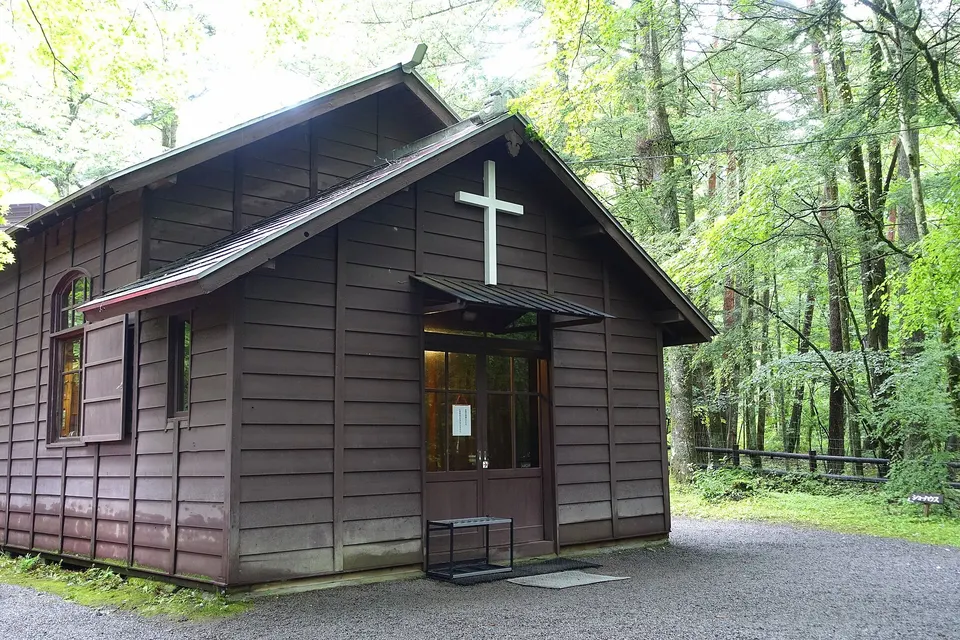
Shaw also founded a church in Karuizawa, now the Shaw Memorial Chapel, and his villa was later moved to a site behind the chapel as a memorial house. In August 1893 a Japanese naval captain built the first villa owned by a Japanese, and introduced Karuizawa to Japan's upper class as Shaw had introduced it to foreigners.
The railway climbs the pass
A horse tramway began running between Yokokawa, at the foot of the Usui Pass on the Gunma side, and Karuizawa in September 1888. In December of that year a railway from Naoetsu, on the Sea of Japan, reached Karuizawa. The gap was closed in April 1893, when the rack railway from Yokokawa opened and trains could run through between Ueno in Tokyo and Naoetsu. Karuizawa stands 553 meters higher than Yokokawa.
Until October 1997 every train over the pass stopped at Yokokawa while locomotives were coupled or uncoupled. From February 1958 that stop was where passengers ran along the platform to buy Tōge no Kamameshi, the ekiben in a clay pot.
Hotels and villas
Once the railway was complete, hotels opened and the number of summer visitors grew. Kameya, an inn of the old post town, had lodged Shaw in the summer of 1886. In 1894 its owner, Satō Mampei, remade it as a Western-style hotel for foreign guests, and in 1896 he renamed it the Mampei Hotel, a name foreigners found easier to say. John Lennon and his family stayed there for three summers, from 1977 to 1979.
A businessman began building the Mikasa Hotel in the summer of 1904, with Satō Mampei supervising the work. The building dates from 1905. It is a wooden hotel in a purely Western style, designed and built by Japanese hands, and so many figures from business and the arts stayed there that it was called the Rokumeikan of Karuizawa, after the hall built in Tokyo in 1883 for entertaining foreign guests. On May 31, 1980, the former Mikasa Hotel was designated an Important Cultural Property.
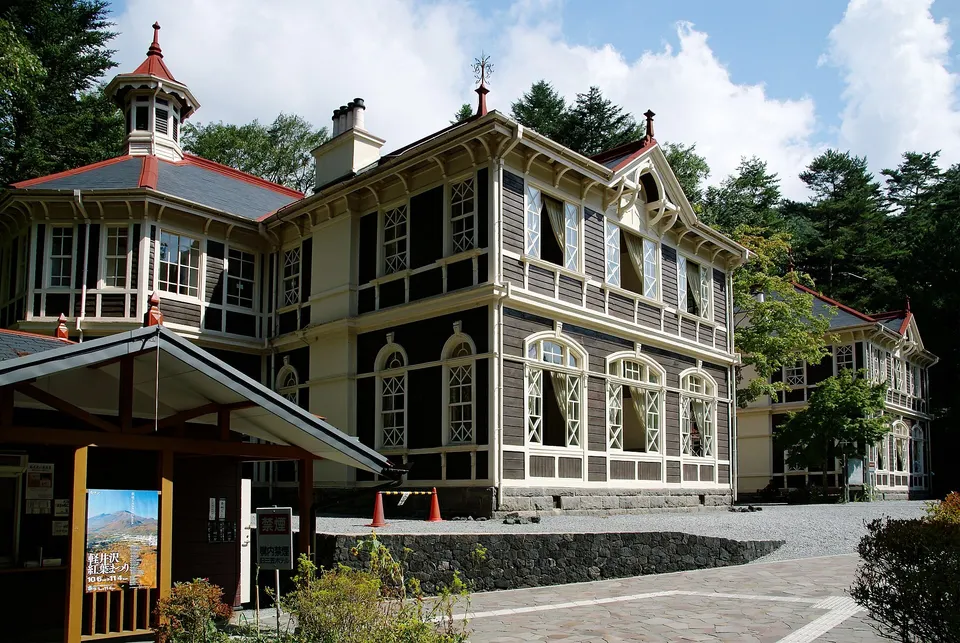
In August 1923 the village of Higashi-Nagakura became a town and took the name Karuizawa. It had 5,012 people. Until the 1930s Karuizawa was known as a villa district for foreigners, centered on old Karuizawa, and the Japanese who had villas were mostly politicians, businessmen and writers. The shopping street of old Karuizawa grew up on the site of the post town.
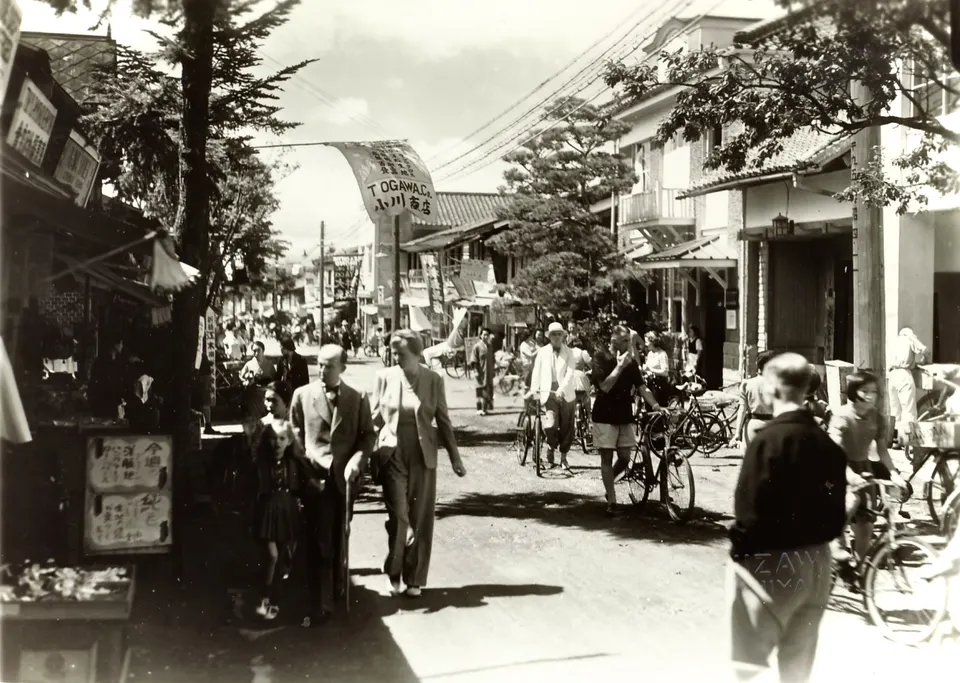
Writers came to Karuizawa as well, among them Murō Saisei, Arishima Takeo and Kawabata Yasunari. Hori Tatsuo first visited in 1923 and returned almost every year, setting a number of his works in Karuizawa. He lived at Oiwake from 1944 and died there in 1953.
After the war
In 1972 the town drew up guidelines of its own for protecting nature, with limits on the division of land, the height and color of buildings, and signs.
Villas spread to Naka-Karuizawa, the former Kutsukake, and to Minami-Karuizawa, south of the railway. By 1997 there were about 12,800 villas and 375 company lodges.
In 1964 the equestrian three-day event of the Tokyo Olympics was held in Karuizawa, with 48 athletes and officials from 12 countries. In 1998 the curling of the Nagano Winter Olympics was played at the Kazakoshi Park Arena.
1997: the Shinkansen arrives
On October 1, 1997, the Shinkansen from Takasaki to Nagano opened, and Tokyo was about an hour away. On the same day the old line between Yokokawa and Karuizawa was closed and replaced by buses, and the line from Karuizawa to Shinonoi passed to a new company, the Shinano Railway. Oginoya began selling Tōge no Kamameshi aboard the Shinkansen between Takasaki and Karuizawa that day.
On October 20 and December 1, 2018, for the 130th anniversary of the Shin-etsu Line, Tōge no Kamameshi was sold at Karuizawa Station in commemorative wrappers, a different design on each day.
References
- Town of Karuizawa, "Town handbook 2016: 130th anniversary of the health resort"
- Town of Karuizawa, "Profile of the town"
- Town of Karuizawa, "Cultural properties of the town"
- Town of Karuizawa, "Hori Tatsuo Memorial Museum of Literature"
- Japan Meteorological Agency, "Climate normals for Karuizawa (1991–2020)"
- Japan Meteorological Agency, "Climate normals for Tokyo (1991–2020)"
- Mampei Hotel, "About the hotel"
- Kotobank, "Karuizawa"
- Kotobank, "Karuizawa-shuku"
- Kotobank, "Mount Asama"
- Kotobank, "Onioshidashi"
- Oginoya, chronology
Image credits (resized for display):
- Charlie fong / Wikimedia Commons, CC BY-SA 4.0, 2024
- Daderot / Wikimedia Commons, CC0
- 663highland / Wikimedia Commons, CC BY-SA 4.0, 2007
- 土屋写真館 / Wikimedia Commons, Public domain, 1930