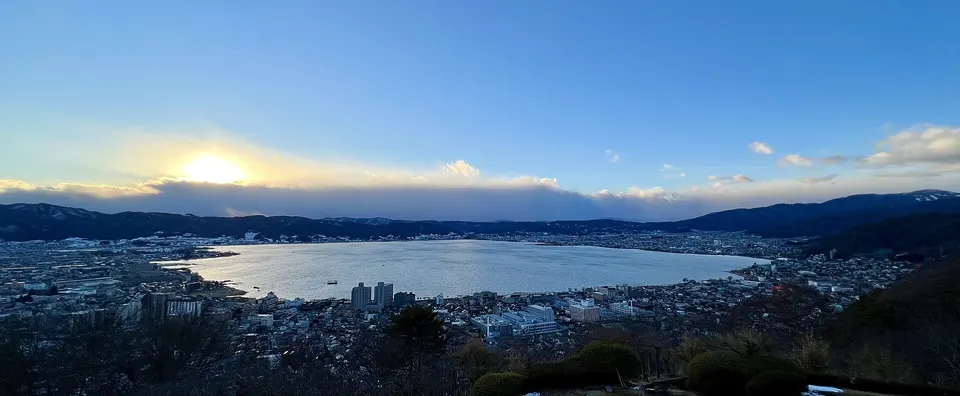
Suwa is the basin around Lake Suwa, in the middle of Nagano Prefecture, where the surface of the lake lies 759 meters above sea level. It is known for the ridges of ice that rise across the frozen lake, for Suwa Taisha, the head shrine of the roughly 10,000 Suwa shrines in Japan, and for Onbashira, the festival in which 16 fir logs are hauled out of the mountains by hand.
A shallow lake 759 meters up
Lake Suwa covers 13.3 square kilometers and is the largest lake in Nagano Prefecture. It is 7.2 meters deep at its deepest point. Thirty-one rivers flow into the lake and one flows out, the Tenryū River, which begins at a sluice gate in the city of Okaya.
The god's crossing
When the whole lake freezes and the temperature stays below minus 10 degrees Celsius for several days, the ice grows more than 10 centimeters thick. It shrinks at night and expands by day until it splits with a roar, throwing up a ridge 30 to 60 centimeters high from the southern shore to the northern shore.
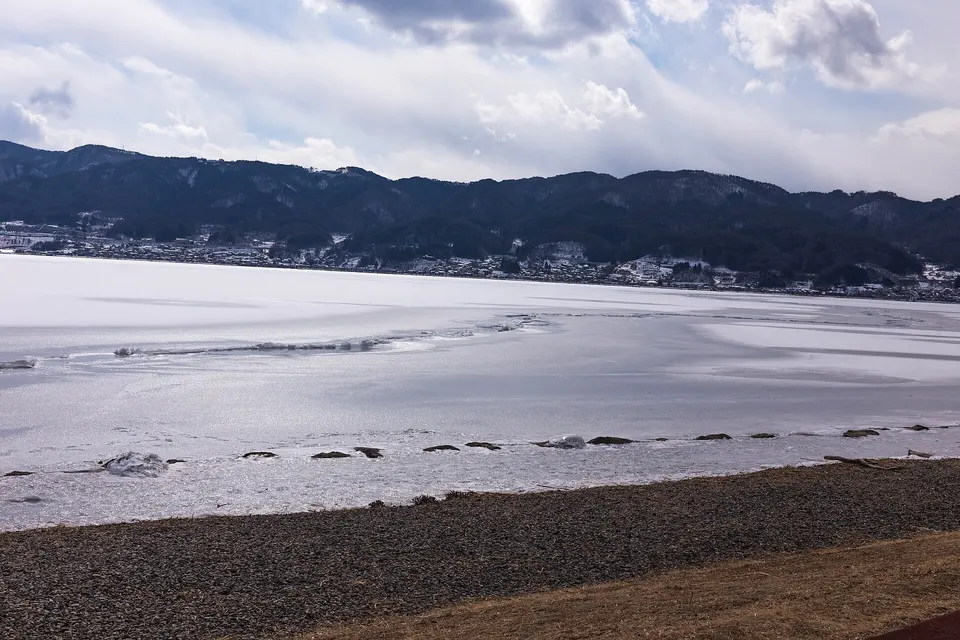
The ridge is called omiwatari, the god's crossing. In legend it is the path of the male god of the Upper Shrine of Suwa Taisha, south of the lake, on his way to the goddess of the Lower Shrine on the north side. Yatsurugi Shrine in the city of Suwa watches the lake every winter, and when the ridges have formed it holds a rite and declares an omiwatari.
Year-by-year records of the omiwatari survive from 1443, and they are used to study how Japan's climate has changed. Yatsurugi Shrine last held its rite on February 5, 2018. On February 4, 2026, in the 584th year of observation, the shrine announced that no omiwatari would form, for the eighth winter in a row.
Four shrines around the lake
Suwa Taisha is four shrines. The Upper Shrine consists of the Maemiya, in the city of Chino, and the Honmiya, in the city of Suwa, both south of the lake. The Lower Shrine consists of the Harumiya and the Akimiya, 1 kilometer apart in Shimosuwa on the north side.
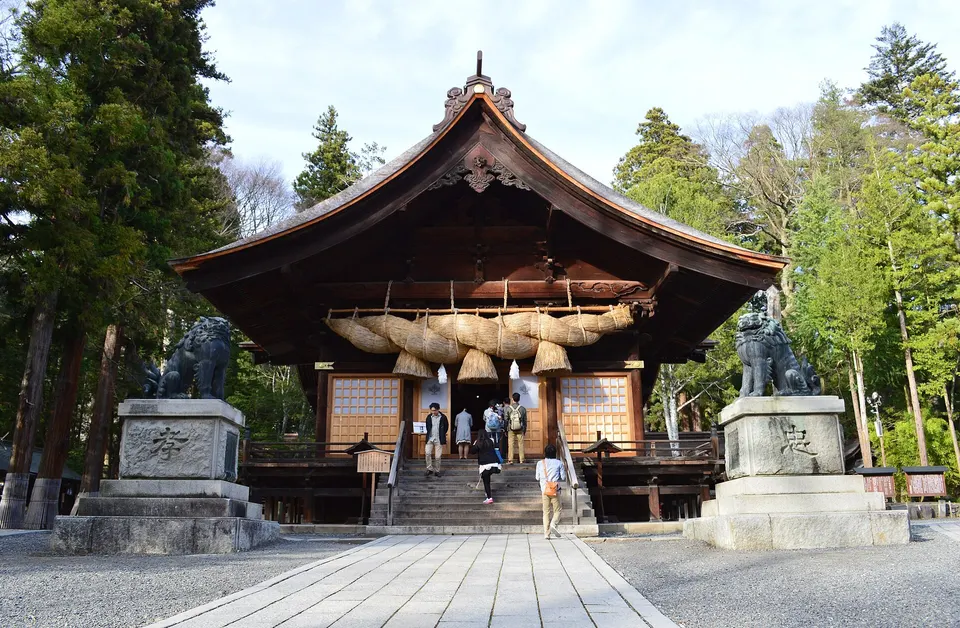
The Honmiya, the Harumiya and the Akimiya have no main sanctuary. The Upper Shrine reveres a mountain as the body of its deity, the Harumiya a cedar tree and the Akimiya a yew tree. The deities are Takeminakata no Kami and his consort, Yasakatome no Kami. In the myths of the Kojiki, Takeminakata alone refused when envoys from the heavenly realm demanded the land, was chased to "the sea of Suwa" and yielded there. In Suwa he has long been worshipped as the god who opened up the region, as a guardian of wind and water, and as a god of hunting, farming and war.
Sixteen fir logs
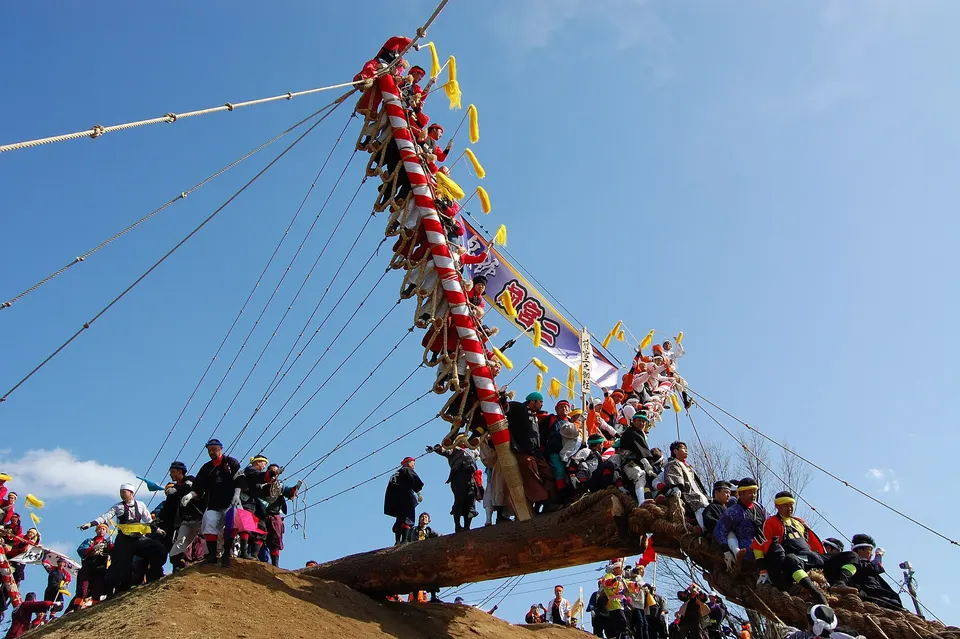
Onbashira is held in the years of the Tiger and the Monkey, which come six years apart. In Japan the festival year itself is counted as the first, so Onbashira is described as held once in seven years. The most recent Onbashira was in 2022, and the next falls in 2028. Fir trees are felled in the mountains, hauled to the four shrines and set upright, one at each corner of each shrine, 16 pillars in all.
The eight logs of the Upper Shrine come from a shrine-owned forest at the foot of the Yatsugatake mountains, about 25 kilometers away. The largest logs are nearly 17 meters long and weigh about 13 tons. No wheels or rollers are used: each log is dragged on ropes by 1,000 to 2,000 parishioners.
In April the logs are brought down from the mountains, and on the way each log is sent down a steep slope with men riding on it, a stage called kiotoshi, the log drop. The Upper Shrine's slope is 27 degrees, and the Lower Shrine's slope reaches 35 degrees and runs for about 100 meters. In May the logs are drawn to the shrines, and each log is raised by hand with men still riding on it.
Hot springs, a castle and a post town
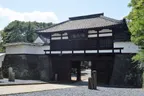
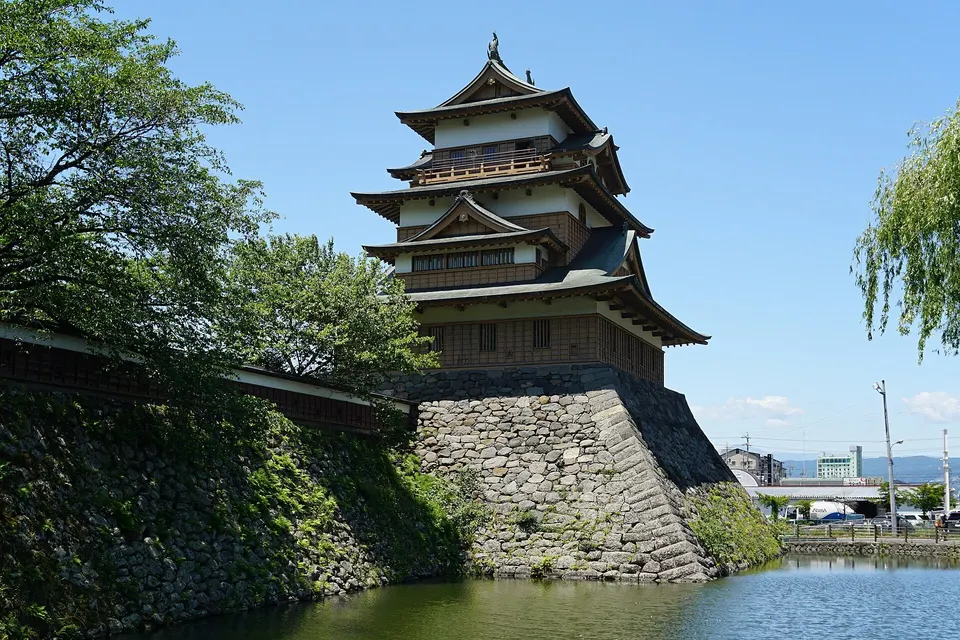
Kamisuwa, the center of the city of Suwa, has a hot spring with more than 500 sources on the eastern shore of the lake, first mentioned in writing in 1237. Kamisuwa was the castle town of the Suwa lords and a station on the Kōshū Kaidō, one of the five highways from Edo, today's Tokyo. Takashima Castle was built in 1592 out in the lake and was known as the floating castle. The castle's keep was rebuilt in 1970.
Shimosuwa grew up at the gate of the Lower Shrine. A station of the Nakasendō was set up there in 1602, below the Wada Pass, and the Kōshū Kaidō ended there. The station had hot springs of its own.
From silk to watches
A silk-reeling mill with Western-style machines was built in 1875 in the village of Hirano, now the city of Okaya. By 1930 Hirano had 53,000 people, about half of them women mill workers, and was the most populous village in Japan. Katakura, one of the large silk companies of Okaya, took over the Tomioka Silk Mill in 1939.
The economic depression of 1930 hit the silk mills hard, and some mills turned to making miso. During the Second World War, factories making watches and military optical instruments were evacuated from the Tokyo–Yokohama area into the mill buildings. After the war the towns around the lake made watches, cameras and music boxes, and the city of Okaya says that Okaya came to be called "the Switzerland of the East."
Oginoya, the maker of Tōge no Kamameshi, opened a drive-in in the city of Suwa on April 21, 1983, near the Suwa interchange of the Chūō Expressway. The plant next to that drive-in is one of the two plants where Tōge no Kamameshi is made. Oginoya also makes a kamameshi named for the lakeshore, Kohan no Kamameshi, with Nagano beef, yam and asparagus.
References
- Kotobank, "Lake Suwa"
- Kotobank, "Omiwatari"
- Kotobank, "Suwa Taisha"
- Kotobank, "Onbashira Festival"
- Kotobank, "Shimosuwa"
- Kotobank, "Kamisuwa Onsen"
- Kotobank, "Suwa"
- Kotobank, "Okaya"
- Suwa Taisha, "About Suwa Taisha"
- Suwa Taisha, "Shikinen Zōei Onbashira Taisai"
- Nagano Prefecture, Suwa Construction Office, "Kamaguchi Sluice Gate" (PDF)
- Suwa Tourism Association, "Omiwatari on Lake Suwa"
- Suwa Tourism Association, "No omiwatari declared for the eighth winter in a row" (February 2026)
- Suwa Regional Tourism Federation, Onbashira official site, "Yamadashi"
- Suwa Regional Tourism Federation, Onbashira official site, "Frequently asked questions"
- City of Okaya, "Welcome to Okaya"
- Oginoya, chronology
- Oginoya online shop, "Kohan no Kamameshi"
Image credits (resized for display):
- Irvin / Wikimedia Commons, CC BY 4.0, 2022
- Kzu06 / Wikimedia Commons, CC BY-SA 4.0, 2018
- Saigen Jiro / Wikimedia Commons, CC0, 2015
- C1815 / Wikimedia Commons, Public domain, 2010
- 663highland / Wikimedia Commons, CC BY 2.5, 2016