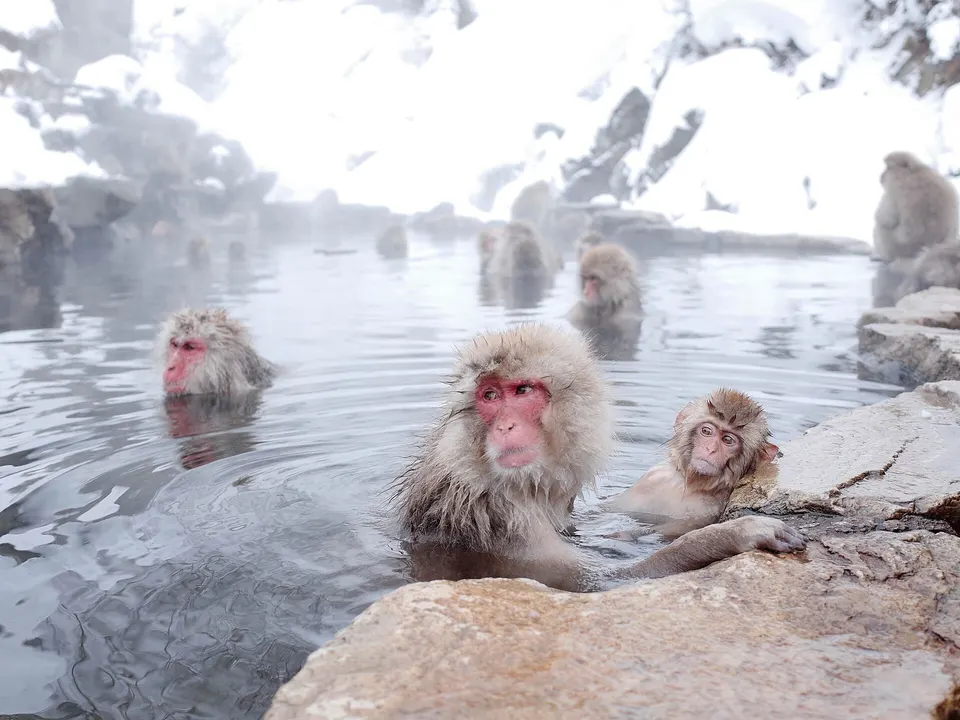
The monkeys that sit in the hot spring at Jigokudani, in the north of Nagano Prefecture, are wild Japanese macaques, and they go into the water to keep warm in a valley where winter temperatures fall below minus 10 degrees Celsius. The habit began in 1963, when a young female was seen in the outdoor bath of an inn in the valley. Other monkeys copied her, and the troop has handed the habit down from generation to generation.
A valley 850 meters up
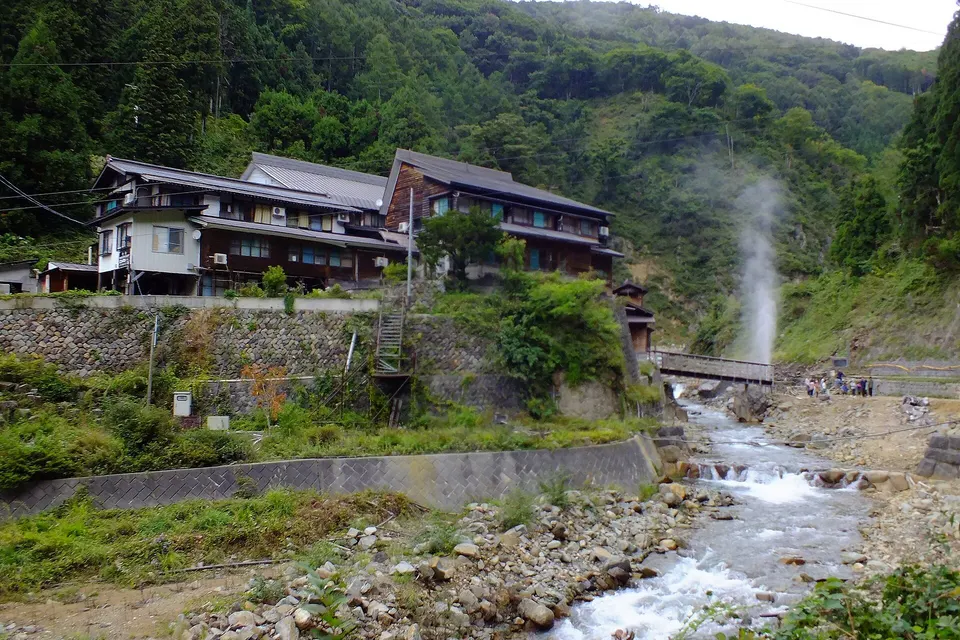
Jigokudani lies in the gorge of the Yokoyu River, which rises in Shiga Kōgen, the highland at the center of Jōshin-etsu Kōgen National Park. The valley is in the town of Yamanouchi, 850 meters above sea level. Snow covers Jigokudani for almost a third of the year and lies more than a meter deep in the coldest weeks of January and February, and in winter the sun does not reach the valley floor.
Steep cliffs close the valley in, and its hot springs send up steam without a pause, which is how people came to call the place Jigokudani, "hell valley." The geyser Shibu no Jigokudani Funsen throws hot water and steam into the air day and night, and it was designated a national Natural Monument on April 8, 1927.
The northernmost monkeys
The Japanese macaque, Macaca fuscata, is found only in Japan and is the only species of monkey that lives there. Japanese macaques range from the Shimokita Peninsula in Aomori Prefecture, at the northern end of Honshu, to the island of Yakushima in the south. They live farther north than any other primate except humans, and outside Japan they are known as snow monkeys.
An adult male measures 50 to 60 centimeters from head to rump and weighs 10 to 15 kilograms, and females are smaller. The tail is about 10 centimeters long. The face and rump are red and turn a deeper red in the mating season, from autumn into winter. In summer the coat is shed for short, glossy hair, which has grown long again by winter.
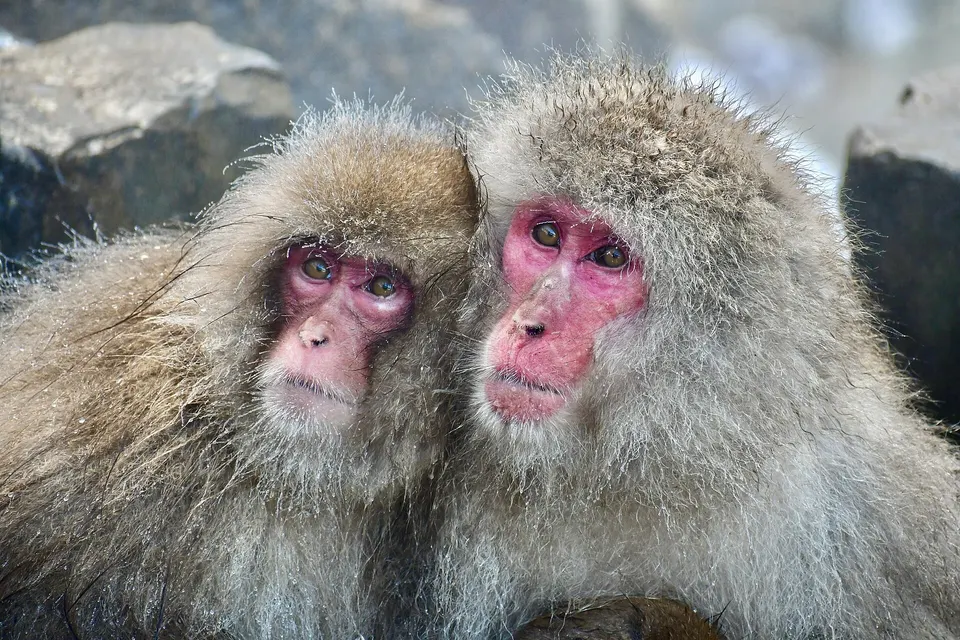
A troop is made up of several adult males, two to three times as many adult females, and their young. Females spend their whole lives in the troop where they were born, and males leave before they are fully grown. In winter the monkeys of Jigokudani have little to eat but bark and winter buds, and they press together against the cold.
One young monkey in 1963
Jigokudani Yaen-Kōen, a park where wild monkeys are drawn with food so that anyone can watch them at close range, opened in 1964. No fence or cage stands between the monkeys and the visitors.
The monkeys of Jigokudani did not always bathe. On a snowy day in 1963 a young female was seen in the outdoor bath of Kōrakukan, the one inn of Jigokudani Onsen, where the monkeys were being fed. Other young monkeys copied her, and then other members of the troop.
Monkeys in a bath used by people were a problem of hygiene, so an outdoor bath for the monkeys alone was built inside the park. By 2003 one in three of the troop's females bathed regularly. Adult males seldom go in. Hot-spring bathing is seen only among the monkeys of Jigokudani.
Only in the cold
The monkeys bathe from about December to March. In the heat of summer and in mild weather they have no need of the bath and stay out of it. On cold days of heavy snow more monkeys go in, and some stay for hours, dozing with their eyes shut. Some monkeys dislike the bath. None of them wash in it.
A monkey that climbs out of the bath in winter does not catch a chill. Animals covered in fur have few sweat glands and sweat little, so their body temperature does not change sharply. The capillaries at the ends of a macaque's limbs also narrow in the cold to hold in body heat, which is why macaques live barefoot on snow without frostbite.
What a hormone study found
That the monkeys bathe to keep warm was long a guess without physiological data behind it. A team led by a researcher at Kyoto University's Primate Research Institute tested the guess at Jigokudani and published the results in the journal Primates on April 3, 2018. The researchers studied 12 adult females from April to June and from October to December. They timed how long each female spent in the bath and measured, in the monkeys' droppings, the breakdown products of glucocorticoids, the stress hormones.
The females bathed more often in winter than in spring, and most often in the coldest periods. In winter, hormone levels were lower in the weeks when bathing was observed than in the weeks when it was not, and in spring there was no difference. High-ranking females spent longer in the bath than low-ranking females. About 500 visitors a day come to Jigokudani on average, and the team found that the visitors caused no rise in the monkeys' stress hormones.
A magazine cover and the Olympics
In 1970 the bathing monkeys of Jigokudani appeared on the cover of the American magazine Life. During the Winter Olympics held in Nagano in 1998, athletes, officials and reporters from around the world came to Jigokudani in large numbers, and the bathing monkeys became widely known around the world.
Visitors to the park may not feed the monkeys, touch them or stare into their eyes at close range, which among macaques is a sign of hostility.
Shibu and Yudanaka, below the valley
Downstream from Jigokudani, the town of Yamanouchi has the hot springs of Shibu and Yudanaka. Shibu is said to have been discovered by the monk Gyōki between 724 and 729, and it has nine communal bathhouses. Yudanaka stands on the old road that crosses Shiga Kōgen to Kusatsu Onsen, in Gunma Prefecture.
The Nagano Electric Railway, which runs from Nagano, the city that grew up at the gate of the temple Zenkōji, reached Yudanaka in 1927. The Shinkansen from Tokyo to Nagano opened on October 1, 1997, in time for the Olympics of February 1998. On that day Tōge no Kamameshi, the ekiben (station bento) in a clay pot that Oginoya had sold since 1958 at Yokokawa Station, at the foot of the Usui Pass, went on sale aboard the Shinkansen between Takasaki and Karuizawa.
References
- Jigokudani Yaen-Koen, "About Jigokudani Yaen-Koen"
- Jigokudani Yaen-Koen, "Learn about the monkeys"
- Jigokudani Yaen-Koen, "Monkeys that bathe in the hot spring"
- Jigokudani Yaen-Koen, "A year at the park"
- Jigokudani Yaen-Koen, "Rules for visitors"
- Kyoto University, "Japanese macaques of Jigokudani relieve stress by bathing in hot springs" (April 4, 2018)
- Takeshita, Bercovitch, Kinoshita and Huffman, "Beneficial effect of hot spring bathing on stress levels in Japanese macaques," Primates 59, 215–225 (2018)
- Agency for Cultural Affairs, database of nationally designated cultural properties, "Shibu no Jigokudani Funsen"
- Kotobank, "Nihonzaru" (Japanese macaque)
- Kotobank, "Jigokudani Onsen"
- Kotobank, "Shibu Onsen"
- Kotobank, "Yudanaka Onsen"
- Kotobank, "Shiga Kōgen"
- Oginoya, chronology
Image credits (resized for display):