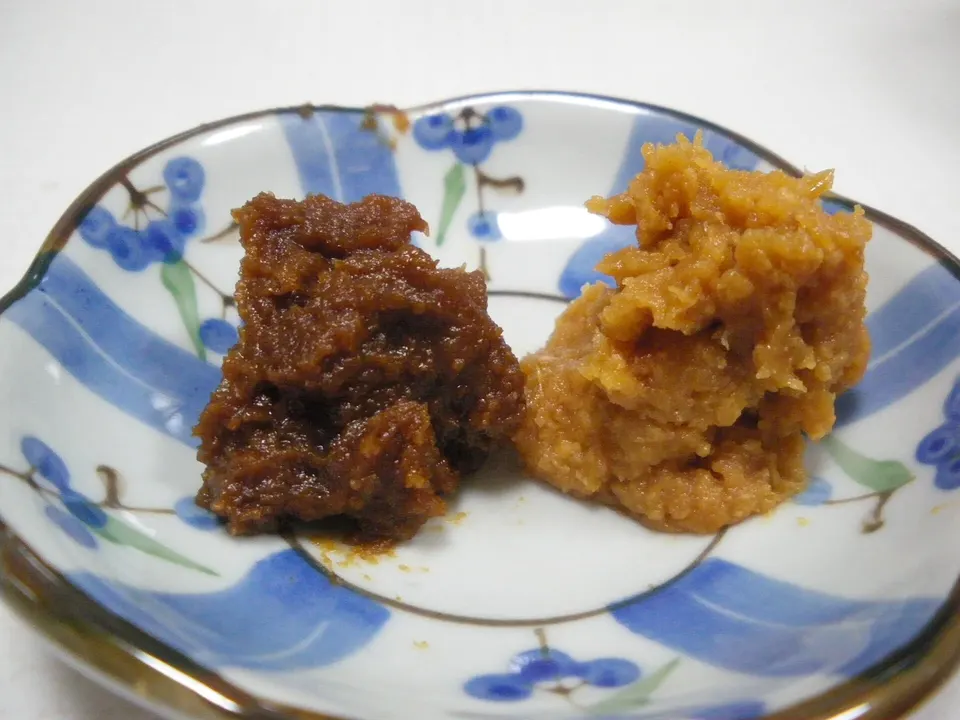
Miso is a seasoning made by fermenting steamed, mashed soybeans with salt and kōji, steamed rice, barley or soybeans on which a mold has been grown. What the kōji is made from gives the three basic kinds, rice miso, barley miso and soybean miso, and each is sorted further by color into red, light and white, and by salt into sweet and salty.
Soybeans, kōji and salt
Rice miso is the most common kind. For its kōji, polished rice is washed, soaked overnight, steamed, cooled and dusted with kōji spores, then kept at 30°C for about 40 hours. The soybeans are soaked, steamed and mashed, mixed with the rice kōji and salt, and packed tightly into a vat with a little water carrying yeast and lactic acid bacteria. As the miso ages, enzymes break its ingredients down into amino acids, sugars, alcohols and esters, and these make the flavor. Held at 25 to 30°C, the main fermentation is over in two to three months.
Barley miso is made the same way, with barley in place of rice. Soybean miso uses neither grain: the steamed soybeans are mashed and shaped into balls, the mold is grown on the balls themselves, and they are packed with salt and water and fermented for three months or more.
Rice, barley and soybean miso
Japan's miso makers shipped 365,617 tonnes in 2025. Of that, 83.8 percent was rice miso, 3.4 percent barley miso and 4.1 percent soybean miso. The other 8.6 percent was blended miso, which is two or more kinds of miso mixed together, or miso brewed with more than one kind of kōji.
Rice miso is made all over the country, and barley miso mainly in Kyushu and parts of the Chūgoku and Shikoku regions. Soybean miso comes mainly from three prefectures, Aichi, Mie and Gifu, where summers are hot and humid and miso made with rice or barley kōji sours easily.
Miso is heavy and was hard to transport, so each part of Japan made its own. Households made miso too, each with a different taste, and temae miso, "my own miso," is still the expression for singing one's own praises.
Red and white, sweet and salty
Sweet miso contains 6 to 7 percent salt and salty miso about 10 to 13 percent. Color and flavor change with the proportions of the ingredients and the length of aging. For light-colored miso, the soybeans are boiled in water instead of steamed. Kyoto's white miso, called Saikyō miso, is made from hulled soybeans, which are boiled, and a high proportion of kōji from well-polished rice, and it ages for only a week to ten days. The barley miso of Kantō, the region around Tokyo, has little kōji, ages for a long time and is red and salty, while the barley miso of Kyushu ages for a shorter time and is mostly sweet and light in color.
| Miso | Kōji | Where it is made | Color and taste |
|---|---|---|---|
| Edo sweet miso | Rice | Tokyo | Red, sweet |
| Sendai miso | Rice | Sendai, Miyagi Prefecture | Red, salty |
| Shinshu miso | Rice | Nagano Prefecture | Light, salty |
| Saikyō miso | Rice | Kyoto | White, sweet |
| Kyushu barley miso | Barley | Kyushu | Light or reddish brown, mostly sweet |
| Hatchō miso | Soybean | Okazaki, Aichi Prefecture | Dark brown, salty |
Shinshu, Sendai and Hatchō
Shinshu miso is the light-colored, salty rice miso of Nagano Prefecture, and a bright, glossy golden yellow is considered the mark of good quality. In 1923 the Great Kantō Earthquake damaged many miso makers in and around Tokyo, and the miso sent from Nagano as relief supplies was well received. In the depression of the early Shōwa era (1926–1989), the silk mills of the Suwa area in Nagano closed. The mills had made miso for their own workers, and with that skill miso production began in the empty buildings. Suwa is also where Oginoya opened a drive-in in 1983. In 2020 shipments of Shinshu miso passed 200,000 tonnes a year, more than half of the national total.
Sendai miso is a salty red rice miso, said to go back to the miso that the lord Date Masamune had made for his army in the field. The Sendai domain's miso storehouse, the Oensogura, began production in 1645.
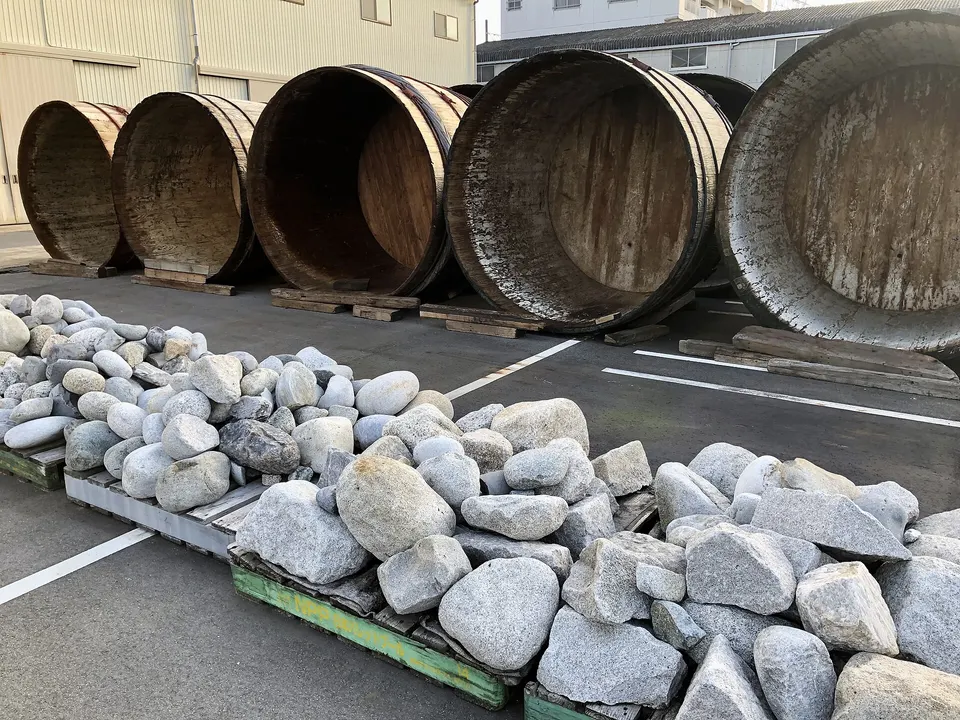
Hatchō miso is the soybean miso of Okazaki in Aichi Prefecture. It is named after Hatchō, the village where it was made, which lay eight chō (hatchō), about 870 meters, west of Okazaki Castle. It is made from soybeans and salt alone, with little water, packed into wooden vats under a pyramid of stacked stones and aged for more than two years.
From mishō to miso
Two fermented seasonings, hishio and kuki, are thought to have reached Japan from the Asian mainland shortly before the Nara period (710–794). The Taihō Code of 701 lists a third beside them, written 未醤, read mishō or miso, and made at an office of the court kitchens. This 未醤 is considered the forerunner of miso. The characters now used, 味噌, first appear in a chronicle compiled at the end of the Heian period (794–1185).
In the Kamakura period (1185–1333) Zen temples made miso and other soybean foods in quantity. In the Warring States period, the civil wars that began in 1467, miso was valued as food for soldiers. Over the Muromachi period (1336–1573) and after, the solid part of such ferments became miso and the liquid part became soy sauce. Until soy sauce spread in the Edo period (1603–1868), miso was the seasoning with the widest range of uses.
Miso soup and beyond
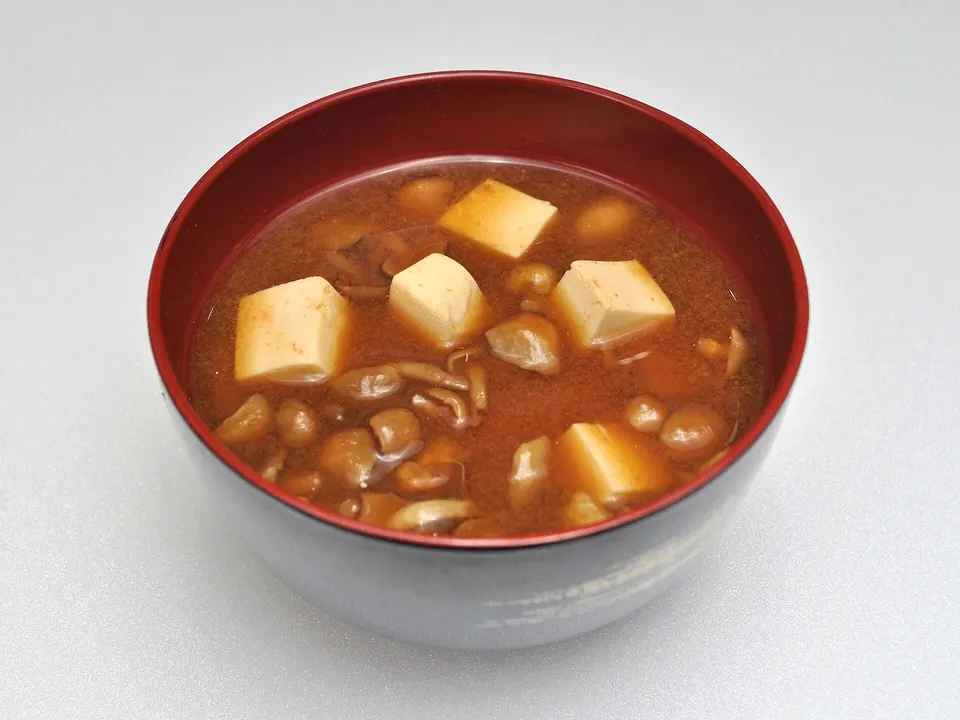
Miso soup is dashi with vegetables, tofu, seaweed or shellfish in it and miso dissolved into it. The miso goes in just before the soup is served, and the soup is not boiled again, because boiling drives off the aroma of the miso. Akadashi is a dark miso soup made with Sanshū miso, another name for the soybean miso of Okazaki.
Miso also removes smells, because its proteins take up odors. Mackerel simmered in miso, the oyster hot pot dote-nabe and the wild boar hot pot botan-nabe all use this property. Vegetables, fish and beef are pickled in miso. For dengaku, tofu, taro or konnyaku is dressed with miso flavored with yuzu, sesame or the young leaves of the sanshō pepper tree. Fukagawa-meshi, a rice bowl from Kōtō Ward in Tokyo, is said to have begun as green onion and raw clams simmered briefly in miso and poured over rice.
References
- Kotobank, "Miso" (Heibonsha World Encyclopedia and others)
- Kotobank, "Miso" (Encyclopedia Nipponica)
- Kotobank, "Hatchō miso"
- Kotobank, "Shinshu miso"
- Kotobank, "White miso"
- Kotobank, "Miso soup"
- Kotobank, "Sendai miso"
- Kotobank, "Soybean miso"
- Kotobank, "Warring States period"
- Japan Federation of Miso Manufacturers Cooperatives, "Miso shipments by type, 2000–2025" (PDF)
- Nagano Prefecture Federation of Miso Manufacturers Cooperatives, "About Shinshu miso"
- Ministry of Agriculture, Forestry and Fisheries, aff magazine, February 2021, on soybean foods
- Ministry of Agriculture, Forestry and Fisheries, Traditional Foods of Japan, "White miso" (Kyoto)
- Aichi Now (Aichi Prefecture official tourism site), "The miso of Mikawa"
- Oginoya, chronology
- Ministry of Agriculture, Forestry and Fisheries, Our Regional Cuisines, "Fukagawa-meshi / Fukagawa-don" (Tokyo)
Image credits (resized for display):
- Kentin / Wikimedia Commons, CC BY-SA 3.0, 2009
- Evelyn-rose / Wikimedia Commons, CC0, 2023
- Ocdp / Wikimedia Commons, CC0, 2021