Japanese chopsticks, hashi, are held about two-thirds of the way up from the tips, with the lower stick kept still and only the upper stick moved. A set of named habits called kirai-bashi is treated as bad manners, and two of those habits, standing chopsticks upright in rice and passing food from one pair of chopsticks to another, are avoided because they recall funeral rites.
How to hold them
The upper stick is held the way a pencil is held. The lower stick passes between the middle finger and the ring finger and stays fixed there. To pick something up, the thumb, index finger and middle finger move the upper stick, and opening or closing the tips lets the chopsticks grasp food of any size.
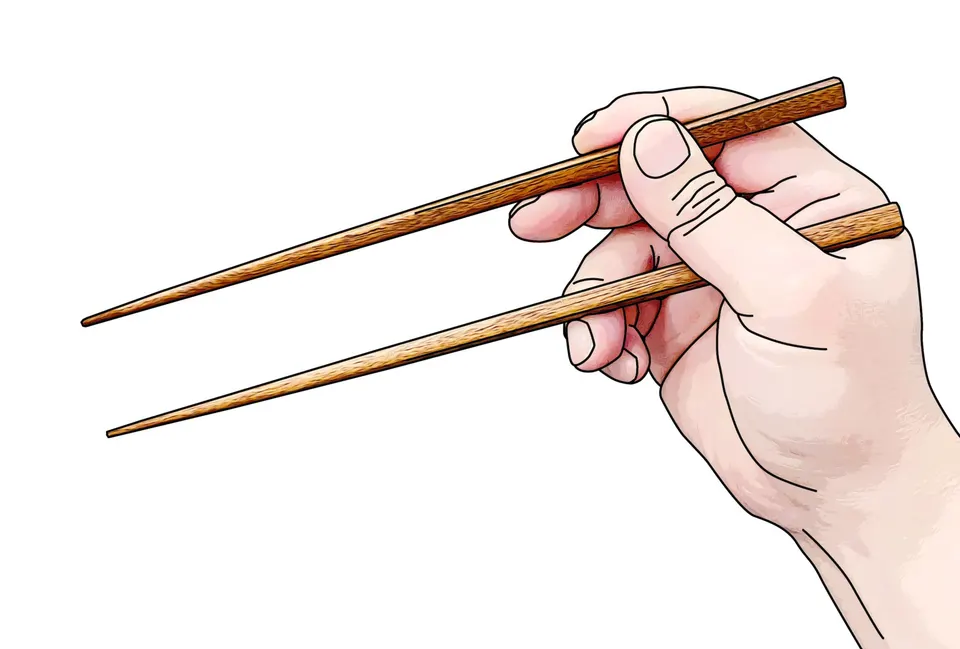
A comfortable length is one and a half times the span between the thumb and the index finger opened at a right angle: about 22.5 centimeters for an adult man and 21 centimeters for an adult woman.
A meal eaten with chopsticks alone
Chopsticks are the everyday eating tool in China, the Korean Peninsula, Vietnam and Japan. At the Japanese court of the Heian period (794–1185), chopsticks and a spoon were set out together on a footed dish, and the spoon gradually fell out of use. A Japanese meal, washoku, is eaten with chopsticks alone, which is why Japanese chopsticks taper to fine tips. Soup is drunk from the bowl: the bowl is lifted with both hands, the right hand then takes up the chopsticks, and the chopsticks hold back the solid pieces.
At home, each member of a family commonly has a pair that differs from the others in size, color, pattern or material, so that the pairs are not mixed up.
Kirai-bashi: the habits with names
Kirai-bashi, "disliked chopsticks," are ways of using chopsticks that are regarded as bad manners. They include the following.
| Name | What it describes |
|---|---|
| Utsuri-bashi (移り箸) | Starting to take from one dish, then moving the chopsticks to a different dish |
| Mayoi-bashi (迷い箸) | Moving the chopsticks about over the dishes while deciding which to take |
| Sashi-bashi (刺し箸) | Spearing food that is hard to pick up, such as simmered taro |
| Sashi-bashi (指し箸) | Pointing at a person or a thing with the chopsticks during the meal |
| Watashi-bashi (渡し箸) | Laying the chopsticks across a dish partway through the meal |
| Yose-bashi (寄せ箸) | Pulling a distant dish closer with the chopsticks |
| Neburi-bashi (ねぶり箸) | Licking the tips of the chopsticks |
| Tate-bashi (立て箸) | Standing the chopsticks upright in the middle of a bowl of rice |
| Hashi-watashi (箸渡し) | Passing food from one pair of chopsticks to another pair, or two people picking up one piece together |
Washoku is properly eaten by going back to the rice between one side dish or soup and the next. The accepted form, in place of utsuri-bashi, is to alternate side dishes with rice. Watashi-bashi is avoided by using a chopstick rest or, where there is none, by folding the paper sleeve of disposable chopsticks into a rest.
Two habits that recall funerals
Tate-bashi is also called hotoke-bashi. When someone dies, a bowl of rice is placed at once beside the dead person's pillow: the rice is heaped high in the bowl the person used in life, and chopsticks are stood upright in it. Chopsticks standing in rice at an ordinary meal call that offering to mind.
Hashi-watashi was first the name of a rite. After a cremation, fragments of bone are passed from chopsticks to chopsticks into the urn, or two people lift one fragment together with their chopsticks. Doing the same with food at the table resembles the rite.
Waribashi, the disposable kind
Waribashi are chopsticks split only partway along their length, pulled apart by the person about to eat and used once. They were devised as disposable personal chopsticks at the end of the Edo period (1603–1868) and spread quickly through eating places. In the Yoshino district of Nara Prefecture, cedar chopsticks began to be made in quantity in the Meiji era (1868–1912) from the offcuts of sake barrels, as eating out became more common. Waribashi produced in Japan are made from forest thinnings and from the offcuts of timber for houses and furniture.
The shapes have names: chōroku is the plain form with a split and nothing more, genroku has a groove along the split and its four edges shaved off, and tensoge has the top end sliced at a slant.
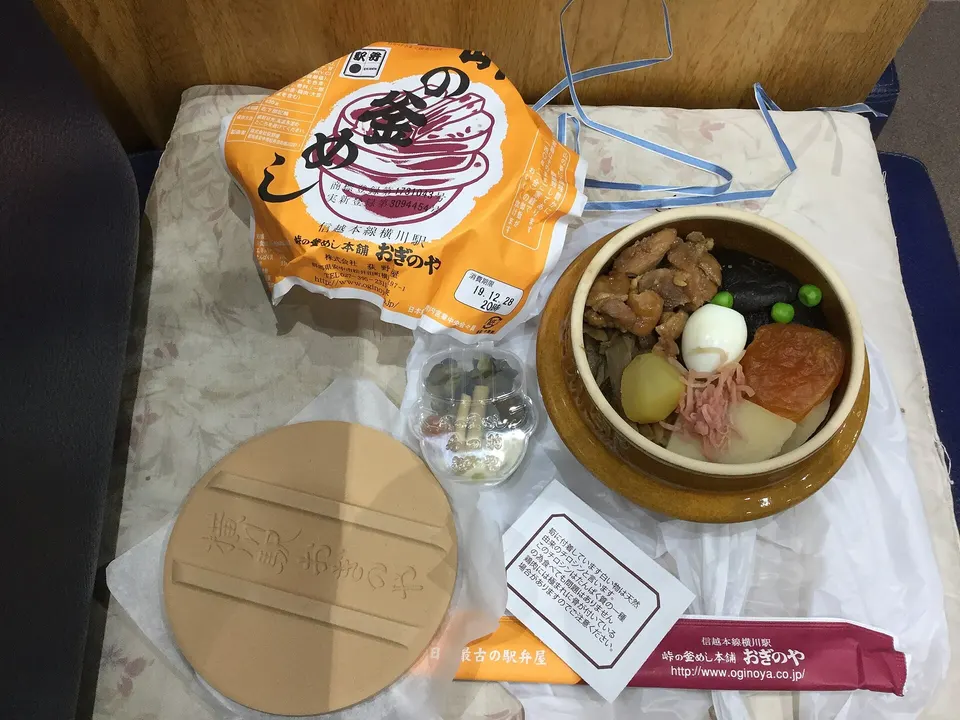
A hashibukuro is the rectangular paper sleeve that holds the tips or the whole pair. It is used mostly for the waribashi of eating places and often carries the name of the shop. The sleeve photographed with Tōge no Kamameshi, the ekiben of Yokokawa Station, is printed with the name of its maker, Oginoya.
Lacquered, festive and kitchen chopsticks
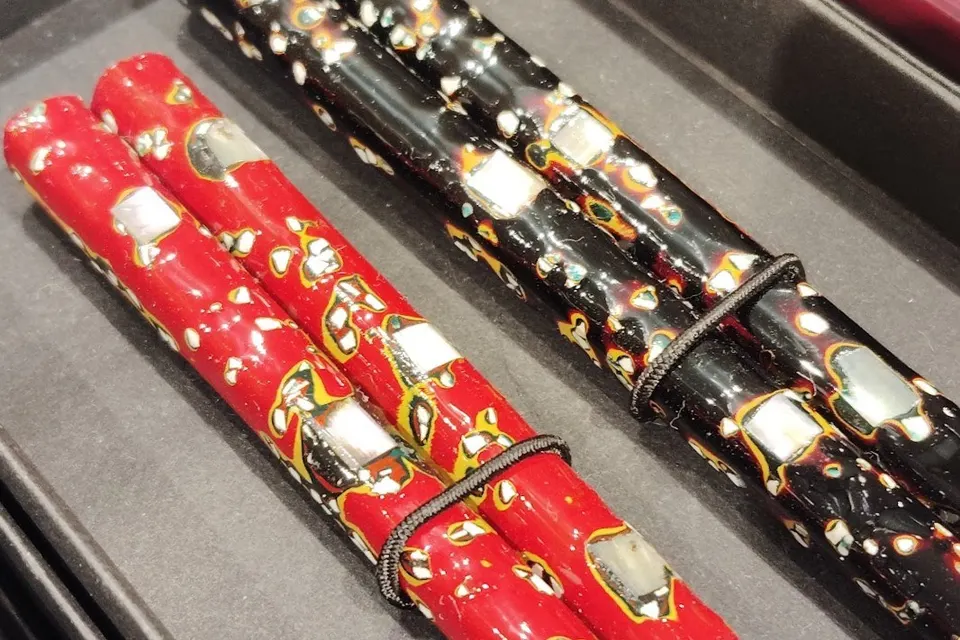
Nuribashi, wooden chopsticks coated with lacquer, are the everyday personal kind. Eighty percent of Japan's lacquered chopsticks are made in Obama, Fukui Prefecture, the home of Wakasa lacquerware. The craft began there in the Keichō era (1596–1615). Its method, perfected in the Manji era (1658–1661), builds a pattern from eggshell powder and rice husks, covers the pattern with colored lacquer and gold and silver leaf, and polishes the surface down until the pattern shows. On August 4 Obama holds a chopstick festival at which a memorial service is held for chopsticks.
Iwai-bashi, festive chopsticks, are made of plain white wood such as willow and taper at both ends. They are used at celebrations, above all at the New Year table, and willow was chosen because it does not break easily. Saibashi are cooking chopsticks, mostly bamboo. Toribashi are serving chopsticks, one pair set out with each shared dish.
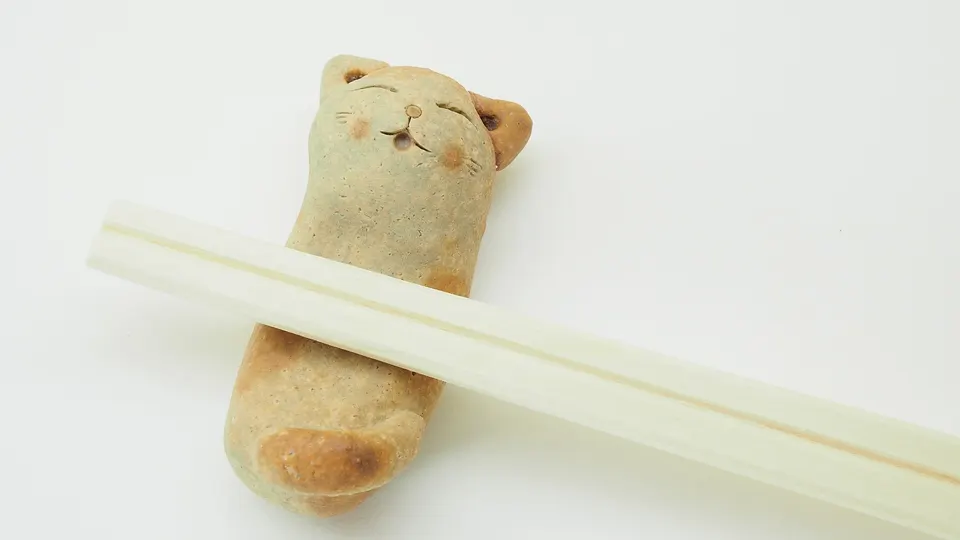
A hashioki is the small rest on which the tips are laid at the table. Rests are made of ceramic and many other materials.
How long Japan has used chopsticks
When chopsticks were first used in Japan is not known. The Wei zhi, a Chinese chronicle, describes the people of Yayoi-period Japan as eating with their hands. Chopsticks appear in the myth of the god Susanoo in the Kojiki, completed in 712, and by the Nara period (710–794) eating with a pair of chopsticks was already common practice.
References
- Kotobank, "Hashi" (chopsticks)
- Kotobank, "Kirai-bashi"
- Kotobank, "Hashi-watashi"
- Kotobank, "Makura-meshi"
- Kotobank, "Waribashi"
- Kotobank, "Wakasa-nuri"
- Ministry of Agriculture, Forestry and Fisheries, aff magazine, May 2016, "The story of chopsticks (1)"
- Ministry of Agriculture, Forestry and Fisheries, aff magazine, May 2016, "The story of chopsticks (2)"
- Ministry of Agriculture, Forestry and Fisheries, consumer consultation, "The correct way to use chopsticks"
- Obama City, "Traditional industries"
- Japan Patent Office, regional collective trademarks, "Yoshino sugi-bashi"
Image credits (resized for display):