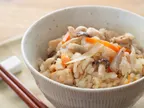
Donburi is a meal in one bowl: rice in a deep bowl, with a topping cooked separately laid over it and its sauce or broth poured on. The bowl gave the dish its name. Donburi began with grilled eel in Edo, the city that is now Tokyo, and from the late 19th century chicken and egg, beef and tempura followed, and then pork cutlet.
The bowl came first
A donburi is a thick, deep ceramic bowl, also called a donburi-bachi, that holds about three times as much as an ordinary rice bowl. The word appears from the end of the 17th century. At that time the bowl was used mainly for soba noodles in broth. The menu of a dinner that a shogunal retainer gave for a restaurant owner in 1781 lists a "Nanking blue-and-white donburi" alongside flat dishes and large bowls. The name is said to imitate the sound of something dropped into water, though that is uncertain.
Rice in a donburi with a seasoned topping and its sauce is a donburi-mono, and the bowl's name alone also means the dish. In the names of individual dishes the word shrinks to -don. A dictionary of new words published in 1919 explained don as short for donburi, with tendon (tempura) and unadon (eel) as its examples.
Eel in the rice
Unadon, grilled eel over hot rice with its sauce, is regarded as the first donburi-mono. In the Bunsei era (1818–30) Ōkubo Imasuke, who put money into theater productions, had eel sent to the theater's dressing rooms almost every day from a shop called Ōnoya. Until then the rice came in a bowl and the eel came separately, kept warm. Imasuke had the shop bury the eel in the hot rice, so that the eel stayed warm, and the story goes that unadon began there. Eel on rice with sauce poured over was simple and good, ordinary townspeople took to it, and it gave rise to the word donburi-mono.
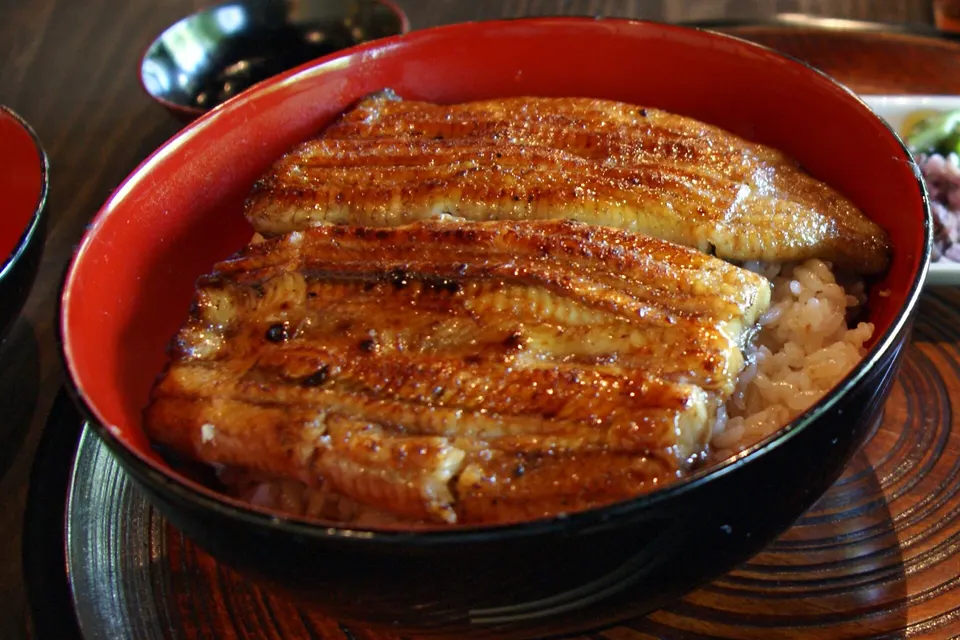
Eel over rice with sauce, served in a jūbako, is unajū. A jūbako is a lidded box, usually lacquered, made to be stacked in tiers. Unajū can also mean rice in the lower box and eel in the upper box.
Sauce over the top
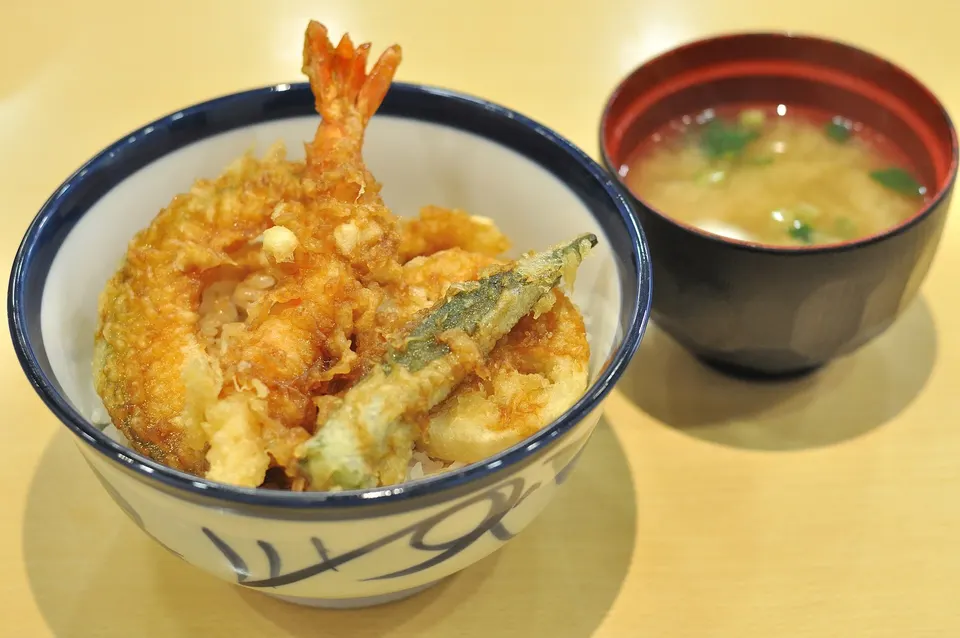
Tendon, short for tempura donburi, is tempura over rice with a strong sauce poured over it. The word is recorded in a book on the customs of Tokyo published between 1899 and 1902.
Butadon is thick slices of pork coated in a sauce of sugar and soy sauce and set on rice. It is said to come from Obihiro, in the Tokachi region of Hokkaido. Pig farming began in Tokachi at the end of the Meiji era (1868–1912). Early in the Shōwa era (1926–89) a diner in Obihiro wanted to serve eel, found eel expensive and hard to get, and grilled pork over charcoal with a sauce in the style of grilled eel.
Bound with egg
Oyakodon is chicken simmered with green onion and shiitake, bound with egg and laid over rice. Accounts of its origin differ. The account told in Tokyo starts around 1887 at Tamahide, a shamo (gamecock) restaurant founded in 1760. Customers finishing a chicken sukiyaki there bound the leftover meat and seasoned stock with egg and ate it with rice, and called it oyako-ni. In 1891 Toku, the wife of the restaurant's fifth-generation owner, put oyako-ni on rice as a dish of its own. At first Tamahide made its oyakodon only for delivery.
Made with beef or pork in place of the chicken, the bowl is a tanindon. Tanin means "unrelated people": the meat and the egg are no kin. Tanindon is thought to date from the middle of the Taishō era (1912–26).
Katsudon was devised after the Western cutlet had become tonkatsu, the Japanese breaded pork cutlet. The tonkatsu is simmered with sliced onion in a sweet and salty broth, bound with egg and laid over rice. The word katsudon appears in print in 1931.
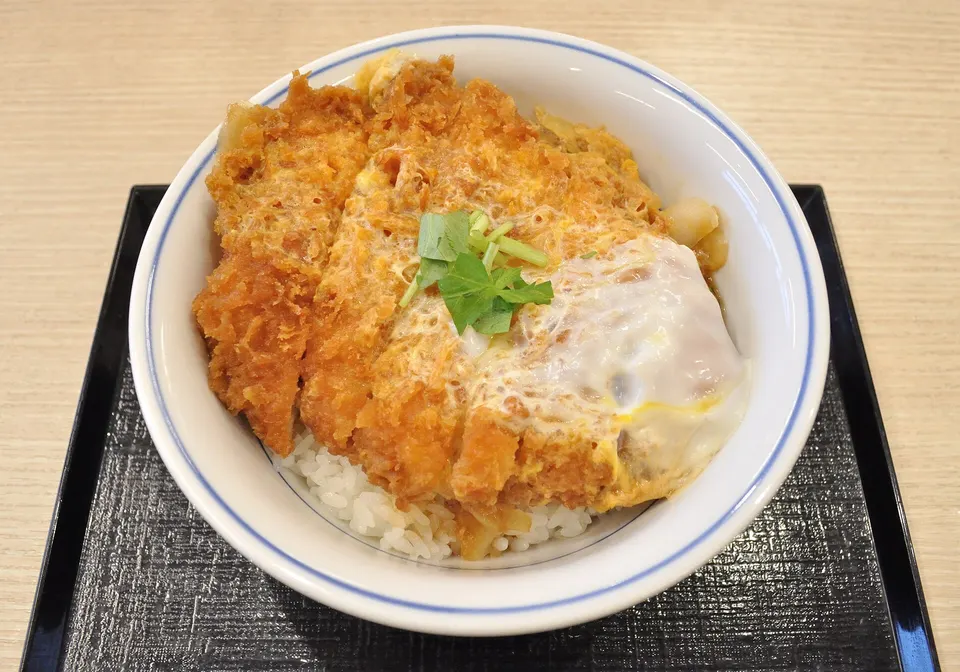
Some regions make katsudon without egg. In Kiryū, in Gunma Prefecture, the word katsudon means sōsu katsudon, "sauce katsudon": a freshly fried cutlet dipped in sauce and set on rice. Niigata's tare-katsudon, which dates from early in the Shōwa era, has two or more thin cutlets dipped in a sweet soy sauce.
Simmered and ladled over
Gyūdon is thinly sliced beef simmered sweet and salty with onion and poured over rice together with its broth. Under its other name, gyūmeshi, it spread from the middle of the Meiji era, when specialist shops hung out 牛めし signs. In 1899 the founder of Yoshinoya came from Osaka to Nihonbashi in Tokyo, which then had Japan's largest fish market, and opened a gyūdon shop with a recipe made to suit the people who worked at the market. The shop served its gyūdon in bowls of Arita ware, and besides beef belly and onion the bowl held bamboo shoot, konnyaku noodles and grilled tofu.
Fukagawa-meshi, also called Fukagawa-don, dates from the later part of the Edo period (1603–1868). Fukagawa, in what is now Kōtō Ward in Tokyo, was a fishing town with plentiful clams, and the dish is said to have begun as green onion and raw clams simmered briefly in miso and poured, broth and all, over rice. The clams were at first mainly bakagai, a surf clam; asari, the short-neck clam, came into use from the Meiji era.
A second form of Fukagawa-meshi cooks the clams into the rice, as kamameshi cooks its ingredients with the rice in a small pot. The cooked-together form has also been sold as an ekiben, the boxed meal of Japan's railway stations.
Raw fish on rice
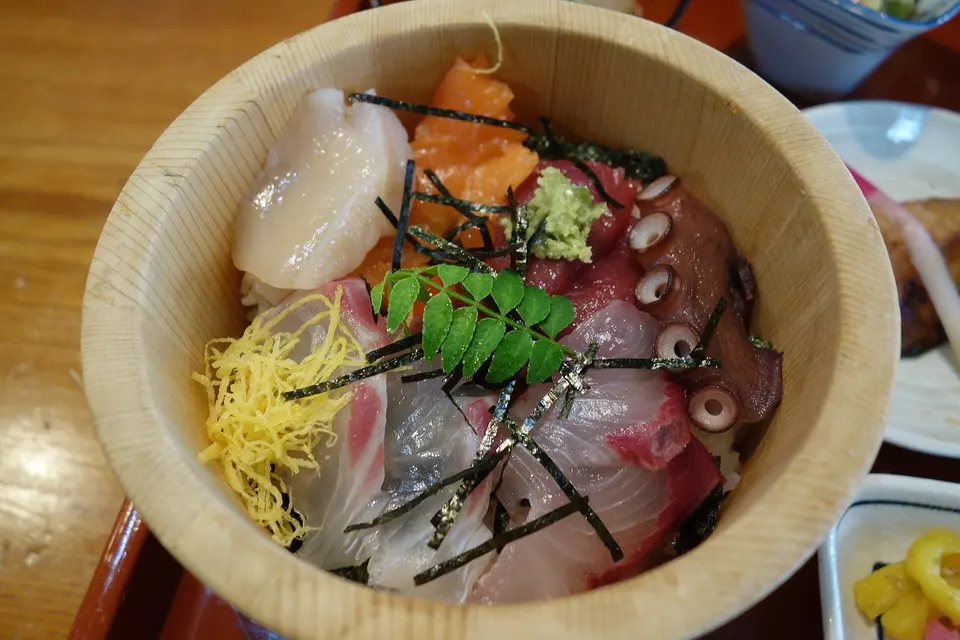
Tekkadon is slices of lean raw tuna on vinegared sushi rice, with wasabi and crumbled nori. It is an adaptation of tekkamaki, a sushi roll, and the name has been in general use since the first years of the Taishō era. Kaisendon is an assortment of fresh seafood, such as tuna and salmon roe, laid over a bowl of rice.
References
- Kotobank, "Donburi-mono" (Japanese dictionaries and encyclopedias)
- Kotobank, "Donburi" (Japanese dictionaries and encyclopedias)
- Kotobank, "Unajū" (Japanese dictionaries)
- Kotobank, "Tendon" (Japanese dictionaries)
- Kotobank, "Katsudon" (Japanese dictionaries and encyclopedias)
- Kotobank, "Fukagawa-meshi" (Japanese dictionaries and encyclopedias)
- Ministry of Agriculture, Forestry and Fisheries, Our Regional Cuisines, "Oyakodon" (Tokyo)
- Ministry of Agriculture, Forestry and Fisheries, Our Regional Cuisines, "Fukagawa-meshi / Fukagawa-don" (Tokyo)
- Ministry of Agriculture, Forestry and Fisheries, Our Regional Cuisines, "Butadon" (Hokkaido)
- Ministry of Agriculture, Forestry and Fisheries, Our Regional Cuisines, "Sauce katsudon" (Gunma)
- Ministry of Agriculture, Forestry and Fisheries, Our Regional Cuisines, "Tare-katsudon" (Niigata)
- Yoshinoya, "History: the founding years, from 1899"
Image credits (resized for display):
- Ocdp / Wikimedia Commons, CC0, 2017
- 663highland / Wikimedia Commons, CC BY 2.5, 2008
- Ocdp / Wikimedia Commons, CC0, 2021
- pelican / Wikimedia Commons, CC BY-SA 2.0, 2014