Nikkō Tōshōgū is a Shinto shrine in the city of Nikkō, in Tochigi Prefecture north of Tokyo, where Tokugawa Ieyasu, the founder of the shogunate that ruled Japan through the Edo period (1603–1868), is worshipped as the god Tōshō Daigongen. His grandson Iemitsu, the third shogun, rebuilt almost all of its buildings in 1636 at the shogunate's expense and covered them in lacquer, color, gold leaf and more than 5,000 carvings, a splendor the shogunate showed even to commoners to impress on them the authority of the deified Ieyasu. With Futarasan Shrine and the temple Rinnōji, Tōshōgū forms the World Heritage site "Shrines and Temples of Nikko."
A small hall at Nikkō
Ieyasu died in 1616 at Sunpu Castle, in today's Shizuoka, and was buried at Kunōzan, also in Shizuoka. He had asked that after the first anniversary of his death a small hall be built at Nikkō to enshrine him. No record shows that he ever went to Nikkō; he is thought to have seen it as the sacred center of the Kantō region.
In 1617 the imperial court gave Ieyasu the divine title Tōshō Daigongen, "great gongen shining over the east," and his remains were moved to Nikkō and enshrined. A gongen is a buddha or bodhisattva that has taken the form of a Japanese god. The title followed the teaching of Tenkai, the Tendai Buddhist monk who headed the temples of Nikkō. The shrine was called Tōshōsha until 1645, when the court granted it the title gū.
The rebuilding of 1636
Iemitsu revered his grandfather deeply. For the memorial of 1636, twenty years after Ieyasu's death, he rebuilt almost every building, following the custom of the Ise Shrine, which is rebuilt every 20 years. Under the master carpenter Kōra Munehiro, 55 buildings, the Yōmeimon gate among them, went up in a year and five months. The shogunate paid the whole cost: 568,000 ryō, the gold coin of the period, along with silver and rice. The work took more than 4.5 million person-days of labor and 2,485,500 sheets of gold leaf.
The Yōmeimon
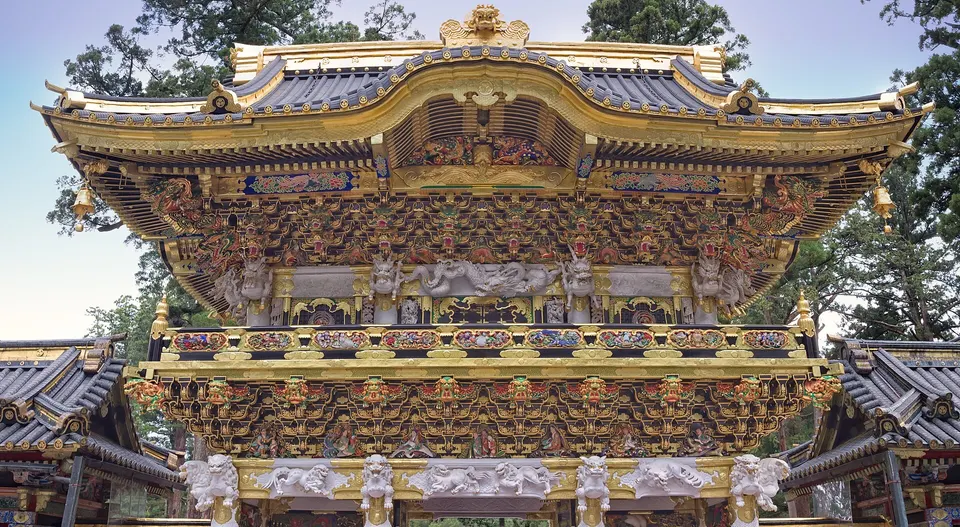
The Yōmeimon is the inner gate on the way to the main sanctuary, a two-story gate about 11 meters high and 7 meters wide. Its 508 carvings show dragons, phoenixes and other imaginary beasts, children at play, and sages and stories of ancient China, and about 240,000 sheets of gold leaf cover its metal fittings and lacquered wood. It is also called Higurashi-no-mon, the gate one can gaze at until dusk without tiring, and it is known as the most beautiful gate in Japan.
The carvings are those of 1636. A repair that took four years and ended in 2017 scraped off the worn paint, applied new lacquer and laid the gold leaf again.
Monkeys, a sleeping cat and a crying dragon
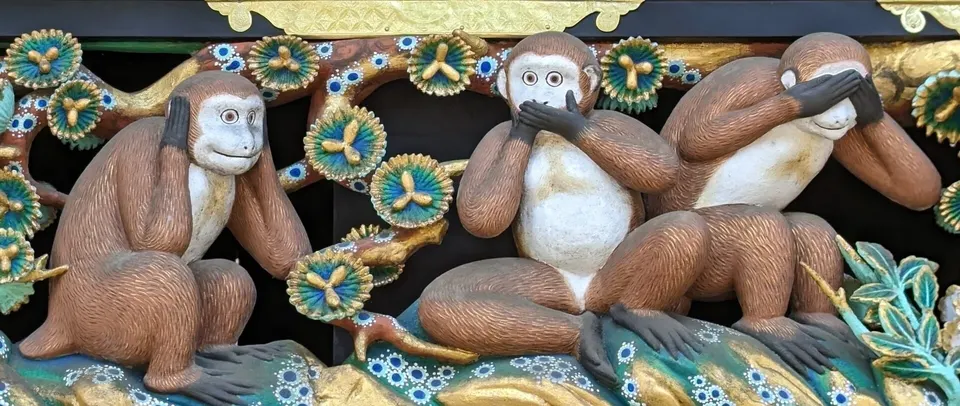
The shrine explains that its carvings carry beliefs, learning and ideas. The Shinkyūsha, the stable for the sacred horse and the only building at Tōshōgū left in plain wood, has eight carved panels of monkeys, animals long believed to protect horses. The panels satirize the course of a human life, and the best known shows three monkeys covering their ears, mouth and eyes: hear no evil, speak no evil, see no evil.
The Nemuri-neko, the sleeping cat, marks the way to the Okumiya, Ieyasu's grave, where his remains lie beneath a bronze tower cast in 1683. The cat dozes among peonies in the sunlight, and it is said to have been carved with the name Nikkō, which means "sunlight," in mind. Tradition credits it to Hidari Jingorō, a carver of the early Edo period whose fame spread through storytellers and whose existence is uncertain.
In the Honjidō, a Buddhist hall in the grounds also called the Yakushidō, a dragon is painted on the slightly concave ceiling. A clap beneath it echoes back and forth between ceiling and floor with a trembling ring, and the dragon is called the Nakiryū, the crying dragon.
Buddhas and gods on one mountain
Nikkō was sacred long before Ieyasu. In the eighth century the Buddhist monk Shōdō opened the mountains around Mount Nantai as a place of worship. By the Kamakura period (1185–1333) the three peaks of Nantai, Nyohō and Tarō were identified with three buddhas and with three shrines. Until the Meiji era the temples and shrines of Nikkō formed a single religious community, Nikkōzan, and Buddhist priests served at Tōshōgū alongside shrine families.
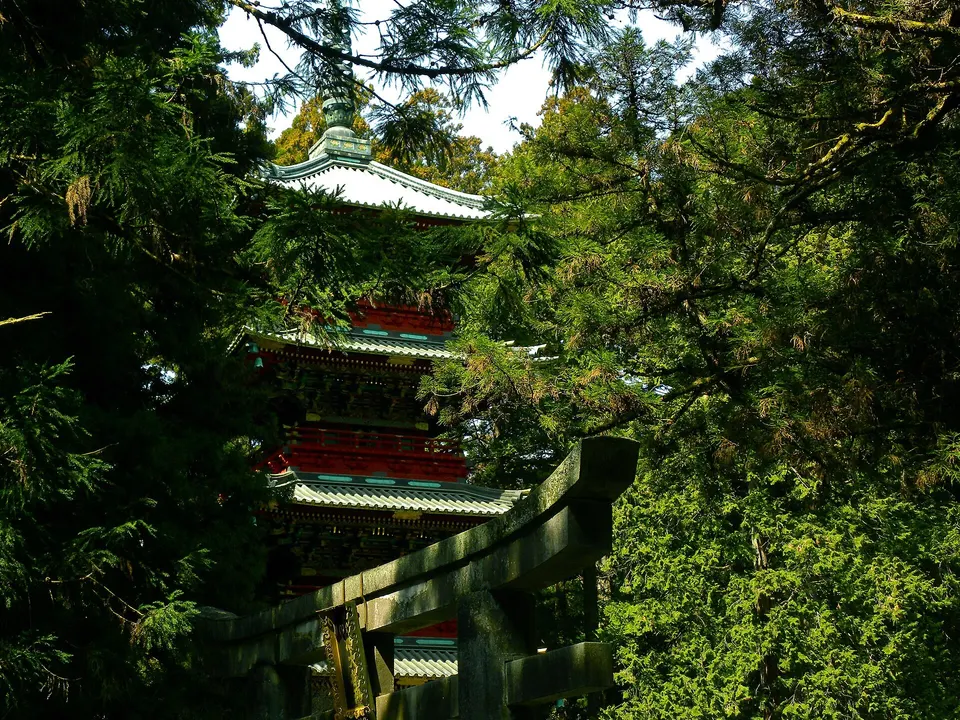
In 1871, under the Meiji government's separation of Shinto and Buddhism, Futarasan Shrine and the temple Manganji, later renamed Rinnōji, were made independent of Tōshōgū. Several Buddhist buildings stayed where they stood, among them the Honjidō, the bell and drum towers, and the five-story pagoda, first built in 1650 and rebuilt in 1818 after a fire. The first gate, the Omotemon, is also called the Niōmon for the Niō, Buddhist guardian figures, housed on its left and right.
The World Heritage site
Inscribed in December 1999, the World Heritage site covers 103 buildings: 23 of Futarasan Shrine, 42 of Tōshōgū and 38 of Rinnōji. Nine are National Treasures and 94 are Important Cultural Properties.
Shoguns, envoys and cedars
Shoguns came to worship, mostly on the anniversary of Ieyasu's death, but the cost was so great that after the fourth shogun only the eighth, tenth and twelfth made the journey, once each. The shoguns traveled by the Nikkō Kaidō, one of the five highways that started from Edo, today's Tokyo. The imperial court sent an envoy with offerings every year from 1646 to 1867, usually by way of the Nakasendō, and in the Edo period Ise and Tōshōgū were the only shrines to receive the court's offerings every year.
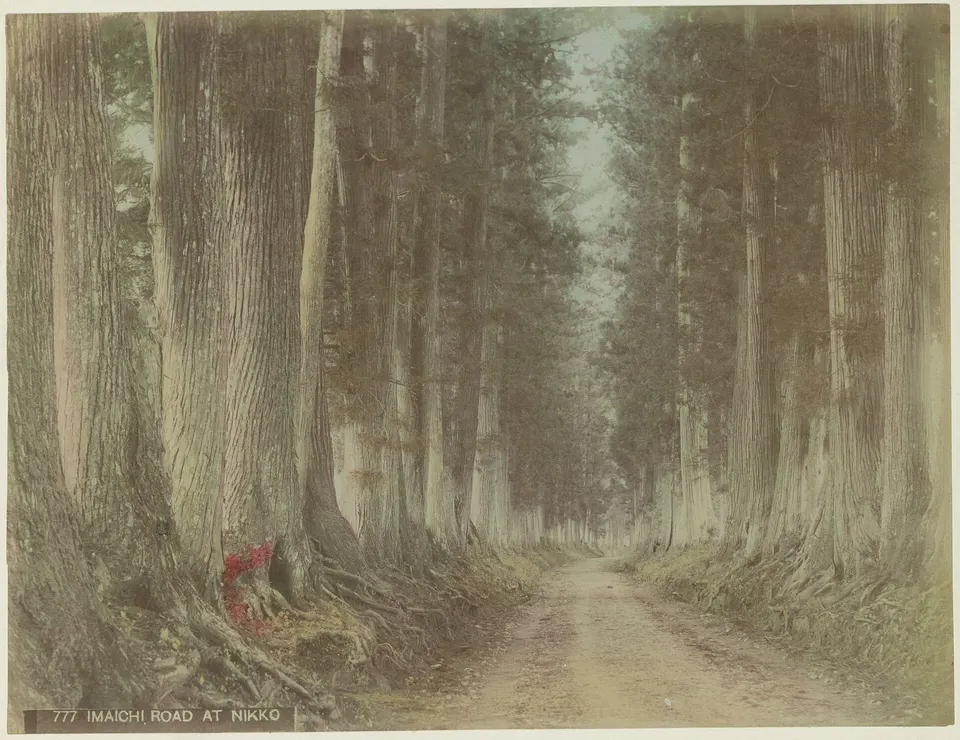
From about 1625 Matsudaira Masatsuna spent some 20 years planting cedars along the roads into Nikkō and gave them to the shrine. The avenue runs about 37 kilometers along three roads, the Nikkō Kaidō among them, and about 12,500 of its trees still stand. It is both a Special Historic Site and a Special Natural Monument.
The railway from Utsunomiya
In July 1885 the Nippon Railway's line from Ueno in Tokyo reached Utsunomiya, where the rice balls counted as the first ekiben were sold at the station. To carry sightseers to Nikkō, the Nippon Railway built a 40.5-kilometer line from Utsunomiya, opened to Imaichi in June 1890 and to Nikkō that August. The state bought the line in 1906, and it became the Nikkō Line.
References
- Nikkō Tōshōgū, "History"
- Nikkō Tōshōgū, "Overview of the shrine buildings"
- Nikkō Tōshōgū, "The Nikkō cedar avenue and its protection"
- Nikkōzan Rinnōji, "About Rinnōji"
- UNESCO World Heritage Centre, "Shrines and Temples of Nikko"
- City of Nikkō, "Shrines and Temples of Nikkō: Tōshōgū"
- Government of Japan, Highlighting Japan (June 2016), "The great Heisei restoration"
- Government of Japan, Highlighting Japan (October 2022), "The dazzling beauty of the Yōmeimon at Nikkō Tōshōgū"
- Kotobank, "Nikkō Tōshōgū"
- Kotobank, "Yōmeimon"
- Kotobank, "Nakiryū"
- Kotobank, "Nikkō shasan"
- Kotobank, "Nikkō Line"
- Kotobank, "Gongen"
- Kotobank, "Hidari Jingorō"
- Kotobank, "Gokaidō"
- Kotobank, "Ekiben"
Image credits (resized for display):