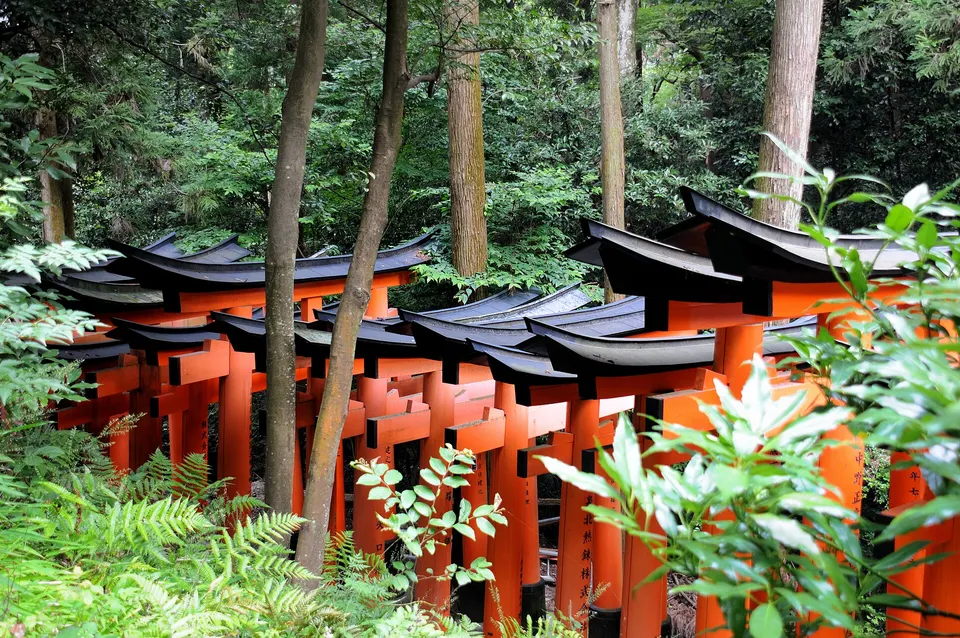
Fushimi Inari Taisha, a Shinto shrine in Kyoto, has so many torii because worshippers have offered them to its kami, or god, Inari Ōkami, since the Edo period (1603–1868), praying that a wish will tōru, "go through," or giving thanks that it has. About 10,000 torii now stand along the paths all over Mount Inari, the mountain behind the shrine, and those on the approach to its inner place of worship are called the Senbon Torii, the "thousand torii." Japan is said to have about 30,000 Inari shrines, and Fushimi Inari Taisha is their head shrine.
A gate for a wish
The torii come from worshippers all over Japan, and the shrine still accepts new ones. The inner place of worship, the Okusha Hōhaisho, better known as the Oku-no-in, stands east of the main hall where the Senbon Torii end. It is a place for worshipping the mountain from below, and the three peaks of Mount Inari rise directly behind it.
Why vermilion
Inari torii, like the shrine buildings, are painted vermilion by a custom called Inari-nuri. Vermilion is held to ward off evil, and in ancient times it was used widely on palaces, shrines and temples. At Fushimi Inari it stands for Inari Ōkami's power to bring abundance, the power of life, of the earth and of production. Made from mercury, vermilion was also used from early times to keep wood from rotting.
The head shrine of Inari
Inari Ōkami was first worshipped on the three peaks of Mount Inari, where it was enshrined on the first Day of the Horse in the second month of 711. By legend, a wealthy forebear of the Hata clan shot an arrow at a rice cake set up as a target; the cake turned into a white bird and flew to a peak of the mountain, and rice grew where it came to rest. The name Inari is taken to come from ine-nari, "rice grows," and the Hata clan served the shrine as its priests for generations.
Five kami are enshrined together in the main hall, their names personifying the powers of Inari Ōkami. The first, Uka-no-Mitama no Ōkami, takes its name from uka, an old word for food and above all for rice. In 1468, during the Ōnin War, fighting burned every building at the shrine. The main hall was rebuilt in the 1490s with money collected across the provinces, and it is an Important Cultural Property.
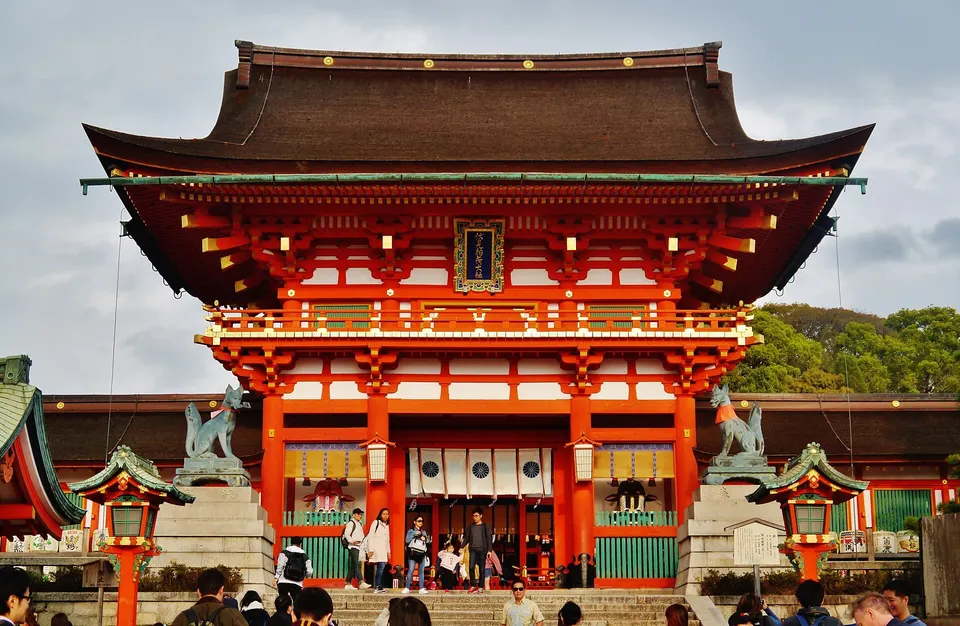
Toyotomi Hideyoshi, who unified Japan, prayed here for his mother's recovery from a grave illness and promised 10,000 koku of rice, a koku being about 180 liters, if she got well. She recovered, and in 1589 Hideyoshi built the Rōmon, the shrine's two-story gate. It is among the largest gates of its kind at any shrine and, after the main hall, the oldest of Fushimi Inari's shrine buildings.
From rice to business
Inari began as a kami of rice and farming. The imperial court prayed to it for rain or for the rain to stop, for good harvests and for peace in the land, and in the Heian period (794–1185) people asked it for a good marriage. As trade and industry grew from the Middle Ages on, Inari spread into the towns as a kami of production and commerce, and today people pray to it for business, safety at home and on the road, and progress in the performing arts. From the middle of the Edo period, kanjō, taking a share of the kami's spirit from Fushimi to enshrine it elsewhere, spread Inari worship across Japan.
Mount Inari
Mount Inari, 233 meters high, is the southernmost of the 36 peaks of Higashiyama, the hills on the east side of Kyoto, and its three peaks rise one above another from west to east. Inari worship began with the worship of the mountain itself. The whole mountain is the shrine's sacred ground, and with the land at its western foot the grounds cover about 870,000 square meters.
Climbing the mountain to pray at its sacred sites is called o-yama suru, "doing the mountain," and it goes back to the Heian period: The Pillow Book and The Kagerō Diary both mention it. Heian people climbed it every year on Hatsuuma, the first Day of the Horse in the second month, believing that a visit that day would bring good fortune.
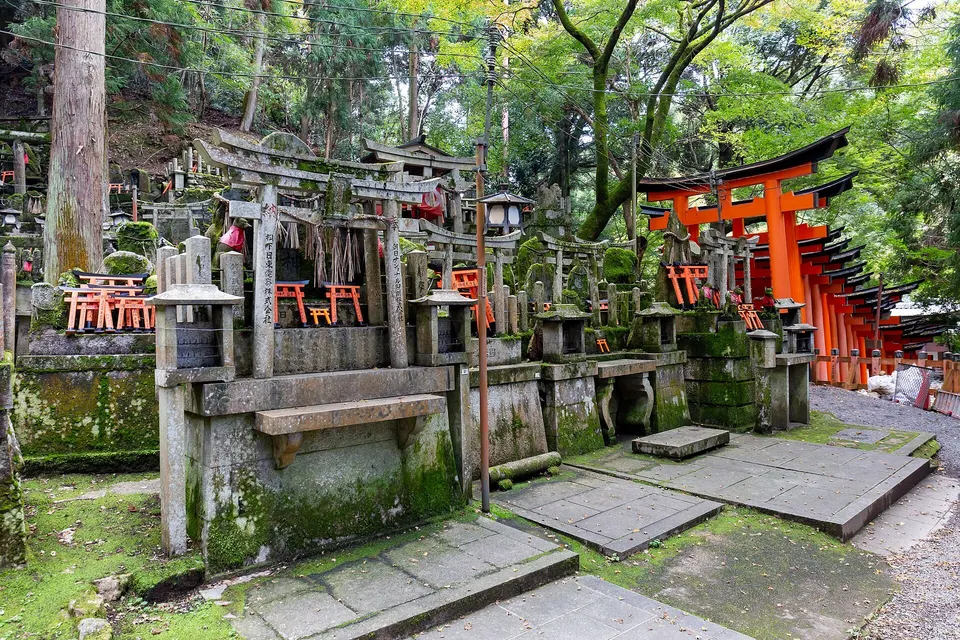
Along the paths are the shinseki, sites where small shrines once stood, and thousands of otsuka: stones carved with a name for Inari Ōkami that a worshipper has chosen, or with the name of the Inari enshrined in the worshipper's household. People began setting otsuka up around the shinseki in the Meiji era (1868–1912).
Foxes
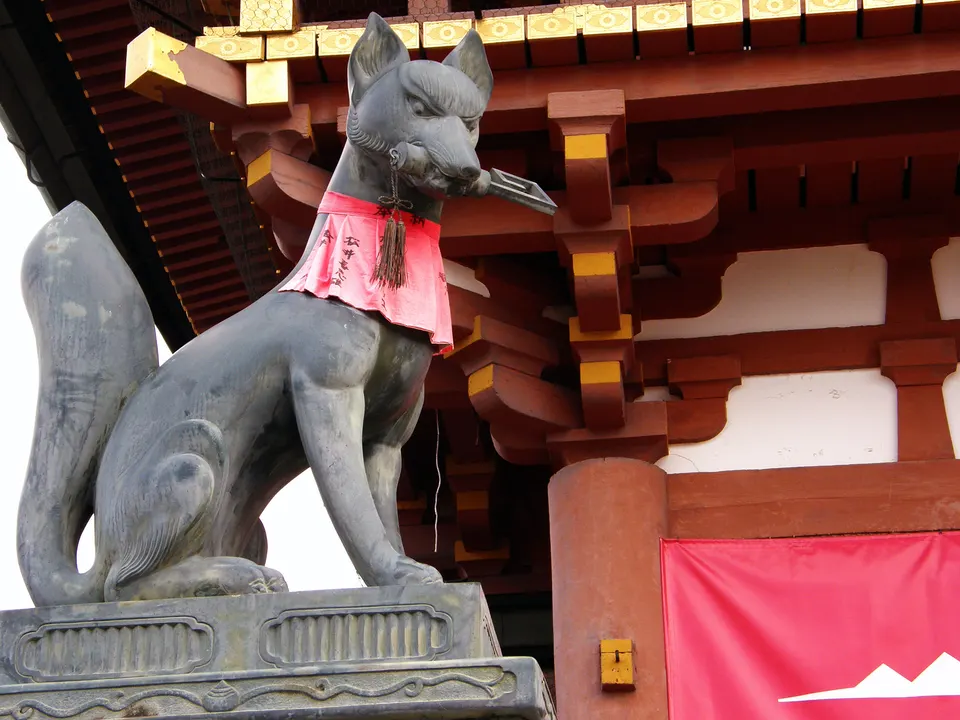
Foxes are the kenzoku of Inari Ōkami, messengers given a standing like that of the kami's own kin. Like the kami, they are invisible to human eyes, so they are revered as white, or clear, foxes, byakko-san, and a small shrine in the grounds, the Byakkosha, is dedicated to them.
One theory traces the bond to Inari's role as a kami of food, a miketsu-kami, whose miketsu turned in time into mi-ketsune, "three foxes." Another points to the fox ridden by Dakiniten, a deity of esoteric Buddhism with whom Inari came to be identified. Folk belief also made the fox the messenger of the kami of the rice fields.
In front of the main hall and the Rōmon, stone foxes hold a jewel, a key or some other object in their mouths. The key is said to be the key to a granary.
Inarizushi and kitsune soba
Inarizushi is fried tofu simmered sweet and salty, opened into a pouch and filled with vinegared rice. It is named for the fox, Inari's messenger, which is said to love fried tofu. From the last years of the Tenpō era (1830–1844), vendors walked the streets of Edo, today's Tokyo, at night, selling inarizushi by the light of paper lanterns painted with torii. Kitsune soba, noodles in broth topped with fried tofu, and kitsune udon take the fox's name for the same reason.
References
- Fushimi Inari Taisha, "About Fushimi Inari Taisha"
- Fushimi Inari Taisha, "Frequently asked questions"
- Fushimi Inari Taisha, "Enshrined deities"
- Fushimi Inari Taisha, "Shrine map"
- Fushimi Inari Taisha, "History: Rebuilding the main hall"
- Fushimi Inari Taisha, "History: Inari kanjō"
- Fushimi Inari Taisha (English)
- Fushimi Inari Taisha, "Visiting Oinari-san"
- Fushimi Inari Taisha, "Dedicating a torii"
- Agency for Cultural Affairs, database of nationally designated cultural properties, "Fushimi Inari Taisha Rōmon"
- City of Kyoto, Fushimi Ward Office, "Fukakusa Trail: sights along the course"
- Kyoto City Tourism Association, "Fushimi Inari Taisha Rōmon"
- Kyoto City Official Travel Guide, "Fushimi Inari Taisha Shrine"
- Kotobank, "Fushimi Inari Taisha"
- Kotobank, "Inari shinkō"
- Kotobank, "Inarizushi"
- Kotobank, "Kitsune"
Image credits (resized for display):