In Japan, a shrine, or jinja, is a place where the kami, the gods of Shinto, are worshipped, and a temple, or tera, is a Buddhist place that houses images of buddhas and is home to monks and nuns. A shrine is entered through a torii, a gate of two pillars and two crossbeams with no roof, and a temple through a roofed gate called the sanmon. At the end of 2024 Japan had 80,570 shrines and 76,390 temples.
Kami and buddhas
Shrines did not begin as buildings. The kami were welcomed on mountaintops and in deep forests, at large rocks and tall trees where they were thought to come to rest. Permanent shrine buildings seem to have become common only in the seventh century, as Buddhist temples went up one after another. Some shrines still have no main sanctuary. Ōmiwa Jinja in Nara reveres Mount Miwa itself as the body of its kami, and three of the four shrines of Suwa Taisha in Nagano revere a mountain, a cedar and a yew.
A temple houses images of buddhas, chief among them its principal image, the honzon. A temple's pagoda enshrines relics of the Buddha, as the stupas built across India after his death did.
How to tell them apart
| Shrine (jinja) | Temple (tera) | |
|---|---|---|
| Worships | Kami | Buddhas |
| Gate | Torii | Sanmon |
| Guardians | Komainu, a pair of lion-dogs | Niō, a pair of fierce guardians |
| Main building | Honden, the sanctuary, and a haiden for worship | Hondō, the main hall, with the principal image |
| Other signs | Shimenawa straw rope, temizuya water basin | Pagoda, incense burner, graves |
| Served by | Shinto priests | Monks and nuns |
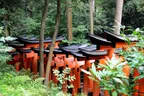
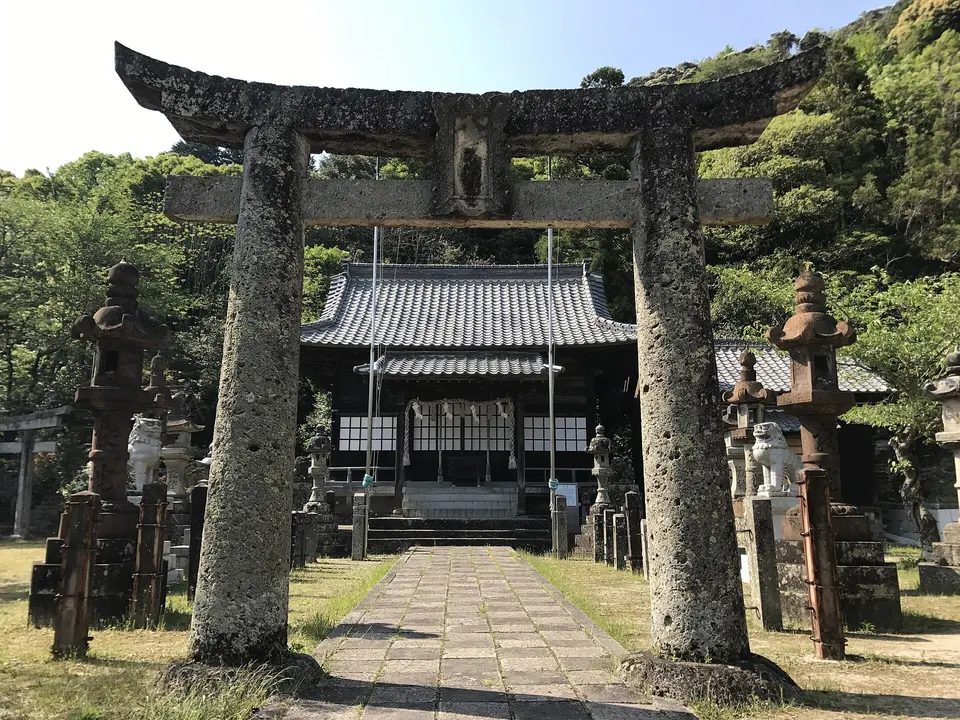
A torii is two pillars joined by a beam across the top, the kasagi, and a tie beam below it, the nuki. It marks the boundary of the kami's ground, and every shrine has at least one; Fushimi Inari Taisha in Kyoto has about 10,000. Torii also stand at some temples, and Shitennōji, a temple in Osaka, has one dated 1294.
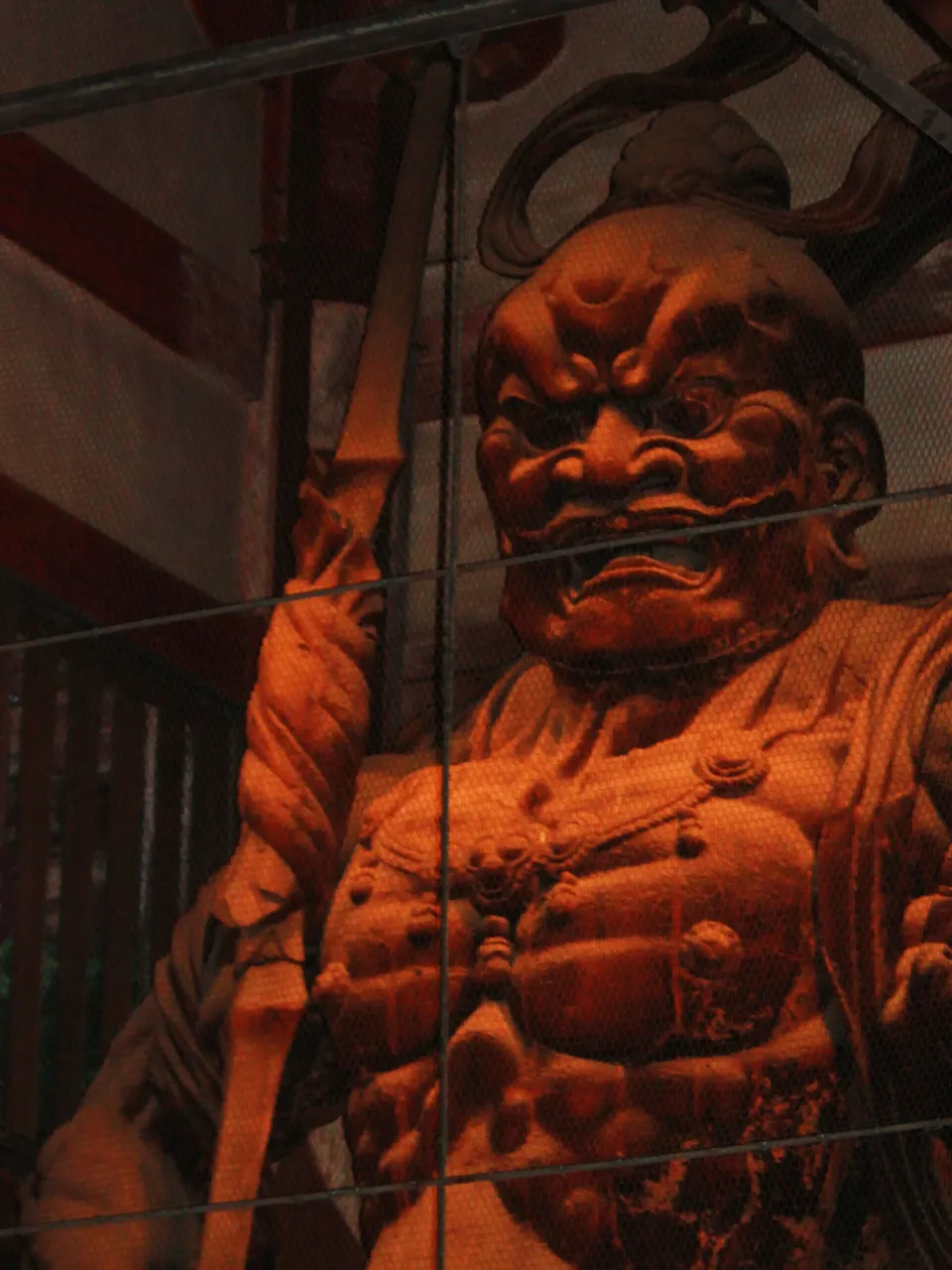
The sanmon, or "mountain gate," takes its name from the time when temples were built in the mountains. Niō stand on either side of a temple gate to drive off the enemies of Buddhism, one with his mouth open and the other with his mouth closed. The pair in the Nandaimon gate of Tōdaiji in Nara, carved by Unkei, Kaikei and others in the Kamakura period (1185–1333), is famous.
Shrines have komainu, lion-like figures that stand in pairs at the entrance or in front of the hall to guard the sacred ground and keep evil out. As with the Niō, one usually has an open mouth and the other a closed one. Some komainu guard temples, such as Yakushiji in Nara.
The thick straw rope across the front of a shrine hall is a shimenawa. It is twisted to the left and hung with paper streamers, shide, to set a sacred place apart from the world outside.
A shrine's name ends in a word such as jinja, jingū or taisha, as in Isonokami Jingū, and a temple's name ends in ji or dera, as in Tōdaiji, Zenkōji or Asukadera.
Temples also care for graves and hold rites for the dead, which ties each temple to its member households, the danka. In the Edo period (1603–1868), under the shogunate's ban on Christianity, everyone had to belong to a temple.
Why some places have both
For about a thousand years, kami and buddhas were worshipped together, a blending called shinbutsu shūgō. In the Nara period (710–794), temples called jingūji were built attached to shrines, and when the Great Buddha of Tōdaiji was being made, the kami Hachiman became the temple's guardian. From the Heian period (794–1185) the belief spread that kami were forms in which buddhas appeared in Japan, and a record of 1134 pairs three kami of Kumano with Amida, the Thousand-armed Kannon and Yakushi. Buddhist images were placed in shrines, torii were put up at temples, and most shrines other than Ise came under the Buddhist priests of their jingūji.
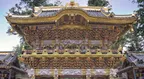
In 1868 the new Meiji government ordered kami and buddhas to be separated. Monks serving at shrines had to return to lay life, Buddhist titles for kami such as gongen and bosatsu were abolished, and Buddhist images and sutras were taken out of shrines. In many places the order turned into haibutsu kishaku, attacks on Buddhism that went on in some areas until about 1874, and many temples across Japan were closed. Kami of the land that had been worshipped inside temple grounds became large shrines of their own. The separation shaped the view, common in Japan today, that Shinto and Buddhism are entirely distinct, though signs of the old blending can still be seen in many places. At the shrine Nikkō Tōshōgū, a five-story pagoda, a bell tower and other Buddhist buildings were left standing after the separation.
Praying at each
At a shrine, visitors first rinse their hands and mouth at the temizuya. Holding the ladle in the right hand, they pour water over the left hand; holding it in the left, they pour water over the right; then they pour water into the left palm and rinse the mouth, without touching the ladle with their lips. At the hall they drop a coin in the offering box and ring the bell. They bow twice from the waist, bring their hands together at chest height, clap twice, and bow once more. This "two bows, two claps, one bow" is the basic form across Japan, and some shrines have a form of their own.
At a temple, visitors put their palms together and pray in silence, with no need to clap. Many temples have incense: a bundle is bought by dropping a coin in the box, lit, put out with a wave of the hand rather than by blowing, and stood in the burner.
Goshuin at both
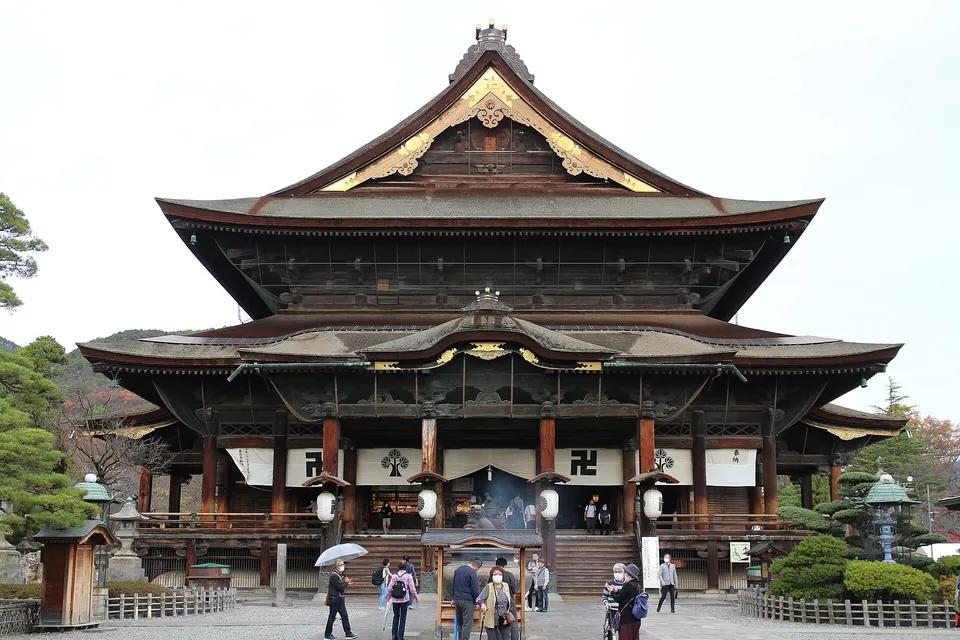
Shrines and temples alike give goshuin, a record of a visit. The name of the shrine or temple, the name of what it enshrines and the date are usually brushed in ink and stamped with a red seal, and the visitor makes an offering in return. Goshuin are said to have begun as proof given to people who had offered a hand-copied sutra and to have spread with pilgrimages. Goshuin are collected in a folding book, the shuin-chō, and many people keep their goshuin on the household kami shelf or Buddhist altar, as they would a charm.
References
- Agency for Cultural Affairs, "Religious Yearbook, 2025 edition" (PDF)
- Jinja Honchō (Association of Shinto Shrines), "How to pray at a shrine"
- Japan National Tourism Organization, "Shrine and Temple Traditions"
- Suwa Taisha, "About Suwa Taisha"
- Kotobank, "Jinja"
- Kotobank, "Jiin"
- Kotobank, "Shinbutsu shūgō"
- Kotobank, "Shinbutsu bunri"
- Kotobank, "Torii"
- Kotobank, "Komainu"
- Kotobank, "Niō"
- Kotobank, "Sanmon"
- Kotobank, "Hondō"
- Kotobank, "Shimenawa"
- Kotobank, "Goshuin"
- Kotobank, "Nikkō Tōshōgū"
Image credits (resized for display):