A picnic and a bento are both meals prepared ahead and carried to be eaten away from home. What separates them is what each word holds on to: a picnic is a meal eaten together and outdoors, around dishes taken out of a basket, while a bento is a meal packed into a box, rice and side dishes together, and eaten under the cherry trees, at the theater or in a seat on a train.
Picnic: first a meal where everyone paid a share
The French word appears in 1694 in the phrase faire un repas à piquenique, that is, a meal at which each person pays his own share. The masculine noun is recorded in 1732 in the form picnic, and the dictionary of the Académie française has listed it since 1740. The older sense is a meal for which each person pays a share or brings a dish: as late as 1855, George Sand tells of dinners taken en pique-nique in a quiet little restaurant. The usual sense, a country meal eaten together and generally on the grass, can be read in 1842 in Stendhal, who writes that people held picnics at Maisons and at Meudon.
English and German took the word from French. In English, picnic in the mid-18th century meant a social event at which each guest contributed a share of the food, and today it means the occasion when people pack a meal and take it to eat outdoors, especially in the countryside. German Picknick meant, in the first half of the 18th century, a shared meal to which each participant contributed money or food, and from the second half of the 19th century a meal outdoors, on excursions, made up of food brought along.
The basket, the cloth and the dishes people share
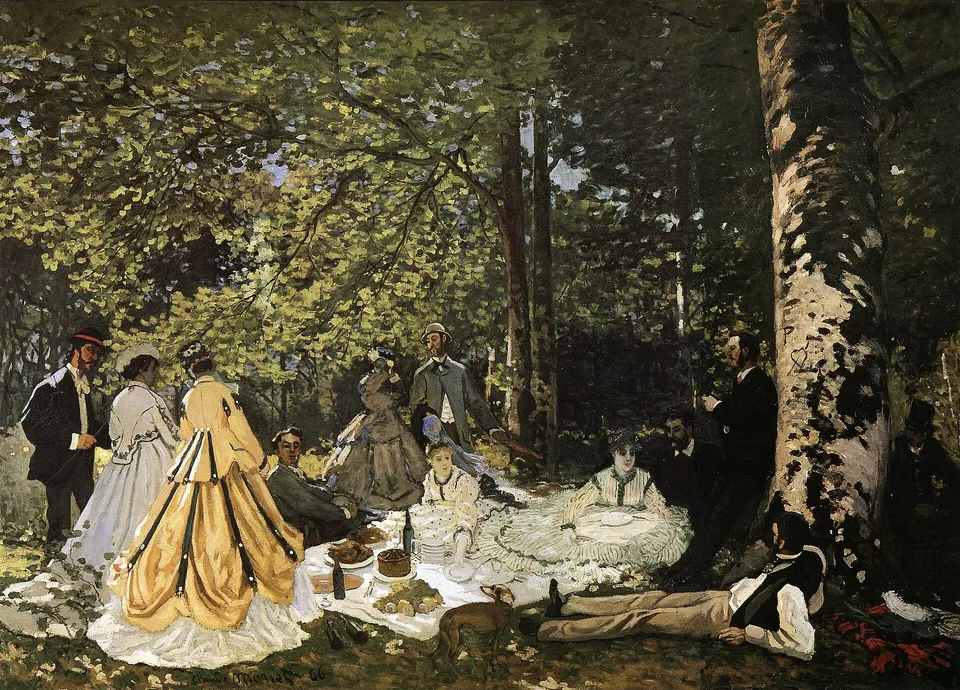
In 1866 Claude Monet painted friends gathered for a picnic: a cloth spread on the grass, a roast fowl, a pie, fruit, bottles and a stack of plates. In England, Mrs Beeton's Book of Household Management, published in 1861, gives the bill of fare for a picnic for forty people: among other things a joint of cold roast beef, four roast fowls, two roast ducks, a ham, a tongue and pies, with ale, lemonade and tea. Victorian families who could afford it owned a strong wicker basket bought for the purpose, with a cloth or a blanket to sit on.
The dictionaries have kept these objects. An English hamper is a large basket with a lid, used especially for carrying food; French has panier à pique-nique and aire de pique-nique, and German has Picknickkorb, Picknickkoffer and Picknickbesteck. The Brotzeit of southeastern Germany is defined differently, by what is eaten: bread with toppings or other cold food, mostly as a mid-morning snack.
Bento: a meal packed into a box
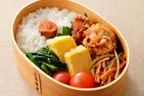
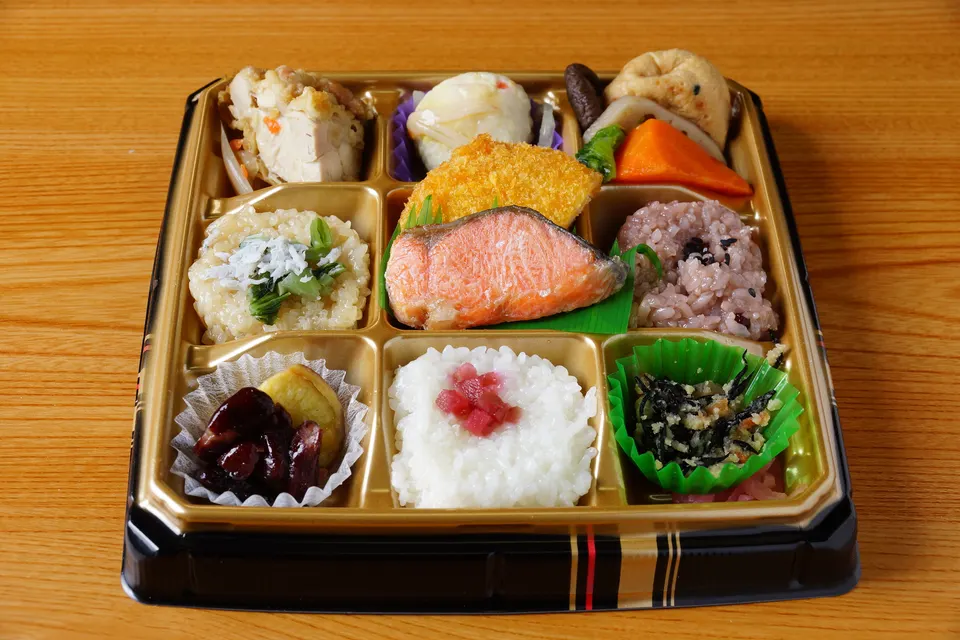
In Japan, bento is food carried to be eaten away from home, and the word also covers the meal of rice and side dishes that a restaurant serves in a box. It was first carried by people who worked outdoors and could not go home to eat. The hokai, a cylindrical lacquered vessel on three legs, held food for several people and was carried by servants; the bento box for one person was carried by its owner.
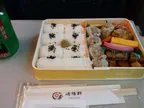
A bento is cooked to be eaten later: dishes that give off no liquid and whose taste and color change little as they cool, and rice left to cool well before the lid goes on. In the Edo period (1603–1868), townspeople took bento on outings and to the theater. The makunouchi bento takes its name from the time when it was eaten, while the curtain was drawn between acts: rice pressed into small barrel shapes and, in the same box, grilled fish, rolled omelet, fish cake and simmered dishes.
Under the cherry trees, boxes in tiers
Hanami means going out to look at the cherry blossoms while eating and drinking. People spread mats on the ground, eat, drink and sing, a custom that developed in the Edo period among the common people of large cities such as Edo, Osaka and Kyoto. In the early modern period, feudal lords and townspeople alike went out with their hanami bento and their sake flasks.
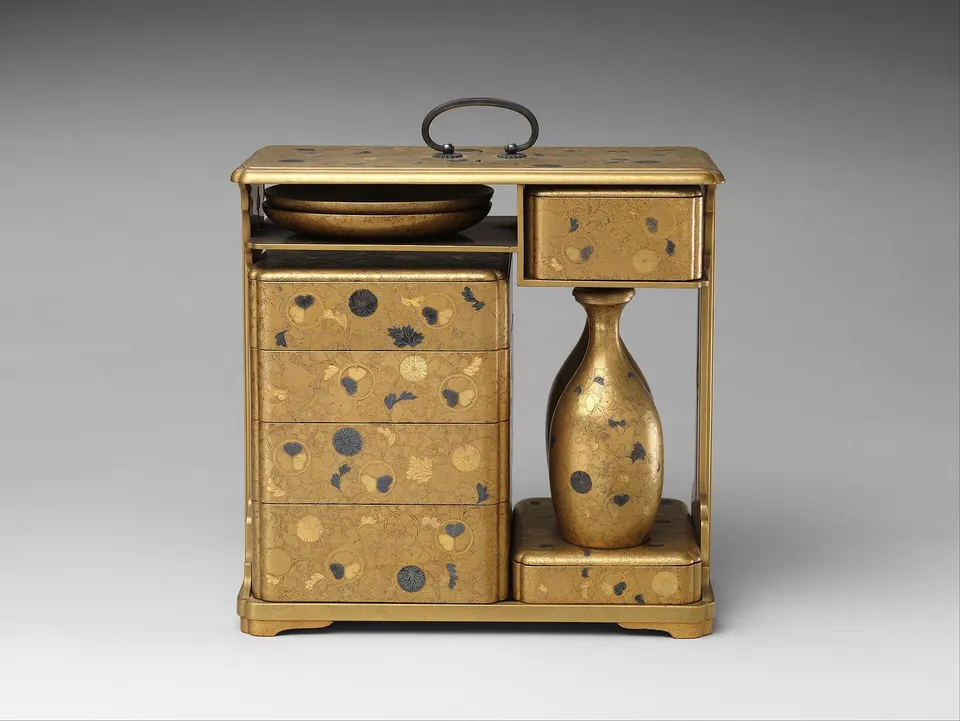
This meal travels in a jūbako: flat square boxes, almost always of lacquered wood, into which the food is packed by kind and which are stacked in three, four or five tiers, with a lid on the top box. For banquets outdoors the sagejū was devised, a jūbako carried by hand; some sagejū bring together, in a frame with a handle, the stacked boxes, sake flasks of silver or tin, cups and individual plates. The Victoria and Albert Museum in London keeps a sagejū from the first half of the 19th century, of wood lacquered black and gold, with four boxes and a sake bottle; the museum's catalogue calls it a Picnic Set. The jūbako is still used for hanami and for sports days.
On the train: ekiben
The bento for one person also boarded the train. Ekiben are the bento sold to travelers at stations and on trains. The first ekiben is held to be the one that an inn sold in July 1885 at Utsunomiya Station: two rice balls and pickled radish, wrapped in bamboo sheath. The makunouchi of the theater passed into ekiben, and its name spread with them. An ekiben is eaten at the traveler's seat, on the train.
| Picnic | Jūbako at hanami | Bento for one person, and ekiben | |
|---|---|---|---|
| The container | a wicker basket, a cloth or a blanket | lacquered boxes stacked in three to five tiers; the sagejū is carried by hand | a single box: bent wood, lacquer, plastic |
| What goes in | cold meats, pies, sandwiches, fruit, bottles | the food packed by kind, tier by tier; in some sagejū, sake flasks, cups and plates | rice and side dishes, together in the same box |
| Where it is eaten | outdoors, on the grass | outdoors, on mats, under the cherry trees | at work, at the theater between acts, in a seat on the train |
| For whom | a meal eaten together | a banquet for several people | one box per person |
Tōge no Kamameshi: an ekiben in a ceramic pot
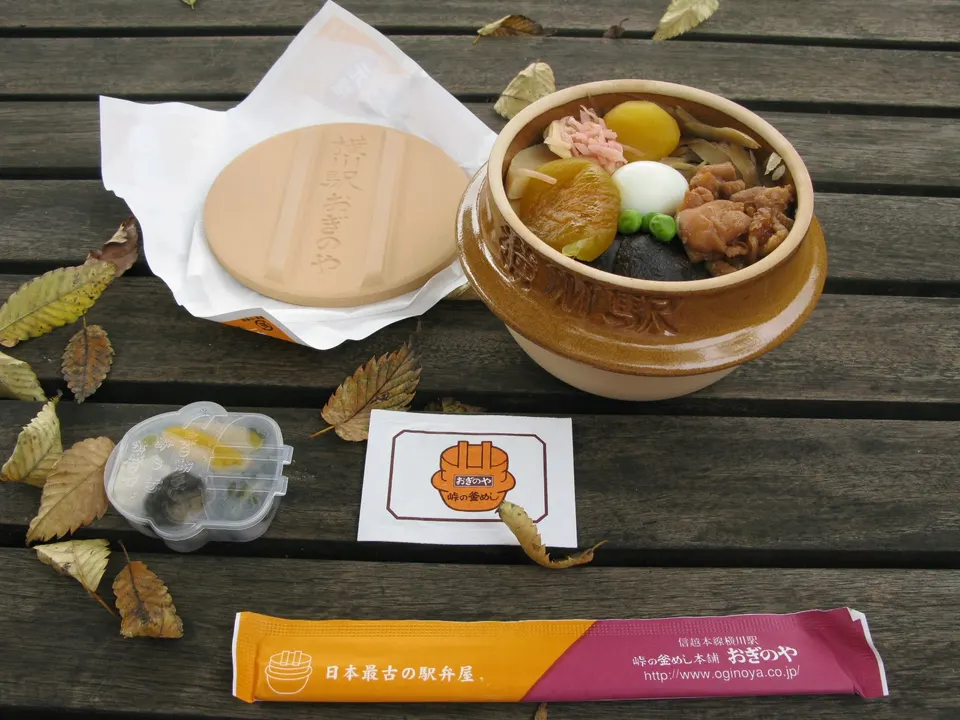
In the 1950s the usual ekiben was a cold makunouchi. At Yokokawa Station in Gunma Prefecture, Takamizawa Mineji, who became president of Oginoya in 1953, stood on the platform every day and asked travelers what kind of bento they wanted. The travelers wanted a meal that was warm, that felt like home cooking and that was a pleasure to look at.
The answer was Tōge no Kamameshi, which went on sale at Yokokawa Station on February 1, 1958. The cooking is done at the factory: seasoned Koshihikari rice and nine toppings are packed there not into a box but into a ceramic pot of Mashiko ware. The pot is sterilized at high heat before it is filled, which is why it holds the warmth. Since 1958 Oginoya has sold more than 170 million pots of Tōge no Kamameshi.
References
- CNRTL, Trésor de la langue française informatisé, « PIQUE-NIQUE »
- Dictionnaire de l’Académie française, 9e édition, « PIQUE-NIQUE »
- DWDS, „Picknick“
- Duden, „Picknick“
- DWDS, „Brotzeit“
- Oxford Advanced Learner’s Dictionary, “picnic”
- Oxford Advanced Learner’s Dictionary, “hamper”
- English Heritage, “Guide to a Victorian Picnic”
- Victoria and Albert Museum, “Picnic Set” (O102015)
- ГМИИ им. А. С. Пушкина, «Клод Моне. Завтрак на траве. 1866»
- Kotobank, "Bento"
- Kotobank, "Makunouchi bento"
- Kotobank, "Hanami"
- Kotobank, "Jūbako"
- Kotobank, "Sage-jūbako"
- Kotobank, "Ekiben"
- Oginoya, chronology
- Oginoya, "How Tōge no Kamameshi was born"
- Oginoya, "Tōge no Kamameshi (ceramic pot)"
- Oginoya, "About the container"
- Oginoya, "Tōge no Kamameshi"
Image credits (resized for display):
- Claude Monet (1840–1926) / Wikimedia Commons, Public domain, 1866
- Adobe Stock #1879295423
- Unknown (photo: The Metropolitan Museum of Art, Open Access) / Wikimedia Commons, CC0
- pcs34560 / Wikimedia Commons, Public domain, 2010