A self-heating ekiben, one of the bento sold at Japan's railway stations, has a heating unit under its food tray that holds quicklime and a bag of water. When the string is pulled out of the side of the box, the water reaches the quicklime, and the steam from the reaction warms the meal in five to ten minutes.
Quicklime and water
Quicklime is calcium oxide, CaO, made by burning limestone at about 900°C or hotter. When water touches it, it gives off a great deal of heat and becomes calcium hydroxide, or slaked lime: CaO + H₂O → Ca(OH)₂.
Under the tray
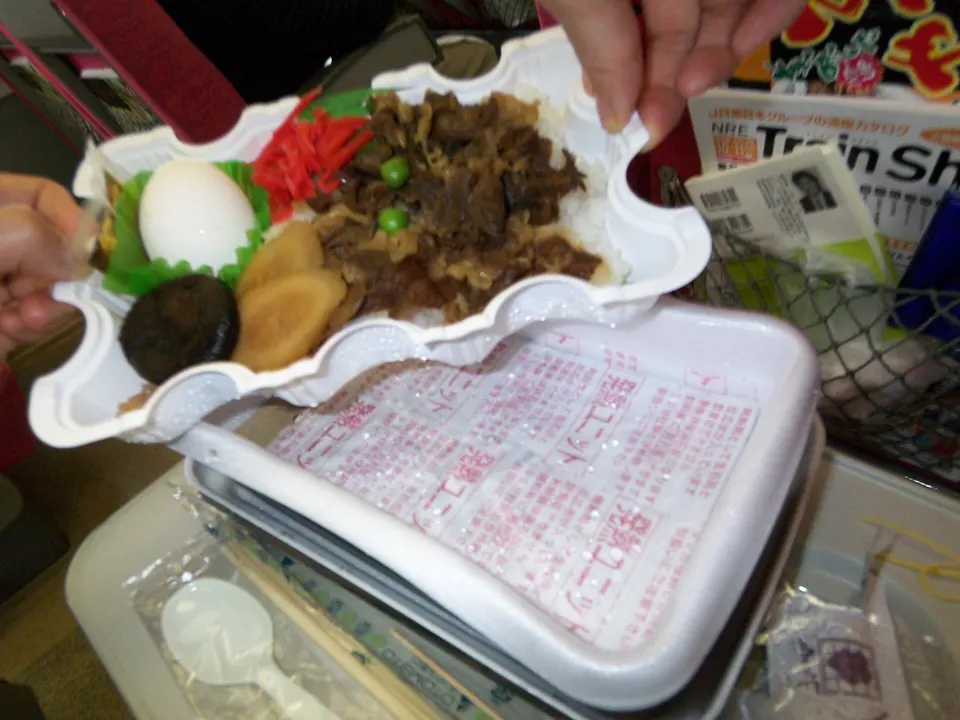
The heating is built into the container. Naruhot, a container used for ekiben around Japan, holds the beef tongue bento of Kobayashi, an ekiben maker in Sendai. From the top down, a Naruhot box has a lid, a tray for the food, the heating unit and an insulating pad, all set inside the outer container. The heating unit holds the quicklime and a bag of water under a seal of nonwoven fabric, and a yellow string leads from the unit out through the side of the box. Nothing burns, and the reaction gives off no hydrogen gas. The photograph above shows a self-heating sukiyaki bento sold at Yonezawa Station in 2008, its food tray lifted clear of the pouch printed 発熱ユニット, "heating unit."
Pulling the string out starts the reaction at once. Steam at 100°C rises for about two minutes and circulates inside the container, and the food is heated by convection, conduction and radiation. Depending on the contents, the meal is ready once it has stood in that heat for five to ten minutes, and the box keeps it warm for about thirty minutes.
Pulling the string
Kobayashi sets out the steps for its own boxes.
- Leave the red cord around the box tied, and put the box on a flat surface.
- Press lightly on the top and pull the yellow string at the side all the way out.
- Take your hands off the box at once. Hot steam comes out.
- Wait. The time differs from product to product; Kobayashi's grilled beef tongue bento takes about five to six minutes.
- Untie the red cord and eat.
The box has to be level and steady when the string comes out, which rules out a lap, and for a tabletop Kobayashi suggests a sheet of newspaper underneath. After the meal the whole container, with the heating unit and the slaked lime now inside it, is in principle burnable trash, sorted by the rules of the local municipality.
A cold box, a warm pot, a string
What matters in the cooking of a bento is that taste and color change little when the food goes cold, and the rice is cooled thoroughly before the lid goes on. Kobayashi chills its finished bento and keeps them cool through delivery so that the quality holds. Awajiya, an ekiben maker in Kobe, describes ekiben as food that is by nature "good even when cold."
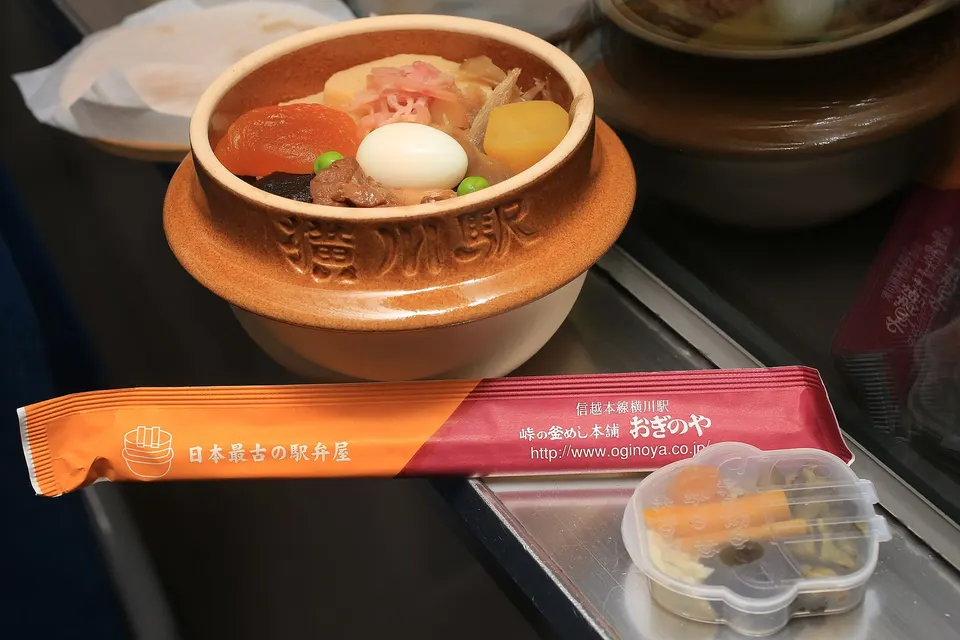
In the 1950s the usual ekiben was a cold makunouchi, rice with an assortment of side dishes. On February 1, 1958, at Yokokawa Station in Gunma Prefecture, Oginoya put Tōge no Kamameshi on sale in an earthenware pot. Oginoya chose a ceramic vessel because passengers worn out by long train journeys said they wanted a warm bento. The pots are sterilized at high heat before use, a ceramic pot treated that way holds its warmth, and so the meal reaches the customer warm. Tōge no Kamameshi is regarded as the leading example of the ekiben named for one local dish that appeared all over Japan from about 1955.
In the second half of the 1980s a container with a built-in warming function, which let people drink warm sake anywhere, went on sale in Japan and drew a strong response. Bento sold aboard limited express trains went cold, and demand for warm bento was strong.
In 1987 Awajiya, which began in 1903 and moved to Kobe in 1944, put a self-heating bento on sale. It calls its heated boxes Atchitchi, a name that echoes achichi, the cry of someone who has touched something hot, and its company history describes the Atchitchi Steam Bento as breaking the conventions of ekiben.
Shingi, the packaging company in Hiroshima that sells Naruhot, dates it to 1990, when it was developed to warm sake: a container that gave off hot steam by chemical reaction when its string was pulled. The container did not heat sake well enough, found a new use in reheating bento, and was taken up for ekiben, which are hard to reheat. Fukuvi Chemical Industry of Fukui, which developed the container for bento, lists Naruhot as going on sale in 1994. Fukuvi says that several million self-heating bento are sold each year.
Beef tongue in Sendai, sukiyaki in Kobe
Beef tongue, a specialty of Sendai, fills one of the regional ekiben that heat themselves. Kobayashi's Amiyaki Gyūtan Bento, grilled beef tongue on barley rice, is in the company's words a very long-selling product and the bento people mean by a self-heating beef tongue bento. Kobayashi labels each of its beef tongue bento "heated by pulling a string" or "not heated."
Awajiya's Atchitchi boxes include Kobe sukiyaki with steak, crab rice with sukiyaki, and in autumn beef sukiyaki with matsutake mushrooms and rice topped with chestnuts. In the autumn of 2023 Awajiya brought out a bento supervised by the Japan Sumo Association as an Atchitchi box and sold tens of thousands of them.
Kept off aircraft
Japan's transport ministry lists self-heating bento and self-heating drinks, those sold with a heating agent, among the items that may be neither carried into an aircraft cabin nor checked as baggage. Kobayashi's guide says that its boxes cannot be taken aboard an aircraft. When Awajiya opened a shop at Kobe Airport on April 10, 2025, it kept its steam-heated bento out of that shop because they cannot be taken aboard an aircraft.
References
- Shingi: Naruhot, a container with a heating function
- Shingi: Naruhot catalog (PDF)
- Shingi: Product development stories
- Fukuvi Chemical Industry: 70th anniversary
- Kobayashi: What is Naruhot?
- Kobayashi: Frequently asked questions
- Kobayashi online shop: Amiyaki Gyūtan Bento
- Awajiya: Company history
- Awajiya: Bento lineup
- Kotobank: “Calcium oxide”
- Kotobank: “Bentō” (Japanese dictionaries and encyclopedias)
- Kotobank: “Ekiben” (Japanese dictionaries and encyclopedias)
- Ministry of Land, Infrastructure, Transport and Tourism: Items restricted in carry-on or checked baggage (PDF)
- Oginoya: About the containers
- Oginoya: The story behind Tōge no Kamameshi
- Oginoya: Company timeline
Image credits (resized for display):
- 克年 三沢 / Wikimedia Commons, CC BY 2.0, 2008
- pcs34560 / Wikimedia Commons, Public domain, 2016