To travel in Japan without carrying your bags, you send them ahead by takuhaibin (宅配便), the door-to-door parcel service: a suitcase handed in at a carrier's office, a convenience store or an airport counter is delivered to a hotel, a home or the airport you fly from. Takkyūbin (宅急便) is the trademark of one carrier, Yamato Transport, which launched it on January 20, 1976, and in fiscal 2024, the year to March 2025, Japan's carriers handled about 5.03 billion takuhaibin parcels.
A parcel service with brand names
Takuhaibin carries relatively small parcels from the sender's door to the receiver's door. Japan's transport ministry, in its yearly count, treats as takuhaibin a parcel of 30 kilograms or less, sent as a single piece under a carrier's brand name. The three brands with the most parcels are Takkyūbin from Yamato Transport, Hikyaku Takuhaibin from Sagawa Express and Yu-Pack from Japan Post, which together accounted for about 95.2 percent of the takuhaibin parcels carried by truck in fiscal 2024.
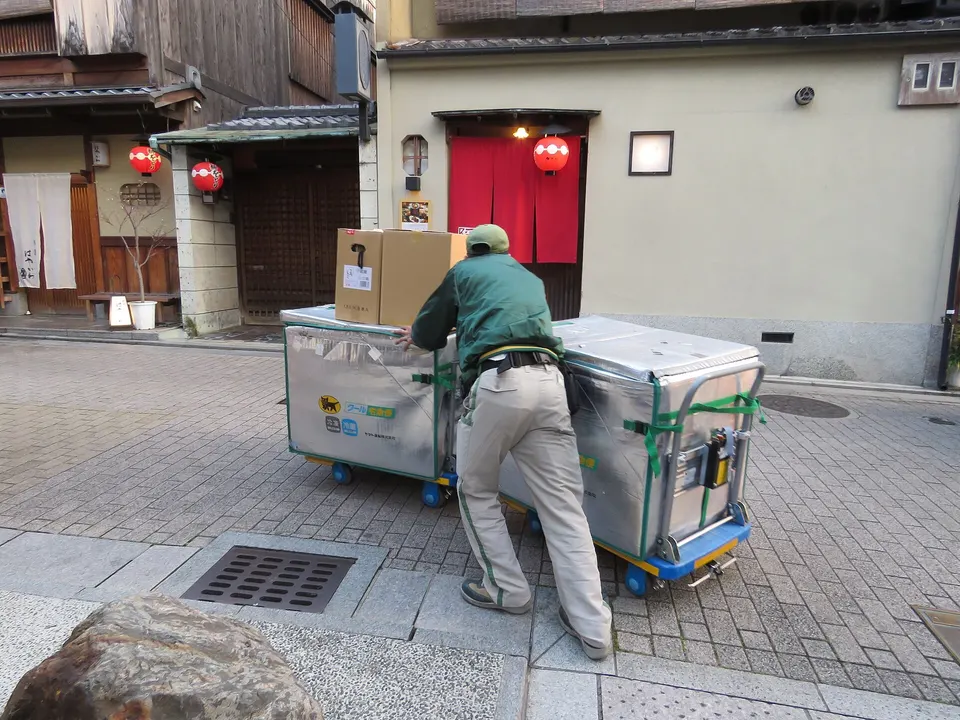
A small truck collects the parcel and takes it to a terminal, where parcels are sorted by destination. Large trucks carry them to the receiving terminal, which sorts them by delivery district, and a small truck takes each parcel to the door.
1976: eleven parcels
Miyago Kamotsu, a mid-sized trucking company in the Tōhoku region, is said to have started the first takuhaibin by truck in 1974. Yamato Transport launched Takkyūbin on January 20, 1976, with 24 offices in Tokyo and 60 in the six other prefectures of the Kantō region. Its offer was collection on a single phone call, delivery the next day, a low and clear price and simple packing. On January 23, the first day the company kept count, it handled 11 parcels.
Yamato asked rice shops, liquor shops, fuel dealers and dry cleaners to take in parcels as agents, and it had 3,000 agents in 1978. Takkyūbin carried 109,244,152 parcels in fiscal 1983. Sagawa Express entered the takuhaibin business in 1998, and Japan Post has been counted as a takuhaibin carrier since its privatization in October 2007.
From ski gear to suitcases
In December 1982 Yamato's Nagano branch, where parcels fell off once the autumn apple shipments ended, began carrying ski gear for skiers. Ski Takkyūbin went on sale in December 1983. Cool Takkyūbin, which carries parcels chilled or frozen, went on sale across Japan, except Shikoku and Okinawa, in July 1988.
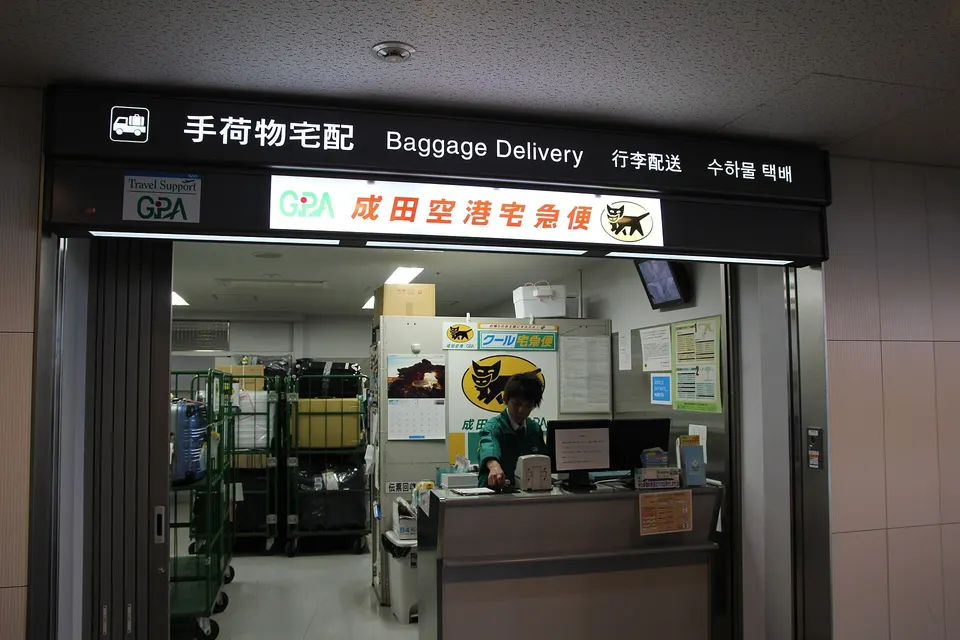
Airport Takkyūbin began in November 1989: a traveler sent a suitcase from home and picked it up at a counter in Narita International Airport. By Takkyūbin's fiftieth anniversary in 2026 there were Takkyūbin counters at 16 airports. In June 1998 Yamato began delivery within a chosen time slot nationwide and added a round-trip form of its ski, golf and airport services.
Sending a suitcase ahead
Airport Takkyūbin takes a suitcase of up to 30 kilograms to the airport the traveler departs from. The sender hands it over at least two days before departure, three days in some regions. The suitcase reaches the airport by the day before the flight, and the traveler collects it at a counter there on the day. A traveler arriving with luggage sends it from an airport counter to a home or a hotel.
A parcel enters Yamato's network in one of five ways: a driver collects it from the sender's home, or the sender takes it to a Yamato office, a convenience store, an agent shop or a parcel locker. By the fiftieth anniversary there were about 120,000 agents, convenience stores, pharmacies and supermarkets among them. In October 2024 Yamato began supplying hotels, airports and other tourist facilities across Japan with a tool that issues a shipping label from a smartphone.
Yamato also stores bags for travelers who are sightseeing or working, and it delivers bags the same day to the place where the traveler is staying or to an airport. JR Central's Luggage Express, which requires a reservation, takes a bag left at a hotel or a station and has it at the traveler's next hotel the same day.
The Hands-Free Travel logo
Japan's transport ministry and the Japan Tourism Agency have promoted tebura kankō, hands-free travel, to spare visitors from abroad the trouble of carrying large bags: counters at airports, stations and shopping facilities store luggage for a time and deliver it to airports, stations and hotels. A common logo that the ministry approves for such counters came into use on July 28, 2015, at 47 counters. Among the 47 were a counter at Tokyo Station and counters at three Tokyo department stores that handle tax-free paperwork and delivery together.
A counter with the logo handles delivery or storage, or both, of suitcases and souvenirs. The counter gives guidance in English at the least, shows a price list in English and posts its compensation terms, and a counter that delivers must reach hotels and airports the same day or the next. On March 31, 2019, 296 counters carried the logo. The ministry counted relief for the shortage of coin lockers and of luggage space on trains among the effects of hands-free travel.
Large bags on the Shinkansen
A traveler who keeps a large suitcase meets a rule on the Tōkaidō, San'yō, Kyushu and Nishi-Kyushu Shinkansen. A bag whose three dimensions total more than 160 centimeters and no more than 250 is called oversized baggage, and bringing it aboard takes a reservation for a seat with an oversized baggage space. These seats are the last row of certain reserved cars, and the bags go in the space behind the row. A seat with the space costs the same as any other reserved seat in the ordinary car or the Green Car, and it is booked online, at a station ticket machine or at a ticket window.
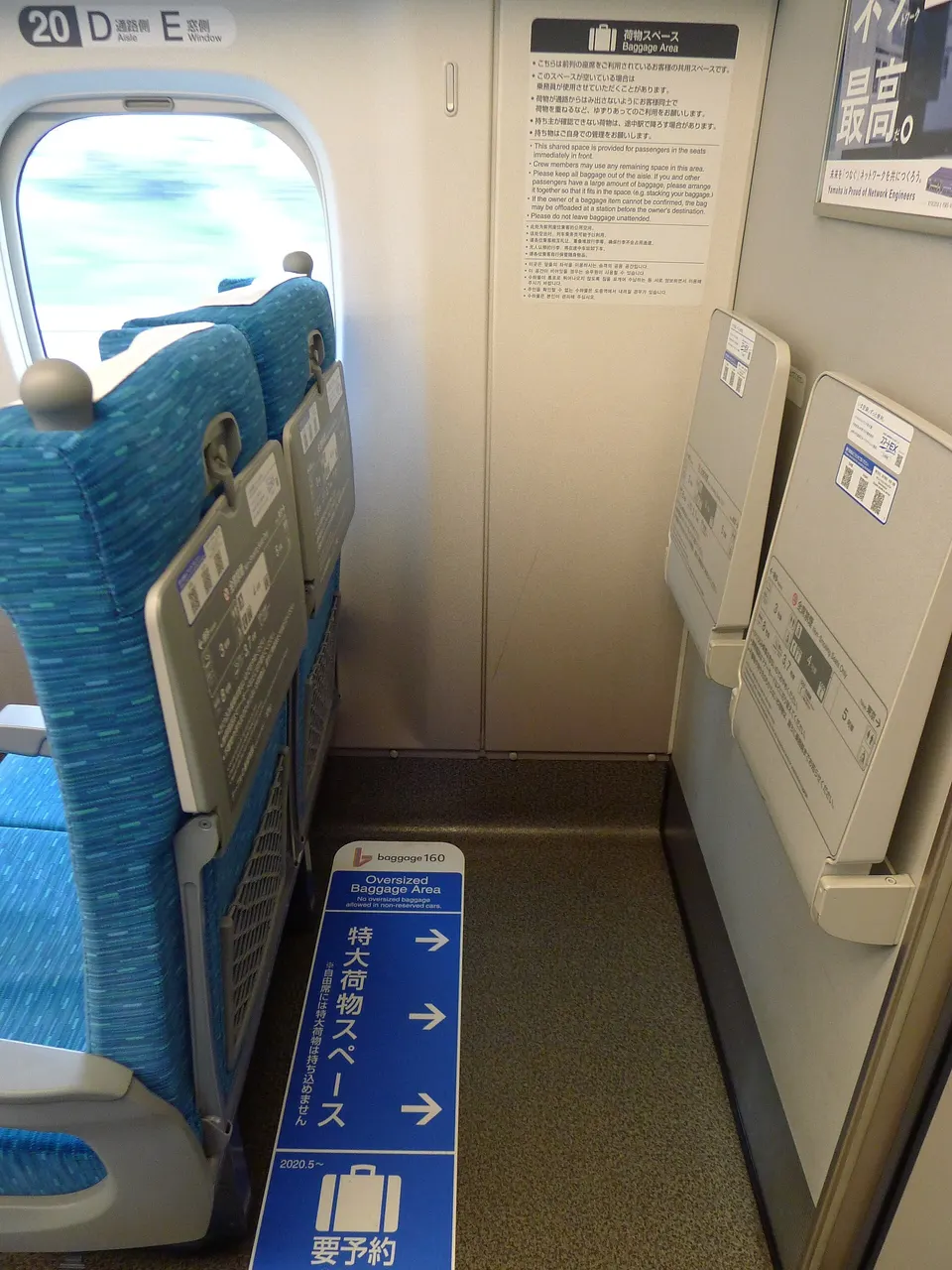
An oversized bag brought aboard without the reservation incurs a handling fee, and a bag over 250 centimeters cannot be brought aboard. A bag of 160 centimeters or less, roughly the size airlines carry in the hold without charge, goes on the overhead rack or at the passenger's feet. Sports equipment, musical instruments, wheelchairs and strollers need no reservation, whatever their size.
JR Central, JR West and JR Kyushu announced the reservation system on August 29, 2019, for the Tōkaidō, San'yō and Kyushu Shinkansen, to apply to trains from mid-May 2020.
References
- Kotobank, "Takuhaibin"
- Kotobank, "Takkyūbin"
- Yamato Holdings, "Company history"
- Yamato Transport, Takkyūbin 50th anniversary site
- Yamato Transport, "Airport Takkyūbin"
- Yamato Transport, "Hands-free services"
- Ministry of Land, Infrastructure, Transport and Tourism, "Takuhaibin and mail-bin volumes, fiscal 2024" (August 27, 2025, PDF)
- Ministry of Land, Infrastructure, Transport and Tourism, "Start of the common logo for Hands-Free Travel service counters" (July 28, 2015)
- Ministry of Land, Infrastructure, Transport and Tourism, "What is Hands-Free Travel" (2019, PDF)
- JR Central, "Baggage information (oversized baggage)"
- JR West, "Oversized baggage areas and advance reservation on the Tōkaidō, San'yō and Kyushu Shinkansen" (August 29, 2019)
Image credits (resized for display):