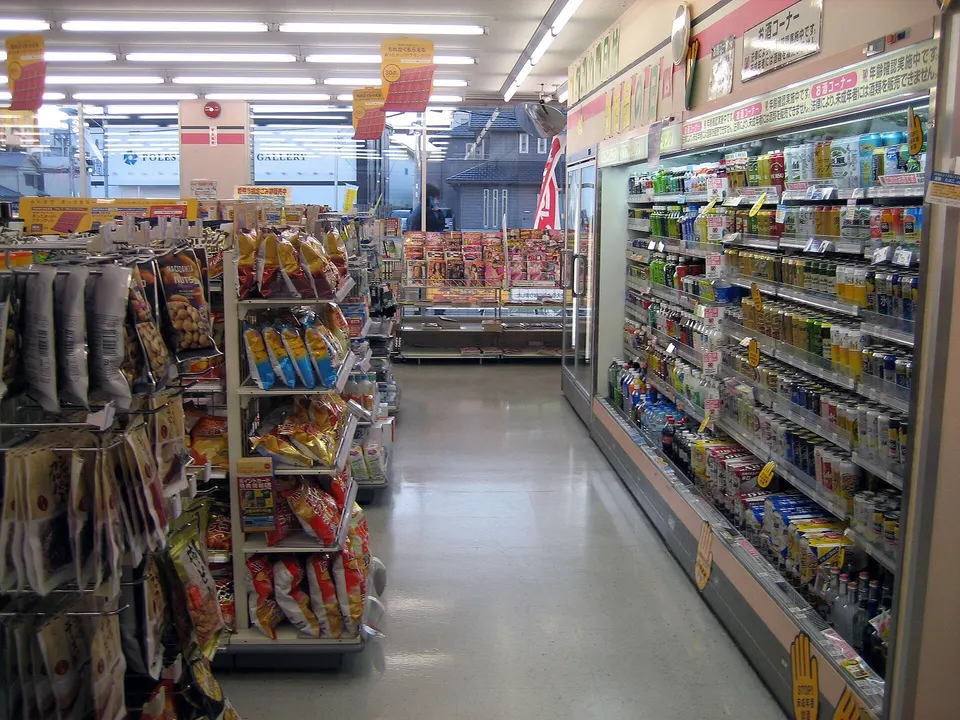
A konbini is a Japanese convenience store: a small self-service shop, usually part of a chain, that sells food and everyday goods for long hours every day of the year, and often around the clock. Besides onigiri, bento, drinks and magazines, a konbini is where people in Japan send parcels, pay utility bills, withdraw cash and print documents, and at the end of 2025 the seven chains in the Japan Franchise Association ran 56,054 of them.
The word is short for konbiniensu sutoa, the Japanese pronunciation of "convenience store."
Small stores, long hours
In the statistics of Japan's Ministry of Economy, Trade and Industry, a convenience store has from 30 to under 250 square meters of sales floor and stays open at least 14 hours a day. Konbini stand near homes, in front of stations and along main roads. Most belong to a franchise chain, with an owner running the store under the support of the chain's headquarters.
Each item is tracked at the register by a point-of-sale (POS) system, and stock arrives in frequent deliveries. Seven-Eleven brought in POS in 1982, and in 1987 began delivering its rice dishes to the stores three times a day.
The industry is represented by Seven-Eleven, FamilyMart and Lawson. The seven chains in the Japan Franchise Association also include Ministop, Seicomart, Daily Yamazaki and Poplar.
How many, and how often
The seven chains had 56,054 stores at the end of December 2025. Over that year they recorded 16.34 billion customer visits and sales of about 12.06 trillion yen. Sales rose 2.2 percent, the fifth year of growth in a row, while visits fell 0.2 percent. The association put part of the rise down to a record number of visitors from abroad and to Expo 2025 in Osaka, and onigiri, counter foods, sweets, soft drinks and ice cream were among the goods that sold well.
The 1970s: whose store came first
Convenience stores are said to have begun in the United States, and they spread across Japan from the 1970s. Which store was Japan's first depends on the account.
Seicomart dates its first store to August 1971. FamilyMart's first store opened in Sayama, Saitama Prefecture, in September 1973, and FamilyMart counts it as the start of a convenience store born in Japan. In November 1973 a Japanese company, York Seven, signed a license agreement with the Southland Corporation of the United States, and in May 1974 it opened its first Seven-Eleven in Toyosu, in Tokyo's Kōtō Ward. One Japanese encyclopedia describes the Toyosu store as the first convenience store opened by a major company; another describes it as the first store to use an American name. York Seven became Seven-Eleven Japan in 1978.
Lawson's first store, in Toyonaka, Osaka Prefecture, opened on June 14, 1975, after its parent company, Daiei, signed a consulting contract with Consolidated Foods, the American owner of the Lawson Milk Company. That same month Seven-Eleven began staying open 24 hours, at a store in Kōriyama, Fukushima Prefecture. From the 1980s konbini multiplied across the country.
On the shelves
The Japan Franchise Association sorts what a konbini sells into four groups. Daily foods take in rice dishes such as onigiri, bento and sushi; bread, sandwiches, side dishes, salads, noodles, tofu, eggs, milk and desserts such as pudding and yogurt; and counter foods sold at the register, such as coffee, fried food and Chinese-style steamed buns. The bento sold at railway stations are called ekiben.
Processed foods include snacks, soft drinks, beer, sake and wine, seasonings such as miso and soy sauce, rice, frozen food, ice cream and instant noodles. Non-food goods run from tobacco, magazines and newspapers to clothing, stationery, batteries, cosmetics, medicines, and stamps and postcards.
More than a shop
Services are the fourth group: prepaid cards, copying, parcel delivery, lottery tickets, and tickets for trains, flights, hotels and events. Bills for electricity, gas, water, telephone and NHK, the public broadcaster, can be paid at a konbini too. Seven-Eleven started taking Tokyo Electric Power bills in October 1987.
FamilyMart began an ATM service through the E-net network in 1999, and in May 2001 Seven-Eleven began installing the ATMs of IY Bank, now Seven Bank. Major stores in the cities have multilingual ATMs that accept cards issued abroad. Seven Bank's machines, found mainly in Seven-Eleven stores, show their screens, receipts and voice guidance in 12 languages when a card from abroad is used.
Many stores also have a machine for copying and printing, with a choice of languages; a document registered on a website, such as an airline ticket, prints out when its number is entered. Seven-Eleven began selling tickets through its multi-function copiers in 2002.
Spoons, hot water and a table
In April 2022 a law on plastic resource circulation came into force. It names 12 plastic items handed out free, among them the forks, spoons, table knives, stirrers and straws given away by shops and restaurants, and it asks the businesses that hand them out to cut down: by asking each customer whether one is wanted, by giving points to customers who go without, by charging, or by switching to other materials. Restaurants and convenience stores that hand out wooden spoons and paper straws are among the early examples.
Some stores set out a hot water dispenser for instant noodles under a sign reading ご自由にお使いください, "please feel free to use," sometimes with spare chopsticks beside it. Larger stores have tables and chairs where customers can eat what they have bought.
In a disaster, and late at night
On July 1, 2017, the Japanese government designated Seven-Eleven Japan, Lawson and FamilyMart, along with four other retail companies, as designated public institutions under the Disaster Countermeasures Basic Act, a status also held by the Bank of Japan, the Japanese Red Cross Society and NHK. The chains' headquarters use their delivery networks to bring daily necessities to evacuation centers.
Konbini are also expected to work as bases for crime prevention, to keep an eye on older residents when delivering food to them, and to take in women and children who need help late at night. In rural areas, where supermarkets and other stores have been cutting back, a konbini can be a valuable place for local people to shop. With workers scarce, some owners find it hard to keep a store open 24 hours, and in October 2019 Seven-Eleven drew up guidelines for closing stores late at night.
References
- Japan Franchise Association, "Convenience store statistics, annual totals, January–December 2025" (PDF)
- Japan Franchise Association, "Convenience store statistics, September 2026" (PDF)
- Kotobank, "Konbiniensu sutoa" (convenience store)
- Kotobank, "Konbini"
- Seven-Eleven Japan, "Company history"
- FamilyMart, "The history of FamilyMart"
- Lawson, "The history of Lawson"
- Seicomart, "Seicomart's 50th anniversary"
- Ministry of Economy, Trade and Industry, "Report of the study group on the future of convenience stores" (PDF, 2020)
- Cabinet Office (Disaster Management), "Additional designation of designated public institutions" (PDF, 2017)
- Japan National Tourism Organization, "How to get the most out of konbini; Japanese convenience store"
- Japan National Tourism Organization, "Japan Currency Exchange"
- Government of Japan, Highlighting Japan, "The Act on Promotion of Resource Circulation for Plastics" (May 2022)
- Ministry of the Environment, "Rationalizing the use of specified plastic products"
Image credits (resized for display):