Ginza is a district of central Tokyo, numbered from 1-chōme to 8-chōme, whose main street is lined with department stores and specialty shops. It is known around the world as the high-end shopping street that stands for Tokyo, and for Japan. The Ginza of today took shape after the Great Kantō Earthquake of September 1, 1923, which destroyed nearly all of the brick district built there in the 1870s. The origin of the name and the building of the brick streets are told in Ginza and Shimbashi.
Eight blocks on a grid
Ginza is in Chūō Ward, close to Yūrakuchō and Shimbashi stations on the JR lines. Its main street, Chūō-dōri, also called Ginza-dōri, runs north to south from Kyōbashi to Shimbashi. Harumi-dōri crosses it at the Ginza 4-chōme crossing. The streets form a grid that dates from the first laying-out of the district under Tokugawa Ieyasu, about 400 years ago, and has hardly changed since.
Ginza was once surrounded by moats and canals. After the Second World War all of them were filled in, and expressways now run around the district. Kyōbashi, Shimbashi, Sukiyabashi and Miharabashi survive as the names of crossings; hashi or bashi means bridge.
In the first years of the Meiji era, Ginza meant only 1-chōme to 4-chōme on the east side of the main street. After the 1923 earthquake it was extended to 8-chōme.
Three department stores in six years
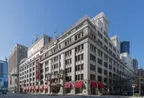
Department stores arrived while Ginza was being rebuilt after the earthquake. Matsuzakaya opened in 1924. Until then customers had left their shoes at the entrance of a department store, and Matsuzakaya's Ginza store was the first department store to let them walk through the whole building in outdoor shoes. It opened a zoo on its roof. Matsuya opened in 1925, with an atrium at its center and an aquarium. Mitsukoshi opened in 1930. The basement food floors of such stores are the subject of depachika.
Ginza's specialty shops worried about the three large stores but grew stronger as specialists, and the mix of department stores and specialty shops became a feature of Ginza. In 1929 real-estate rents in Ginza passed those of Nihonbashi and became the highest in the country. In 1934 the subway that had started from Asakusa reached Ginza.
The clock tower at the 4-chōme crossing
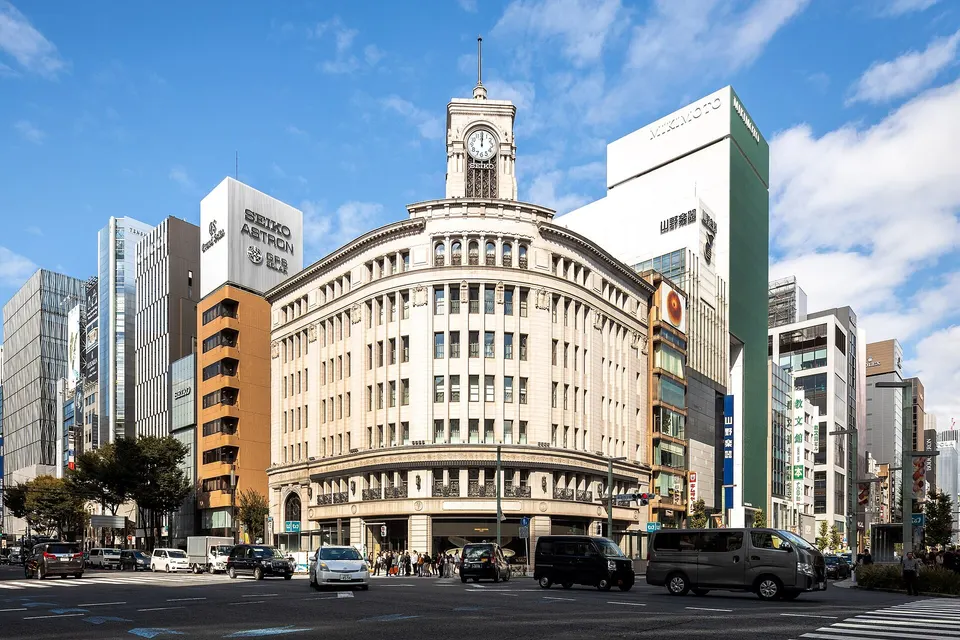
The building with the clock tower at the 4-chōme crossing was completed in 1932 as the head office of Hattori Tokeiten, the watch and clock dealer that is now Seiko. Hattori had put up its first clock tower on the same site in 1894 and pulled it down in 1921 to rebuild. The clock has four dials, each 2.4 meters across, and they face almost exactly north, south, east and west.
The building survived the air raids of 1945, though blast broke three of the dials. After the war the occupation forces took it over as a PX, a store for American military personnel. Wako, a company founded in 1947 to take over Hattori's retail business, began trading in the building in 1952. The clock has played the Westminster chime since June 10, 1954. The building is now named Seiko House.
Burned in 1945, rebuilt by 1968
Air raids between January and May 1945 burned almost the whole of Ginza. In April 1946 the shopkeepers held a Ginza Reconstruction Festival; 180 shops on the main street are said to have reopened by then.
The streetcars on the main street ran for the last time on the night of December 9, 1967, and the street was then rebuilt, a project completed in 1968. Utility poles and overhead wires were removed, and the sidewalks were widened and paved with granite that had been the paving stones of the streetcar tracks. The willows that lined the street were taken out.
A main street without cars
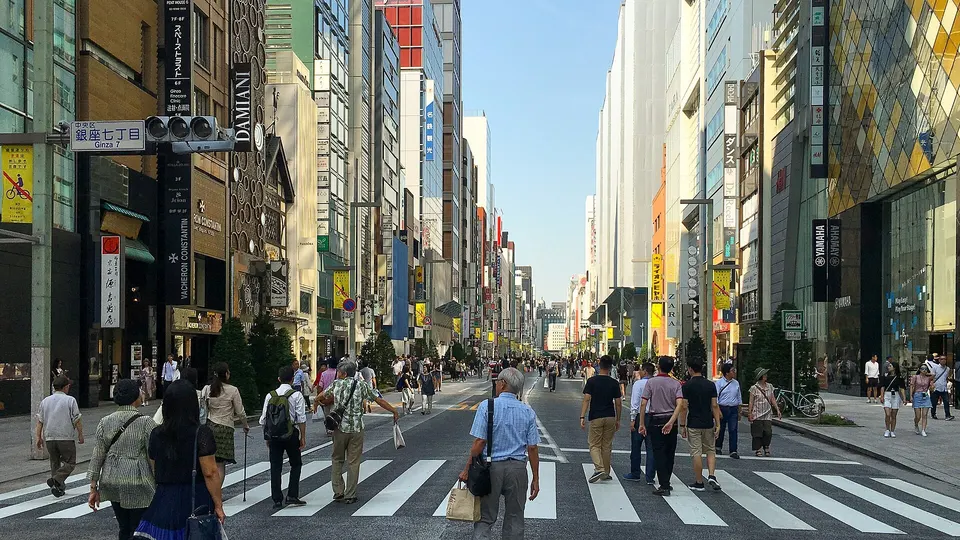
On August 2, 1970, the main street of Ginza was closed to cars for the first time and opened to people on foot. The same was done that day in Shinjuku, Ikebukuro and Asakusa, at the proposal of the governor of Tokyo. The Japanese name for the practice is hokōsha tengoku, "pedestrian paradise." In Ginza the street is closed to vehicles from 1-chōme to 8-chōme on Saturdays, Sundays and public holidays.
Kabukiza
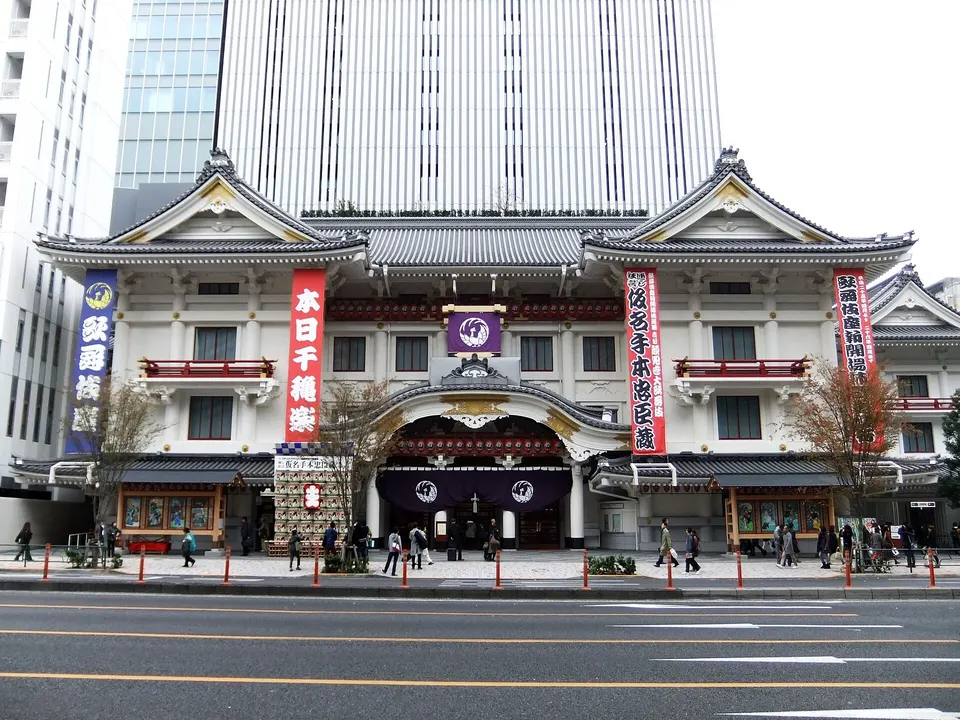
Kabukiza is a theater built for kabuki, a traditional form of Japanese drama. It opened on November 21, 1889, in Kobikichō, which is now Ginza 4-chōme. The theater burned down in 1921, and the earthquake of 1923 struck while it was being rebuilt. The next building opened in January 1925 and burned in the air raid of May 1945. Its successor opened in January 1951 and closed in April 2010.
The present Kabukiza opened in April 2013 with 1,808 seats. It keeps the tiled roof and the curved gables of the building before it, and a 29-story office building, Kabukiza Tower, stands behind it. The Shochiku company has staged kabuki at the theater since 1914.
A height limit, and GINZA SIX
Under a district plan known as the Ginza Rule, buildings in Ginza may be no taller than 56 meters. The limit applies to large redevelopment projects as well. One part of the district is allowed an exception, for projects that help keep its culture alive.
GINZA SIX, which opened on April 20, 2017, is about 56 meters tall. It stands on the site of the Matsuzakaya Ginza store and the block next to it; the two blocks were joined by rerouting the street that ran between them. GINZA SIX describes itself as the largest commercial complex in the Ginza area, and it has a Noh theater on its third basement level and a garden on its roof. Oginoya, an ekiben maker from Yokokawa in Gunma Prefecture, opened its first Tokyo shop in GINZA SIX in April 2017.
Land values, galleries and alleys
Each year Japan's National Tax Agency publishes the value per square meter of land facing each street, as the basis for assessing inheritance and gift taxes. In its figures for 2026, the highest value in Tokyo was on Chūō-dōri in Ginza 5-chōme: 53.36 million yen per square meter. That was the highest among the prefectural capitals, and more than twice the highest value in Osaka, 21.2 million yen.
Ginza is also known as Japan's largest gallery district. About 40 of its galleries form an association, Ginza Galleries. Alleys once ran everywhere between the streets of the grid, and many of them disappeared as buildings grew larger.
References
- Kotobank, "Ginza"
- GINZA OFFICIAL, "History"
- GINZA OFFICIAL, "History" (page 2)
- GINZA OFFICIAL, Q&A, "The streets of Ginza"
- GINZA OFFICIAL, "Pedestrian zone"
- The Seiko Museum Ginza, "The clock tower of SEIKO HOUSE"
- Kotobank, "Kabukiza"
- J. Front Retailing, "History of Matsuzakaya"
- GINZA SIX, "About"
- National Tax Agency, "Rosenka (land values along streets) for 2026"
- Ginza Galleries
- Oginoya, chronology
Image credits (resized for display):
- Supanut Arunoprayote / Wikimedia Commons, CC BY 4.0, 2024
- Daniel Ramirez / Wikimedia Commons, CC BY 2.0, 2016
- Tak1701d / Wikimedia Commons, Public domain, 2013