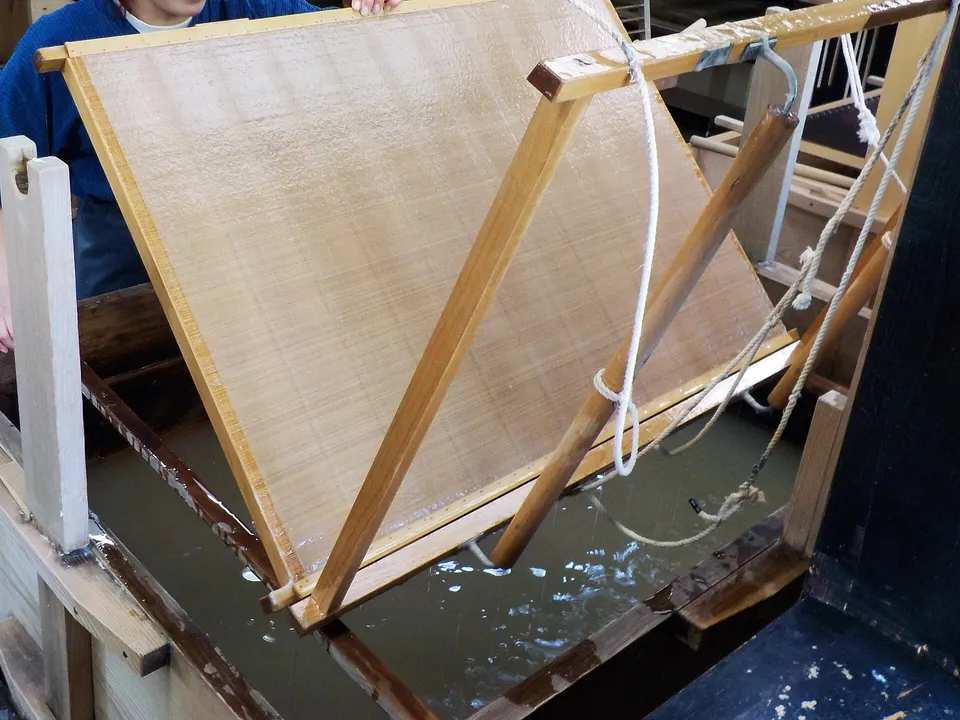
Washi is Japan's handmade paper, formed sheet by sheet from the bark fibers of three shrubs: kōzo (paper mulberry), mitsumata and gampi. The long fibers are floated in water thickened with a plant mucilage and rocked on a bamboo screen until they lock together, which is why a sheet of washi can be thin and still strong.
How washi differs from Western paper
The word washi (和紙), "Japanese paper", is the counterpart of yōshi (洋紙), "Western paper". Yōshi is mass-produced by machine from wood pulp. Its fibers are short and tightly packed, and it is sized, meaning treated so that ink does not spread. Washi is porous. It takes brush and ink well, but as a rule it suits neither a pen nor printing ink.
Three plants
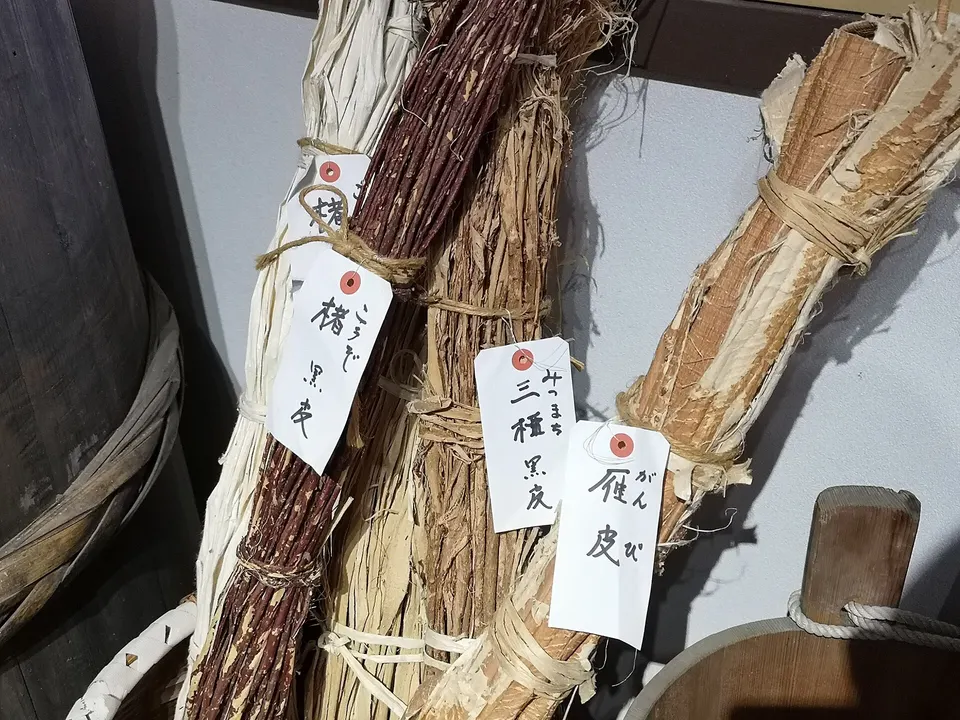
Kōzo is a shrub of the mulberry family. Its fibers are the longest of the three, 1 to 2 centimeters, and kōzo paper is the toughest. Kōzo has gone into shōji paper for sliding screens, umbrella paper and paper for woodblock prints.
Mitsumata is a shrub native to China, named for the way every branch divides into three. Its fibers average about 3 millimeters. The area planted with mitsumata grew quickly after about 1882, when its bark began to be used for banknote paper.
Gampi is hard to cultivate and is gathered wild. Its fibers, 3 to 5 millimeters long, are translucent and glossy. Gampi paper is smooth, dense and hard, and it is the one kind of washi that can be written on with a pen. Pale yellow gampi paper is called torinoko.
From bark to fiber
Kōzo and mitsumata are cut in autumn and steamed so that the bark can be stripped off. Gampi is stripped raw in summer. Scraping away the black outer skin leaves white bark. To make paper, the white bark is boiled for about an hour in an alkaline solution until it can be pinched apart with the fingers. It is rinsed in running water, and in some districts it is buried in snow or laid out in the sun to whiten. Remaining specks are picked out by hand, and the clean fiber is beaten with a hardwood stick or mallet.
Rocking the screen
There are two ways of forming a sheet by hand. In tame-zuki, the pulp is scooped onto a mesh, shaken gently and left to drain, and each wet sheet is laid between cloths. The papermaking handed down in Europe is tame-zuki, with loosened cotton rags scooped up on a wire mesh.
Washi is marked by the second way, nagashi-zuki, which came into general use between the late 8th and early 9th centuries. The vat holds fiber, water and neri, a mucilage extracted from the crushed root of the tororo-aoi plant or the crushed inner bark of noriutsugi. Neri keeps the fibers evenly dispersed, and it slows the water draining through the screen, a mat of fine bamboo splints set in a wooden frame.
The papermaker scoops from the near side and sends the liquid quickly across the whole screen to form the face of the sheet. A second scoop is rocked back and forth so that the fibers tangle, and the scooping and rocking are repeated until the sheet is thick enough. Then the papermaker tips the frame forward and throws off the surplus liquid, which carries dust and lumps of fiber away with it.
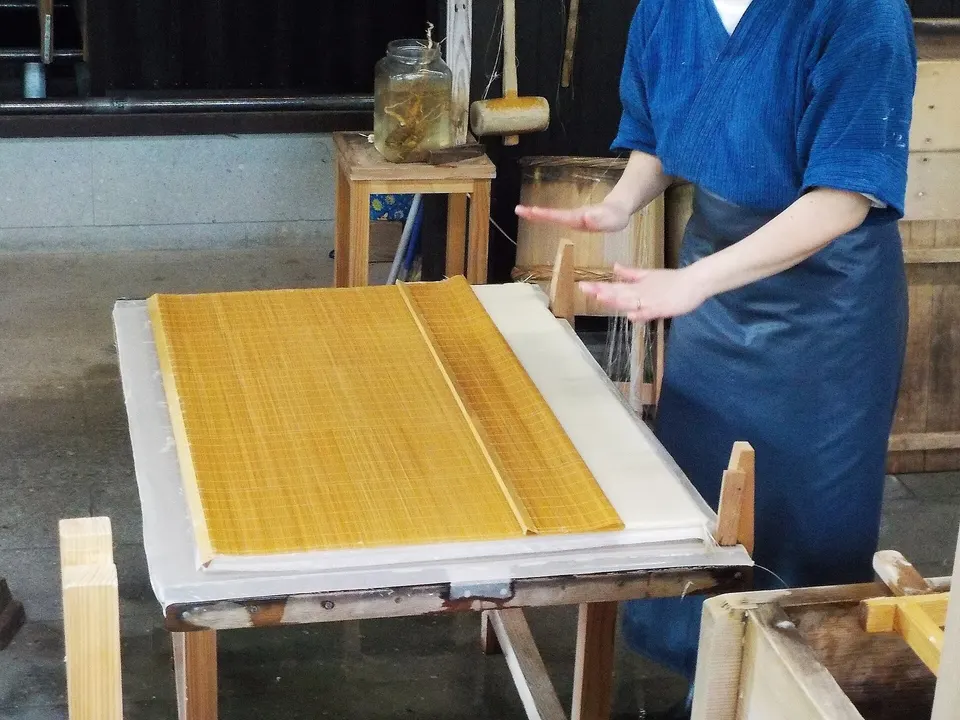
Neri loses its stickiness overnight, so wet sheets can be stacked directly on one another, with no cloth between them, and still be peeled apart. The stack is pressed under weights, and each sheet is spread on a board and dried in the sun, which takes about an hour in fine weather.
Washi since the 7th century
Papermaking is said to have reached Japan from China by way of Korea early in the 7th century. The chronicle Nihon Shoki records under the year 610 the arrival of Donchō, a monk from Goguryeo who was skilled at making pigments, paper and ink, and paper is thought to have been made in Japan before he came. The oldest dated paper made in Japan is a set of household registers of 702 from the provinces of Mino, Chikuzen and Buzen, kept in the Shōsō-in repository in Nara.
From the Muromachi period (1336–1573) more paper was needed for shōji screens. In the Edo period (1603–1868) washi covered shōji, umbrellas and raincoats, and a record of 1736 ranks paper third by value in the Osaka market, after rice and timber. Paper wraps things too: a kakegami is the outer paper on a gift, and the same word names the printed sheet tied over the lid of a station bento.
After 1868 Western paper came in and washi declined. Machine-made rayon shōji paper appeared in 1960, and within about five years handmade shōji paper had disappeared, except for shōji paper made of kōzo alone. Washi is used in conserving and repairing books, wall paintings and other cultural properties.
Where washi is made
The national government has designated the making of some papers as Important Intangible Cultural Properties, and Echizen washi and Tosa washi as traditional crafts.
| Paper | Where | Fiber | Known for | Designated |
|---|---|---|---|---|
| Hon-minoshi | Mino, Gifu Prefecture | Kōzo | Shōji paper | Important Intangible Cultural Property, 1969 |
| Sekishū-banshi | Misumi in Hamada, Shimane Prefecture | Kōzo | Toughness, from the green inner layer left on the bark | Important Intangible Cultural Property, 1969 |
| Hosokawa-shi | Ogawa and Higashichichibu, Saitama Prefecture | Kōzo | Ledgers and land registers | Important Intangible Cultural Property, 1978 |
| Echizen washi | Echizen, Fukui Prefecture | Kōzo, mitsumata, gampi | Hōsho, the paper of official orders, and torinoko | Traditional craft, 1976. Echizen torinoko-shi: Important Intangible Cultural Property, 2017 |
| Tosa washi | Tosa and Ino, Kōchi Prefecture | Kōzo, mitsumata | Tengujō-shi, a kōzo paper 0.03 millimeters thick | Traditional craft, 1976 |
Sekishū-banshi was inscribed as UNESCO Intangible Cultural Heritage in 2009. In 2014 UNESCO inscribed it again, together with Hon-minoshi and Hosokawa-shi, as "Washi, craftsmanship of traditional Japanese hand-made paper". All three papers are made from kōzo alone. In 2025 the inscription was extended to take in Echizen torinoko-shi, the gampi paper of Echizen.
References
- Kotobank, "Washi"
- Kotobank, "Nagashi-zuki"
- Kotobank, "Kōzo"
- Kotobank, "Mitsumata"
- Kotobank, "Gampi"
- Kotobank, "Mino paper"
- Kotobank, "Sekishū-banshi"
- Kotobank, "Hosokawa-shi"
- Kotobank, "Echizen washi"
- Kotobank, "Tosa washi"
- UNESCO Intangible Cultural Heritage, "Washi, craftsmanship of traditional Japanese hand-made paper"
- Agency for Cultural Affairs, "Intangible Cultural Heritage"
- Agency for Cultural Affairs, Cultural Heritage Database, "Washi"
Image credits (resized for display):